.avif)
.avif)

.png)

Content
Top 5 Ways to Spend Cetus Protocol (CETUS) Crypto Coin in 2026

Cetus Protocol (CETUS) is the utility and governance token behind Cetus, a decentralised exchange and liquidity protocol built on the Sui and Aptos blockchains. It uses a concentrated liquidity market maker (CLMM) model, together with a Dynamic Liquidity Market Maker (DLMM), so traders can swap assets efficiently while liquidity providers gain more control over how their capital is deployed. Holders can also stake CETUS as xCETUS, a non-transferable escrowed token that unlocks protocol rewards, governance rights and other ecosystem utilities.
But outside the Cetus ecosystem, finding places to spend CETUS directly is hard. Holders therefore need practical ways to turn their tokens into things they can actually use in real life.
One of the most useful options is travel. You can put your CETUS toward hotels and flights on CoinBooking, which accepts 200+ cryptocurrencies and offers rates up to 30% below Booking.com. New users can also get $25 off their first booking.
See how much you
could save with $CETUS
Answer 2 questions to get your personalized
savings estimate.
Question 1 of 2
Where do you want to go?
Question 2 of 2
How many nights?
Your result
Get similar deals when we go live.
Get $25 off your first trip.
Below, we cover five practical ways to spend or use CETUS in 2026.
1. Book Discounted Hotels and Flights With CETUS on CoinBooking
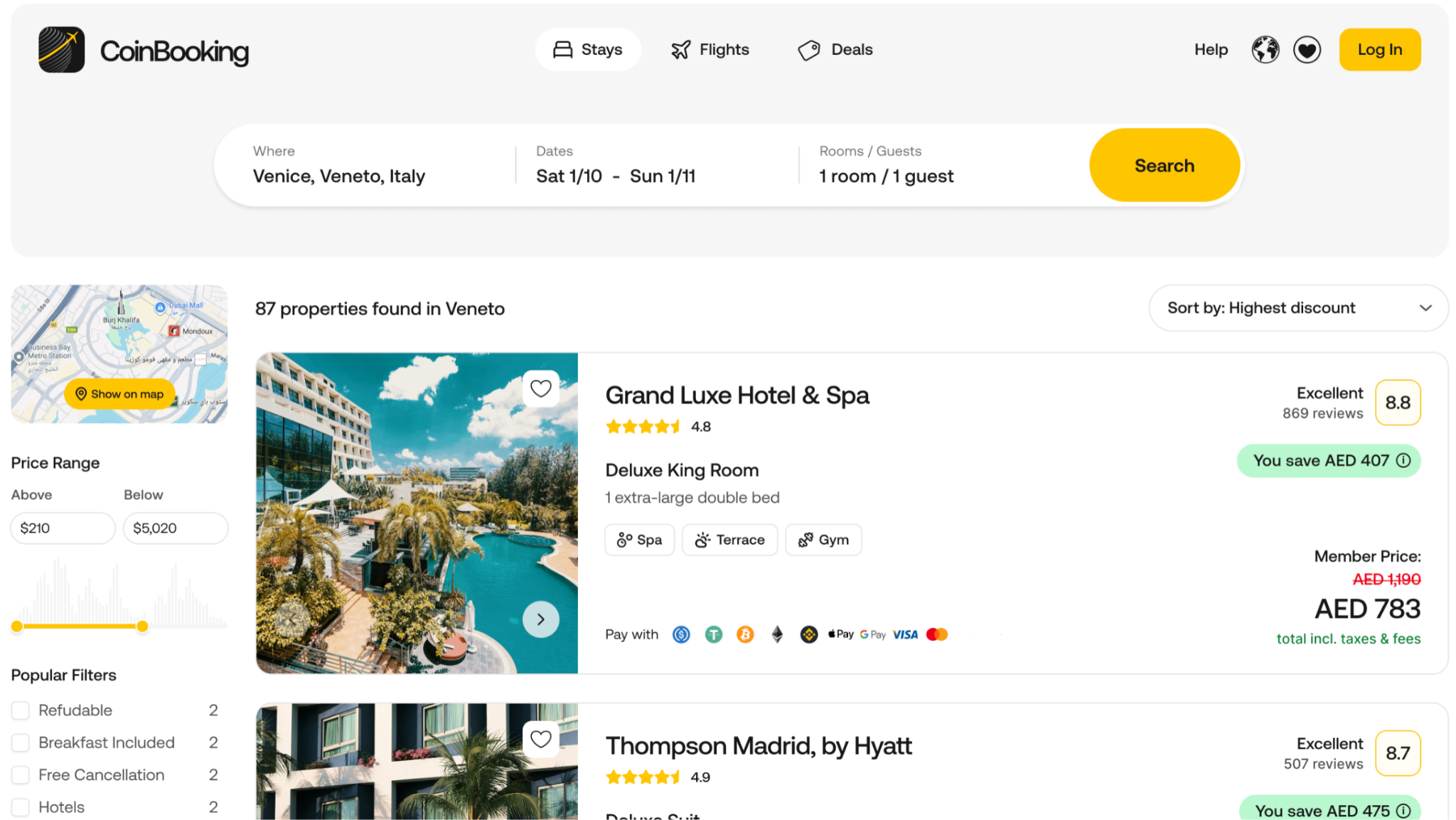
The most practical way to spend CETUS in 2026 is on travel. CoinBooking is a crypto-native travel platform that accepts 200+ cryptocurrencies and offers discounted hotels and flights priced up to 30% less than Booking.com.
Book your next hotel for up to 30% less
For CETUS holders, the process is straightforward and works much like Booking.com and Expedia. If you have not used CoinBooking before, sign up to claim your $25 first-booking discount.
2. Stake CETUS as xCETUS and Earn Rewards From Cetus Protocol
The strongest native use case for CETUS is staking and participating in the Cetus ecosystem. CETUS holders can convert their tokens into xCETUS at a 1:1 ratio. xCETUS is a non-transferable version of the token that represents staked CETUS and gives holders access to several benefits within the protocol.
Staking rewards come from net earnings generated through Cetus’s CLMM and DLMM activities, allowing users to potentially earn rewards while continuing to participate in the ecosystem. But staking isn’t only about earning rewards.
xCETUS can also be used for governance, and the amount you hold can influence your participation in certain Cetus Launchpad opportunities. xCETUS holders may also become eligible for campaigns or airdrops from ecosystem partners, although these opportunities depend on the individual projects.
There is one important thing to keep in mind before staking: getting your CETUS back isn’t instant. The redemption period can range from 15 to 180 days, with the longest vesting period providing a 1:1 conversion back to CETUS.
For holders who plan to keep their tokens for the long term, staking CETUS offers a way to make their holdings more useful while staying involved in the protocol.
3. Buy Physical Collectibles With CETUS Through Polkastarter
If you want to turn your CETUS holdings into something tangible, you can use Polkastarter to buy physical collectibles after converting cryptocurrency accepted by a merchant that sells physical goods.
CETUS is not commonly accepted as a direct payment option for physical products, so you may need to swap your tokens into a supported cryptocurrency first. You can then transfer the converted funds to a compatible wallet or payment platform and use them to purchase eligible physical goods.
Before sending funds, verify the supported cryptocurrency, network and payment requirements to avoid sending CETUS or another asset to an unsupported address.
Explore Polkastarter's physical collectibles marketplace to see available products.
4. Buy Gift Cards, eSIMs and Mobile Top-Ups After Converting CETUS
Another way to turn CETUS into everyday purchasing power is through crypto-commerce platforms such as Bitrefill.
Bitrefill sells gift cards, eSIMs, mobile top-ups and other digital products that can be purchased with supported cryptocurrencies. Its payment options include Bitcoin, Lightning, Ethereum, Litecoin, USDC, USDT, Dogecoin, Dash and several other cryptocurrencies.
CETUS is not currently listed among Bitrefill's direct payment options, so holders would need to swap CETUS into a supported cryptocurrency first. Users should always verify the supported asset and network before making a payment.
Once CETUS has been converted, the supported cryptocurrency can be used for eligible products such as retail gift cards, gaming credit, streaming services, eSIMs and mobile phone refills.
The process is: CETUS → supported cryptocurrency → gift card, eSIM or mobile top-up
This is not a direct CETUS spending option, but it gives holders a practical way to turn their Cetus Protocol tokens into products and services they can use every day.
5. Provide Liquidity With CETUS and Earn Trading Fees
One of the most direct ways to put CETUS to work within its native ecosystem is providing liquidity through Cetus.
Cetus is a decentralized exchange and liquidity protocol built around concentrated liquidity. Liquidity providers can deposit supported token pairs into liquidity pools and earn a share of trading fees when swaps take place within their active price range.
For CETUS holders, this means the token can be used as part of a liquidity position rather than simply sitting in a wallet. CETUS can be paired with other supported assets, such as SUI, in eligible liquidity pools. The potential returns come from trading fees generated by users swapping through the pool.
Cetus also supports permissionless pool creation, allowing projects and community members to establish new liquidity pools under the protocol's rules. CETUS and SUI can serve as quote tokens for permissionless pools on Sui.
However, liquidity provision comes with risks. Because concentrated liquidity positions are exposed to changing token prices and trading ranges, liquidity providers can experience impermanent loss. Returns can also vary depending on trading volume, fees and the position's selected range.
For users who understand those risks, providing liquidity is a distinctly CETUS-native way to use the token while potentially earning fees from activity on the protocol.
Explore Other CoinBooking Supported Tokens:
- What Is Meteora (MET) Crypto Coin? Top 5 Ways to Use MET in 2026
- What Is Sonic (S)? Top 5 Ways to Use Sonic Crypto Coin in 2026
Frequently Asked Questions
1. What is the CETUS Protocol (CETUS)?
Cetus Protocol (CETUS) is a decentralized exchange and liquidity protocol built on the Sui and Aptos blockchains. It uses concentrated liquidity technology and provides tools for token swaps, liquidity provision and other DeFi activities.
2. Can I spend CETUS on hotels and flights?
You can use CoinBooking to book hotels and flights up to 30% lower than Booking.com. New users can also get $25 off their first booking.
3. Can I stake CETUS?
Yes. CETUS can be converted into xCETUS at a 1:1 ratio. xCETUS staking can provide rewards linked to Cetus Protocol earnings and also provides additional ecosystem utilities. Redemption back to CETUS involves a vesting period.
4. Can I buy gift cards with CETUS?
Not directly through Bitrefill at present. You can convert CETUS into a cryptocurrency supported by Bitrefill and then use that asset to purchase eligible gift cards, eSIMs, mobile top-ups and other products.
5. What is the difference between CETUS and xCETUS?
CETUS is the transferable native token of the Cetus Protocol, while xCETUS is a non-transferable escrowed version obtained by staking CETUS. xCETUS provides staking, governance and certain ecosystem participation utilities.

Saira Parveen is a Dubai-based SEO content writer with a background in digital marketing and search visibility. She covers cryptocurrency adoption, travel booking with digital assets, and the practical side of spending crypto in everyday life.
Her work at CoinBooking focuses on helping readers navigate the intersection of crypto and travel, from finding the best rates on hotels and flights to understanding how to pay for travel with digital assets.
Found a hotel you like? Book it for up to 30% less

Found a hotel you like? Book it for up to 30% less