.avif)
.avif)

.png)

Content
What Is Axelar Coin (AXL)? Top 5 Ways to Use It in 2026

Axelar (AXL) is a crypto coin that powers a decentralized network for cross-chain communication, allowing applications and assets to flow freely between isolated blockchains without middlemen or wrapped bridges. Transferring data and tokens across chains typically involves risk, complexity, and delay through multi-signature bridges. Axelar solves this with a proof-of-stake validator network that securely routes messages and asset transfers between major chains like Ethereum, Solana, Cosmos, Avalanche, and the XRP Ledger.
As of July 2026, AXL trades around $0.0408 with a market cap of approximately $49.3 million, ranking in the top 400 cryptocurrencies. Beyond holding, Axelar (AXL) has several real-world use cases, including paying for cross-chain transactions, staking to secure the network, voting on governance, and booking discounted travel.
See how much you
could save with $AXL
Answer 2 questions to get your personalized
savings estimate.
Question 1 of 2
Where do you want to go?
Question 2 of 2
How many nights?
Your result
Get similar deals when we go live.
Get $25 off your first trip.
Key Takeaways
- Axelar is the only decentralized cross-chain network securing messages via proof-of-stake validators, avoiding traditional bridge exploits from multi-signature setups.
- The network was founded in 2020 and launched its public mainnet in February 2022, backed by top investors including Binance, Coinbase Ventures, Dragonfly Capital, and Polychain Capital.
- Axelar recently integrated the XRP Ledger and its EVM sidechain (July 2026), expanding its role as multi-chain infrastructure.
- AXL trades on Coinbase, Kraken, Uniswap, KuCoin, and Huobi with daily volume typically between $2–3 million across major exchanges.
- Developers use Axelar's General Message Passing (GMP) protocol to send arbitrary data and trigger smart contracts across chains without learning new languages.
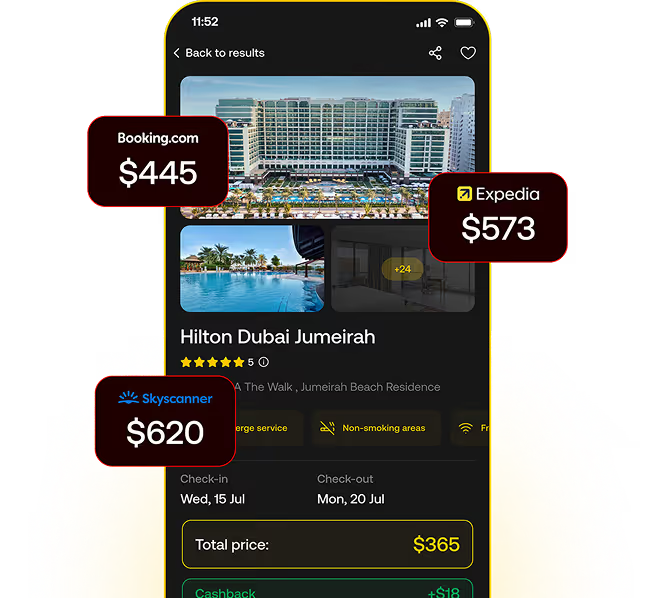
- Book hotels and flights with AXL on CoinBooking at up to 30% below Booking.com prices. Get $25 off your first booking.
Axelar at a Glance (July 2026)
What Is Axelar?
Axelar Network is a decentralized infrastructure layer that enables seamless communication and asset transfers between isolated blockchains. Most cryptocurrencies operate in separate ecosystems with no native way to interact. Moving assets or data between them requires bridges, which are often operated through multi-signature contracts or third-party validators. These bridges have been targets of major exploits that have frozen or lost billions in user funds.
Axelar addresses this by becoming a universal overlay network powered by its own decentralized validator set. It does not replace existing blockchains but sits between them, verifying and routing cross-chain messages through a proof-of-stake consensus mechanism. This architecture removes single points of failure and reduces the trust assumptions needed for developers building multi-chain applications.
The network was founded in 2020 by Sergey Gorbunov and Georgios Vlachos, both founding members of the Algorand team. Vlachos designed Algorand's consensus protocol, and Gorbunov led the standardization of BLS signatures, a cryptographic standard now used in Ethereum 2.0. Following an incentivized testnet launch in February 2021, the project launched its public mainnet in February 2022. The project has since attracted capital from top venture firms and has become the infrastructure layer for developers building applications that need to work across multiple chains simultaneously.
How Does Axelar Work?
Axelar's core innovation is its General Message Passing (GMP) protocol, which allows developers to send not just tokens but arbitrary data between chains and trigger smart contract functions on destination blockchains. This differs from traditional bridges that only move wrapped tokens.
The mechanism works in three stages:
- A developer or application sends a message through Axelar's API, specifying the source chain, destination chain, and the smart contract function to execute.
- Axelar's validator network verifies the message by running light clients of both chains, confirming the request is legitimate.
- Once verified, the validators collectively relay the message to the destination chain, where it executes the intended smart contract function.
AXL is the native token that powers all of this. Validators stake AXL to participate in the network and earn rewards for verifying and routing messages. Developers pay fees in AXL (or stablecoins) to send cross-chain messages. Holders govern the network through proposals that determine which chains to support, fee structures, and funding for ecosystem development.
Axelar's validator-based approach is designed to be more secure than multi-signature bridges, which require a small set of actors to collectively approve transactions. If those actors are compromised or collude, the bridge can be drained. Axelar's proof-of-stake model distributes this responsibility across a larger, decentralized set of validators, where an attacker would need to compromise a majority of them, which is economically expensive.
Top 5 Ways to Use Axelar Crypto Coin (AXL)
1. Book discounted hotels and flights with AXL on CoinBooking
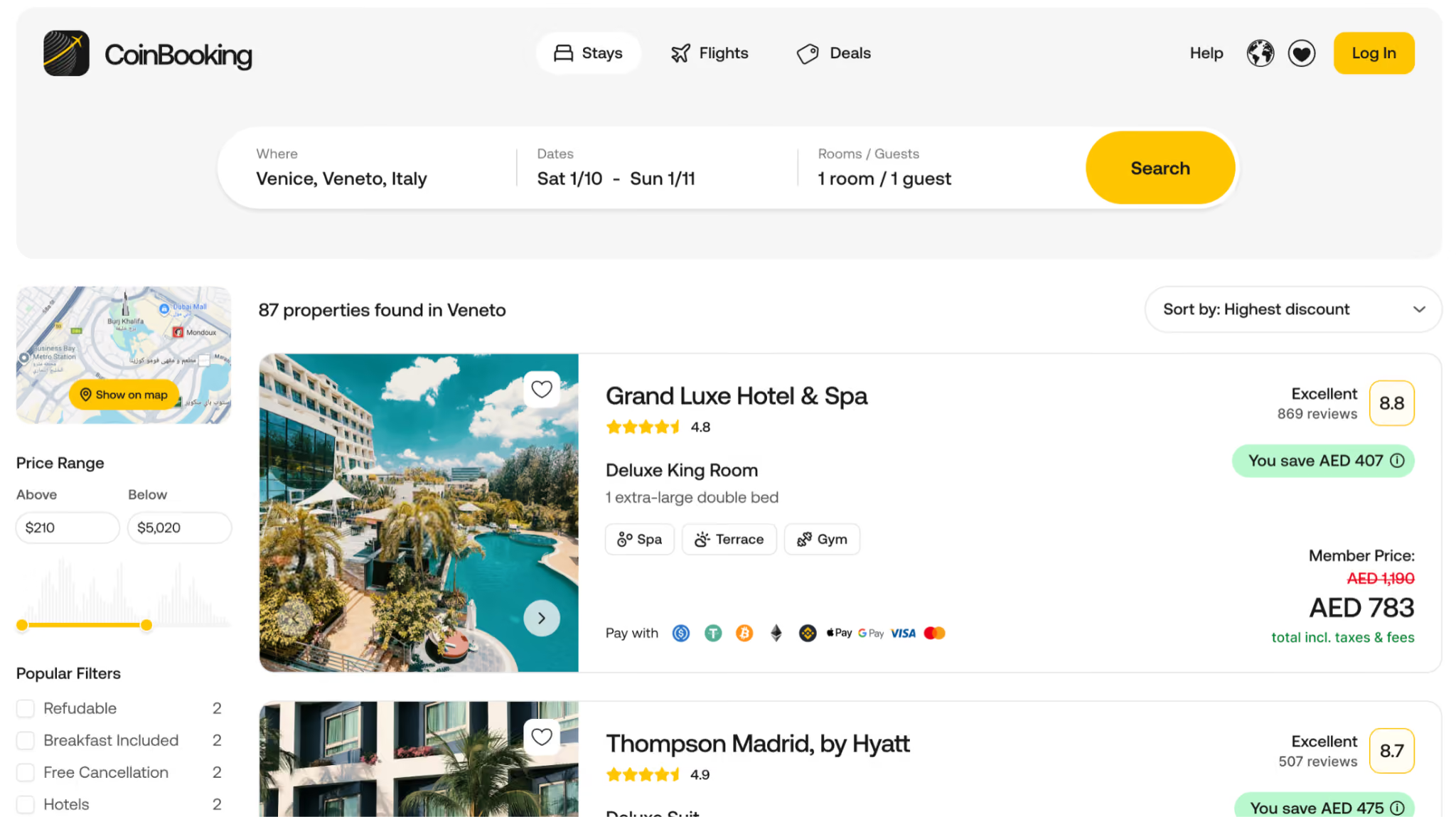
One of the best ways to use your AXL in 2026 is to pay for travel through CoinBooking. When you book with AXL on CoinBooking, you can save up to 30% compared to Booking.com and Expedia.
CoinBooking offers payment flexibility. In addition to AXL and 200+ supported cryptocurrencies, you can pay using Visa, Mastercard, Apple Pay, or Google Pay. The platform makes it simple to pay in crypto without extra fees, unlike most other crypto travel platforms that charge a crypto premium.
Book your next hotel for up to 30% less
Getting started is simple. Just choose your hotel or flight, pay with your AXL tokens at checkout, and you're done. Sign up now with your email to get early access, and you'll also receive $25 off your first booking.
2. Pay for cross-chain transactions
Developers and applications use Axelar to send data and assets across blockchains. If you are building a multi-chain dApp, DeFi protocol, or game, you pay AXL fees to route your messages through Axelar's validator network. Users of these applications indirectly benefit from Axelar's security by being able to bridge assets without using riskier third-party bridges or wrapped token systems.
3. Stake AXL for rewards
AXL holders can stake their coins with a validator through a compatible Cosmos wallet, such as Keplr or Leap, to help secure the network and earn rewards. The exact reward rate varies based on network inflation and the total staked amount. Staking allows you to earn passive income from your holdings while supporting the validator set that secures cross-chain messaging. Unstaking requires a 21-day unbonding period before tokens become liquid again.
4. Vote on network governance
Staked AXL also grants voting power in network governance. AXL holders have voted on which chains Axelar should support, fee structures, and allocation of the $60 million Startup Ecosystem Funding Program launched in December 2022. Governance decisions have meaningful consequences for the network's development, so holders with significant stakes have a material say in Axelar's direction.
5. Trade AXL
AXL is listed on major exchanges, including Coinbase, Kraken, KuCoin, Huobi, and Uniswap. It trades against USD, USDT, and other crypto pairs with an average daily volume between $2–3 million across major exchanges. Traders view AXL as an infrastructure token for the broader multi-chain narrative, so it tends to move in correlation with the adoption of cross-chain protocols and interoperability solutions.
Is Axelar a Good Investment?
Whether AXL is a good investment depends on your risk tolerance and your view of decentralized cross-chain infrastructure as a category. The bull case is unusually concrete for crypto: Axelar operates essential infrastructure for multi-chain applications, launched in February 2022 with the longest track record in decentralized cross-chain messaging, has attracted backing from top venture investors including Binance, Coinbase Ventures, Dragonfly Capital, and Polychain Capital, has integrated major chains including Ethereum, Solana, Cosmos, Avalanche, and the XRP Ledger (July 2026), and operates a $60 million startup ecosystem fund to accelerate multi-chain application development. The team has deep cryptographic and protocol expertise, having been founded by Algorand co-creators.
The risks are just as concrete. AXL trades roughly 98% below its all-time high of $2.66 from March 2024. Competitors like Wormhole and Lava Network are chasing the same cross-chain infrastructure narrative with significant capital and marketing. Validator-based models require sufficient decentralization to maintain security, yet Axelar's validator set remains concentrated among a relatively small number of operators. Enterprise adoption of decentralized cross-chain solutions remains early, and many builders continue using traditional multi-signature bridges due to familiarity and perceived reliability. Regulatory uncertainty around cross-chain asset transfers also poses a long-term structural risk to the category.
This is not financial advice. Crypto is volatile. Always do your own research and never invest more than you can afford to lose.
FAQs
1. What is Axelar Network?
Axelar Network is a decentralized infrastructure layer that enables secure cross-chain communication between isolated blockchains through a proof-of-stake validator network. It allows developers to build applications that work seamlessly across multiple chains.
2. Is Axelar a good investment?
Axelar has real infrastructure use, backing from top venture firms, and integrations with major chains, but AXL remains a volatile small-cap token trading far below its all-time high. Treat it as a high-risk asset and do your own research before buying.
3. Who founded Axelar?
Axelar was founded in 2020 by Sergey Gorbunov and Georgios Vlachos, both of whom were part of the founding team at Algorand. Vlachos designed Algorand's consensus protocol, and Gorbunov led the standardization of BLS signatures used in Ethereum 2.0.
4. What is General Message Passing (GMP)?
GMP is Axelar's protocol that allows developers to send arbitrary data and trigger smart contract functions across different blockchains, not just transfer wrapped tokens. This is more flexible than traditional bridges.
5. Can I spend AXL on real things?
Yes. CoinBooking, a web3 travel booking platform, accepts AXL for hotels and flights at up to 30% below Booking.com prices. Sign up early and get $25 off your first booking.
6. Where can I buy AXL?
AXL is available on major exchanges including Coinbase, Kraken, KuCoin, Huobi, and Uniswap. It trades against USD, USDT, and other pairs.
7. What is the max supply of AXL?
AXL has a total token supply of 1.24 billion coins, with approximately 1.2 billion currently circulating. The remaining supply vests over time according to the token allocation schedule set at launch.
8. How do I stake AXL?
You can stake AXL by delegating your tokens to a validator through a Cosmos wallet such as Keplr or Leap. The process is similar to other proof-of-stake networks and typically earns you validator rewards.

Saira Parveen is a Dubai-based SEO content writer with a background in digital marketing and search visibility. She covers cryptocurrency adoption, travel booking with digital assets, and the practical side of spending crypto in everyday life.
Her work at CoinBooking focuses on helping readers navigate the intersection of crypto and travel, from finding the best rates on hotels and flights to understanding how to pay for travel with digital assets.
Found a hotel you like? Book it for up to 30% less

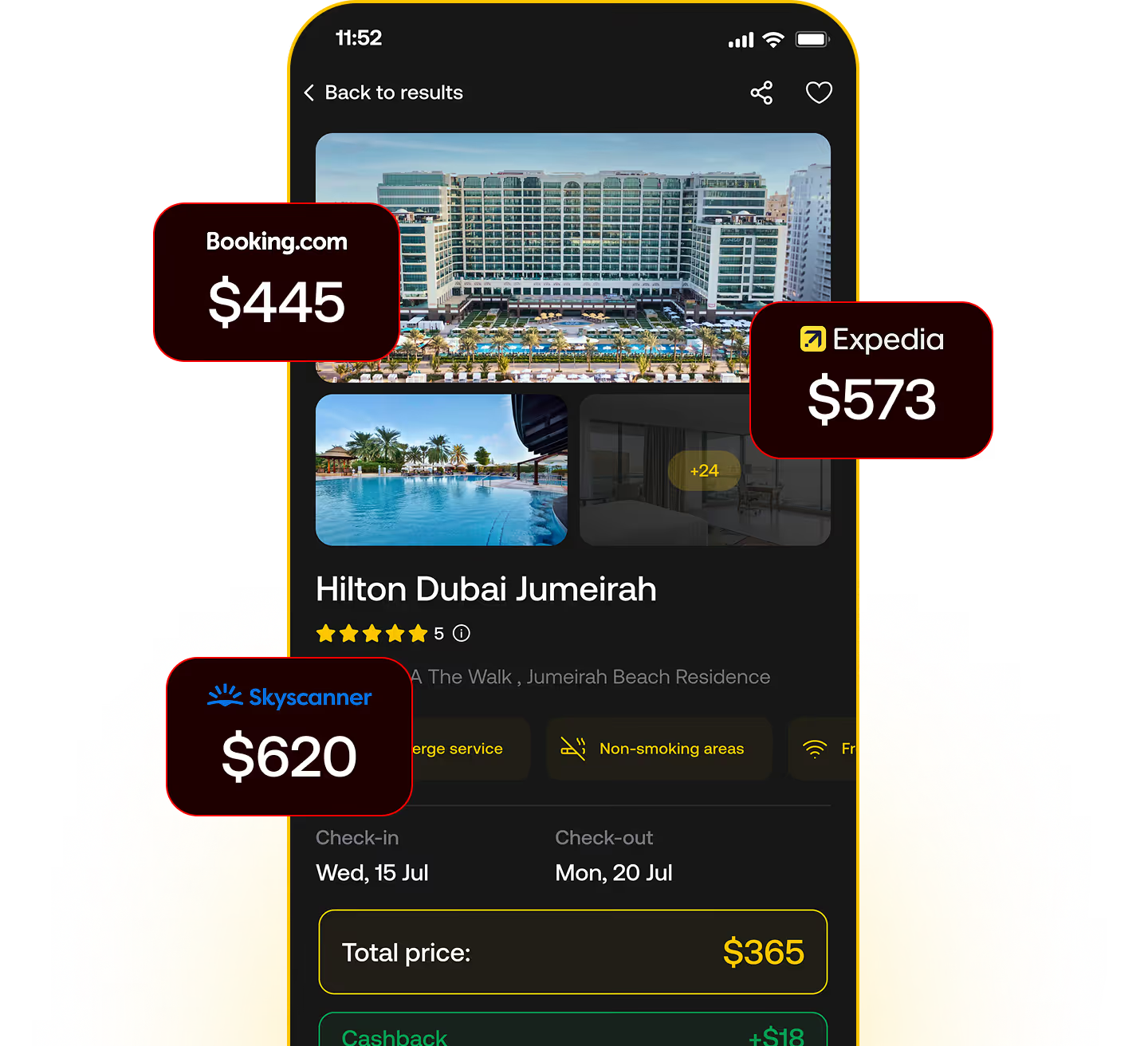
Found a hotel you like? Book it for up to 30% less