.avif)
.avif)

.png)

Content
What Is MANTRA (MANTRA)? Top 5 Ways to Use It in 2026

MANTRA (ticker: MANTRA, formerly OM) is a crypto coin that powers a regulated Layer 1 blockchain built to bring real-world assets such as property, commodities, and private credit on-chain. Unlike most crypto networks, MANTRA runs through a licensed structure: its exchange arm, MANTRA Finance, holds a Virtual Asset Service Provider licence from Dubai's regulator, VARA.
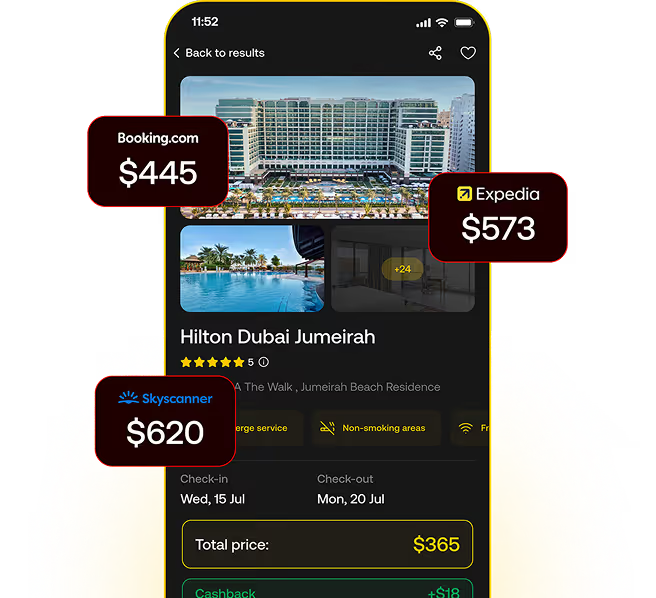
At the time of writing (August 2026), MANTRA trades near $0.0056, with a market capitalisation of roughly $30.9 million and a rank of #491 on CoinMarketCap. Beyond speculation, MANTRA has practical utility across staking, governance, and network fees within the MANTRA ecosystem, and for travellers who already hold MANTRA or other cryptocurrencies,CoinBooking lets you book hotels and flights, with up to 30% savings compared to Booking.com and Expedia and a $25 discount on your first trip upon sign-up.
See how much you
could save with $MANTRA
Answer 2 questions to get your personalized
savings estimate.
Question 1 of 2
Where do you want to go?
Question 2 of 2
How many nights?
Your result
Get similar deals when we go live.
Get $25 off your first trip.
Key Takeaways
- MANTRA is a regulated Layer 1 blockchain built specifically for tokenised real-world assets, with a VARA-licensed exchange arm based in Dubai.
- In March 2026, the project rebranded from OM to MANTRA and ran a 1:4 token split, deprecating its old token and migrating fully to MANTRA Chain.
- Inveniam Capital Partners, which invested $20 million in MANTRA in August 2025, agreed in June 2026 to acquire the project, tying it into Inveniam's institutional real-world asset and private-market data business. The deal was expected to close by the end of June but completion has not been publicly confirmed.
- MANTRA is listed on major exchanges including Binance, Bybit, Bitget and Crypto.com, with MANTRA/USDT the most active pair.
- Book hotels and flights with MANTRA on CoinBooking, at up to 30% below Booking.com prices. Get $25 off your first booking.
MANTRA at a Glance (August 2026)
What Is MANTRA?
MANTRA is a real-world asset ecosystem designed to bring regulated financial assets on-chain. In plain terms, tokenising means turning ownership of something real, like a building, a bar of gold, or a government bond, into a digital token you can buy, sell, or hold in a crypto wallet. "On-chain" simply means that ownership is recorded on the blockchain. MANTRA's goal is to let banks and institutions issue and trade these tokenised assets inside a licensed, compliant framework rather than an unregulated one.
The ecosystem has three main parts. MANTRA Finance is a UAE-based Virtual Asset Service Provider, a company licensed to legally handle crypto assets, approved by Dubai's regulator VARA to run exchange, broker-dealer, and investment management services. MANTRA Chain is the base blockchain itself, a Cosmos SDK chain that added native Ethereum Virtual Machine support in September 2025, so developers can use the same tools they use on Ethereum alongside CosmWasm. mantraUSD is the ecosystem's stablecoin, a token pegged to the US dollar, used to settle trades and provide liquidity; it has roughly $435,000 outstanding.
MANTRA has a long history. It began as MANTRA DAO in the Polkadot ecosystem, then shifted from a community-run finance model towards institutional infrastructure and launched its own network, MANTRA Chain. The project drew wide attention on 13 April 2025 when OM crashed roughly 90% in a single day, falling from about $6.14 to around $0.50 and erasing roughly $5.4 billion in value. The token had reached an all-time high of $8.99 in February 2025. MANTRA attributed the collapse to forced liquidations by centralised exchanges during thin weekend liquidity; OKX's founder publicly disputed that account, and OKX flagged coordinated large-scale deposits and withdrawals across exchanges in the weeks beforehand. A US law firm subsequently opened an investigation on behalf of holders. Since then, the project has restructured, rebranded, and moved under the wing of Inveniam Capital Partners, a firm that handles data and valuations for private real-world assets. MANTRA's co-founders are John Patrick Mullin, who serves as CEO, alongside Will Corkin, Rodrigo Quan Miranda and Jayant Ramanand.
How Does MANTRA Work?
MANTRA Chain is open for anyone to use, but the regulated apps built on top of it can still require identity checks and restrict who is allowed to trade. That combination is deliberate: it keeps the network open while giving institutions the compliance controls they need. Those checks are known as KYC, or "know your customer," the same kind of identity verification a bank runs when you open an account. And because the chain works with Ethereum tooling, teams can use familiar wallets like MetaMask, alongside Cosmos wallets such as Keplr to build on it and interact with it.
The MANTRA token is the fuel for the network. It pays transaction fees, is staked by validators to help secure the chain, and is used to vote on how the network is run. MANTRA Chain also has a companion Layer 2 network, NVNM Chain, launched by Inveniam in May 2026. It is an attestation layer for AI agents in finance, anchoring agentic workflows on-chain with proof of origin, process and state, and includes a Know Your Agent system tying AI agents to verified human operators.
The activity on the network is still developing. MANTRA announced a partnership with Cropto in April 2026 covering CROW, a token backed by real, warehoused wheat at one token per kilogram, with trading planned in a CROW/mantraUSD pool on QuickSwap's MANTRA Chain deployment. The September 2025 MultiVM upgrade added native Ethereum Virtual Machine support, making MANTRA Chain usable with standard Ethereum wallets and tooling.
Top 5 Ways to Use MANTRA Crypto Coin
1. Book discounted hotels and flights with MANTRA on CoinBooking
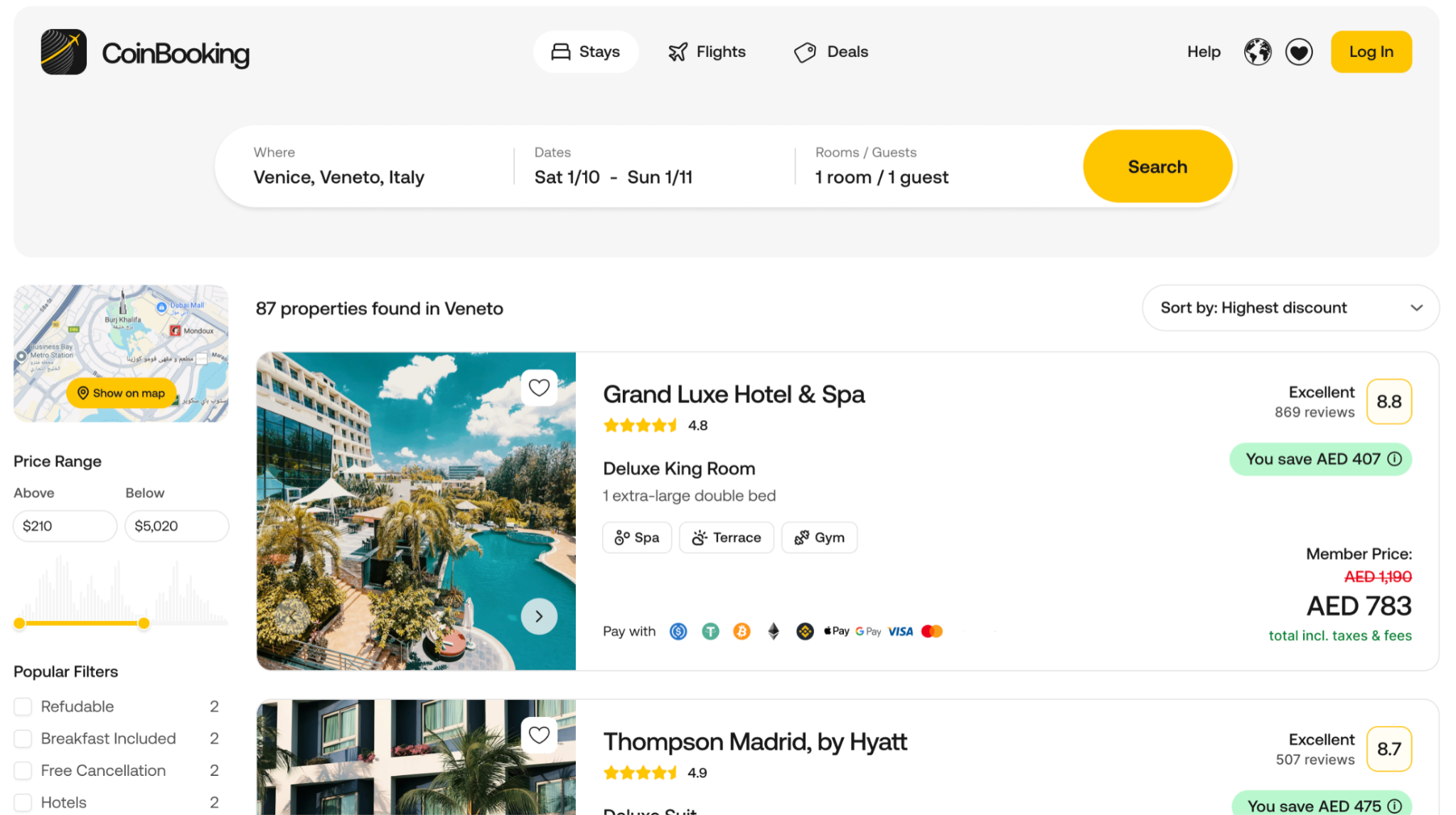
The easiest and most practical way to spend MANTRA is through CoinBooking. Book hotels and flights up to 30% lower than Booking.com. CoinBooking is a crypto-native travel platform operating across 190+ countries. It connects users to over 2 million hotels and flights globally and accepts 200+ cryptocurrencies, including MANTRA, as well as traditional payment methods such as Visa, Mastercard, Apple Pay, and Google Pay. New users get $25 off their first booking.
Book your next hotel for up to 30% less
2. Pay fees and trade tokenised assets onchain
The primary use of MANTRA is powering activity on its own chain. Holders spend it on transaction fees and use it as the gateway to the network's real-world asset services, from trading tokenised commodities to accessing MANTRA Finance products. As the ecosystem onboards more issuers, the token is the entry point to that regulated marketplace. Current adoption sits at roughly $560,000 in total chain value locked, of which about $34,000 is real-world asset value.
3. Stake MANTRA to secure the network
MANTRA holders can stake their coins by delegating to a validator, helping secure the chain and earning rewards in return. Staking has also served as a gateway to new ecosystem projects: MANTRA holders were offered early access to the NVNM token ahead of its launch. Before staking, remember that MANTRA applies an eight-day unbonding period during which your coins are locked and earn nothing, so plan around it.
4. Vote on governance
Staked MANTRA doubles as a governance vote. Token holders have a say over the protocol, and governance has already steered major changes, including the approved transition that migrated OM to MANTRA Chain as the sole network. As the project integrates with Inveniam and expands its real-world asset product line, governance is where the direction of the network gets debated and set.
5. Trade MANTRA
MANTRA is listed on major exchanges including Binance, Bybit, Bitget and Crypto.com, with MANTRA/USDT the most active pair. Traders treat it as one of the reference tokens for the real-world asset sector, so it tends to move with the broader tokenisation and institutional-adoption narrative rather than in isolation.
Is MANTRA a Good Investment?
Whether MANTRA is a good investment depends on your risk tolerance and your view of real-world asset tokenisation as a category. The bull case is built on structure: a full VARA licence that clears a real regulatory hurdle, institutional backing from Inveniam, which agreed in 2026 to acquire the project, partnerships including Cropto and QuickSwap, and a functioning chain with active development in NVNM Chain. The gap between that structure and current usage is stark: MANTRA Chain holds roughly $560,000 in total value locked, of which about $34,000 is real-world asset value, and mantraUSD has around $435,000 outstanding.
The risks are just as concrete. MANTRA carries the scars of the April 2025 OM crash, when the token fell roughly 90% in a day, and it still trades around 79% below its post-split all-time high of $0.02659. It is a small-cap of around $31 million with thin liquidity, which means sharp moves in either direction. The Inveniam acquisition brings integration risk and possible shifts in strategic direction under new ownership. The real-world asset sector is also getting crowded, with rivals such as Plume roughly 2.5 times MANTRA's market cap and holding around $7 million in chain TVL against MANTRA's $560,000 chasing the same institutional narrative. MANTRA cut staff in January 2026, with the CEO citing an unsustainable cost structure, and the token has continued falling since the 2025 crash. Several smaller exchanges have dropped it, including Indodax in December 2025 and KuCoin in February 2026. The model still has to prove it can convert regulatory positioning into sustained on-chain volume.
This is not financial advice. Crypto is volatile. Always do your own research and never invest more than you can afford to lose.
Read More About Other Layer 1 Coins
- What Is Berachain (BERA)? Top 5 Ways to Use It in 2026
- What Is Irys Coin (IRYS)? Top 5 Ways to Use It in 2026
FAQs
1. Is MANTRA a good investment?
MANTRA is a regulated real-world asset blockchain with real partnerships and institutional backing from Inveniam, but the token trades far below its former OM highs and remains a volatile small-cap. Current chain adoption sits at roughly $560,000 in total value locked, of which about $34,000 is real-world asset value. Treat it as a high-risk asset and do your own research before buying.
2. What is MANTRA?
MANTRA is a regulated Layer 1 blockchain built to tokenise real-world assets such as property and commodities, meaning it turns ownership of real things into digital tokens. Its exchange arm, MANTRA Finance, is licensed as a Virtual Asset Service Provider by Dubai's VARA.
3. What happened to OM, and why is it now MANTRA?
In March 2026, MANTRA rebranded its token from OM to MANTRA and carried out a 1:4 split, so each OM became four MANTRA. The old token was deprecated and holdings migrated to MANTRA Chain. The split changed the unit price and supply, not the total value of a holding.
4. Who is behind MANTRA?
MANTRA's co-founders are John Patrick Mullin, who serves as CEO, alongside Will Corkin, Rodrigo Quan Miranda and Jayant Ramanand. In 2026, Inveniam Capital Partners agreed to fully acquire the project, with the MANTRA brand, team and chain continuing to operate. The deal was expected to close by the end of June but completion has not been publicly confirmed.
5. Can you spend MANTRA on real things?
Yes. CoinBooking, a crypto travel platform, accepts MANTRA as payment for hotels and flights at up to 30% below Booking.com prices. Sign up and your first booking is $25 off.
6. Where can you buy MANTRA?
MANTRA is available on major exchanges including Binance, Bybit, Bitget and Crypto.com. The most active trading pair is MANTRA against USDT.
7. What is the max supply of MANTRA?
MANTRA has a maximum supply of 10 billion tokens, with about 5.53 billion circulating as of 10 August 2026 following the 1:4 split from the former OM token.

Saira Parveen is a Dubai-based SEO content writer with a background in digital marketing and search visibility. She covers cryptocurrency adoption, travel booking with digital assets, and the practical side of spending crypto in everyday life.
Her work at CoinBooking focuses on helping readers navigate the intersection of crypto and travel, from finding the best rates on hotels and flights to understanding how to pay for travel with digital assets.
Found a hotel you like? Book it for up to 30% less

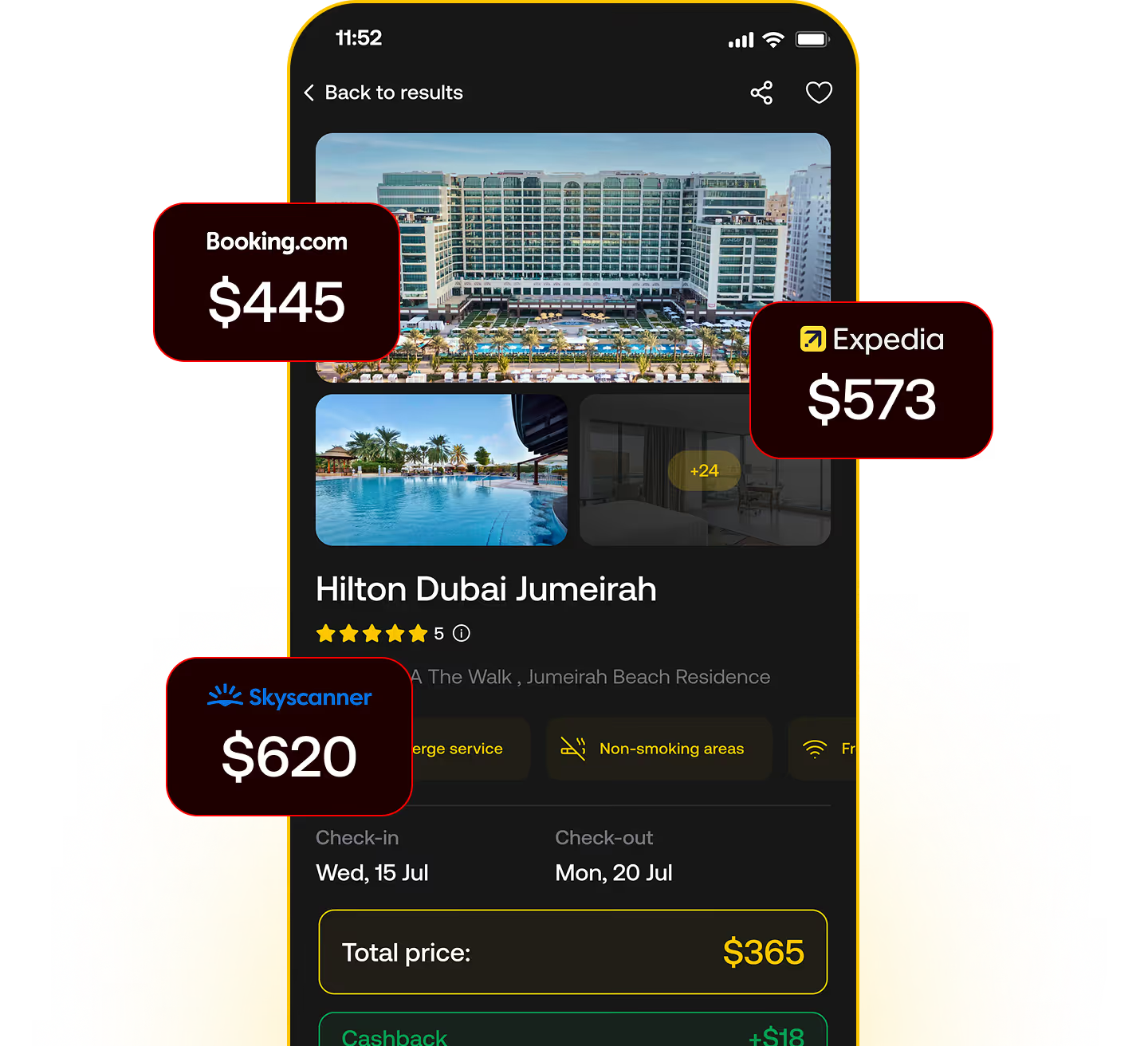
Found a hotel you like? Book it for up to 30% less