.avif)
.avif)

.png)

Content
What Is Meteora Crypto Coin (MET)? Top 5 Ways to Use It in 2026

Meteora (MET) is a crypto coin that powers a decentralized liquidity protocol on Solana, where liquidity providers and traders connect directly without cutting through a traditional exchange. Liquidity providers on Meteora typically earn 40 to 60% higher returns on their deployed capital compared to standard automated market makers.
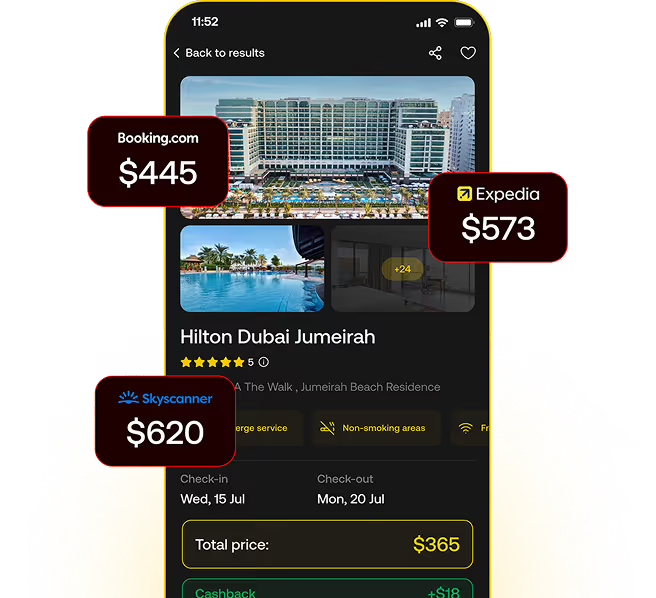
As of July 2026, MET trades around $0.15 with a market cap of about $80 million, ranking inside the top 200 cryptocurrencies. Beyond holding, Meteora (MET) has several real use cases, including providing liquidity to earn yield, staking for rewards, receiving reduced platform fees, voting on the network's future, and booking discounted hotels and flights on CoinBooking.
See how much you
could save with $MET
Answer 2 questions to get your personalized
savings estimate.
Question 1 of 2
Where do you want to go?
Question 2 of 2
How many nights?
Your result
Get similar deals when we go live.
Get $25 off your first trip.
Key Takeaways
- Meteora is Solana's leading liquidity infrastructure, processing over $208 billion in cumulative trading volume and maintaining $800 million in total value locked.
- The MET token launched October 23, 2025, with 48% of the supply immediately in circulation to prioritize community ownership.
- Dynamic Liquidity Market Maker (DLMM) technology delivers 40 to 60% higher capital efficiency than traditional automated market makers.
- Book hotels and flights with $MET on CoinBooking at up to 30% below Booking.com prices. Get $25 off your first booking.
MET at a Glance (July 2026)
What Is Meteora?
Meteora is a liquidity composability layer on Solana that functions as both a decentralized exchange and infrastructure for the broader DeFi ecosystem. The protocol addresses capital inefficiency in traditional automated market makers by using adaptive pricing, dynamic fee adjustment, and concentrated liquidity bins.
The project originated as Mercurial Finance in 2021, co-founded by Ben Chow, Andrew Nguyen, Ming Ng, and others. After FTX's collapse in November 2022, the team announced a rebrand to Meteora in December 2022, issuing a new MET token and resetting tokenomics to rebuild community trust. It is now led by co-leads Zhen Hoe Yong (Project Lead), TRAV (CTO), and ROOK (COO), with former CEO Ben Chow stepping down in early 2025. Meteora operates with no single company controlling the protocol; governance and technical decisions are made through token holder votes.
The core problem Meteora solves is capital waste. Standard liquidity pools spread capital across entire price ranges, even where no trading occurs. This means most liquidity sits idle. On traditional decentralized exchanges, the spread between buy and sell prices widens during volatile periods, making trading expensive. Meteora's technology adjusts both liquidity concentration and trading fees in real time based on market conditions, compensating LPs for increased risk during volatility.
How Does Meteora Work?
Meteora gives liquidity providers three ways to earn, each with different tradeoffs between effort and return.
The first is DLMM pools. Instead of spreading your capital across all possible prices, you pick a specific price range where you expect trading to happen. When traders swap within your range, you earn fees. If volatility spikes and prices move away from your range, you stop earning but your capital is protected.
The system automatically raises fees during volatile periods to reward LPs who take on that risk, then lowers fees when markets stabilize to attract more trading. This concentrated approach means you earn more fees per dollar deployed compared to traditional liquidity pools.
The second option is Dynamic AMM pools. These work like traditional DEX pools where liquidity is spread across all prices. You don't have to actively manage price ranges, but you also earn lower fees per dollar. The tradeoff is simplicity: deposit your tokens and let the protocol handle the rest. These pools also include built-in protection against bot attacks during new token launches.
The third is Dynamic Vaults. Here, you deposit assets and the protocol automatically moves your capital between Solana lending protocols like Solend and Marginfi, chasing the highest yield. Your assets generate returns from both trading fees and lending interest every minute, requiring no manual work.
MET is the fuel for all of this. Traders pay compute fees in MET to use the protocol. Validators stake MET to secure the network. MET holders vote on how much to charge for trades, which protocols to integrate with, and how to distribute ecosystem rewards. The token distribution prioritizes community ownership: 48% of the supply entered circulation immediately at launch with no vesting period, while the team's 18% allocation vests linearly over six years to ensure long-term alignment.
Top 5 Ways to Use Meteora Crypto Coin (MET)
1. Book discounted hotels and flights with MET on CoinBooking
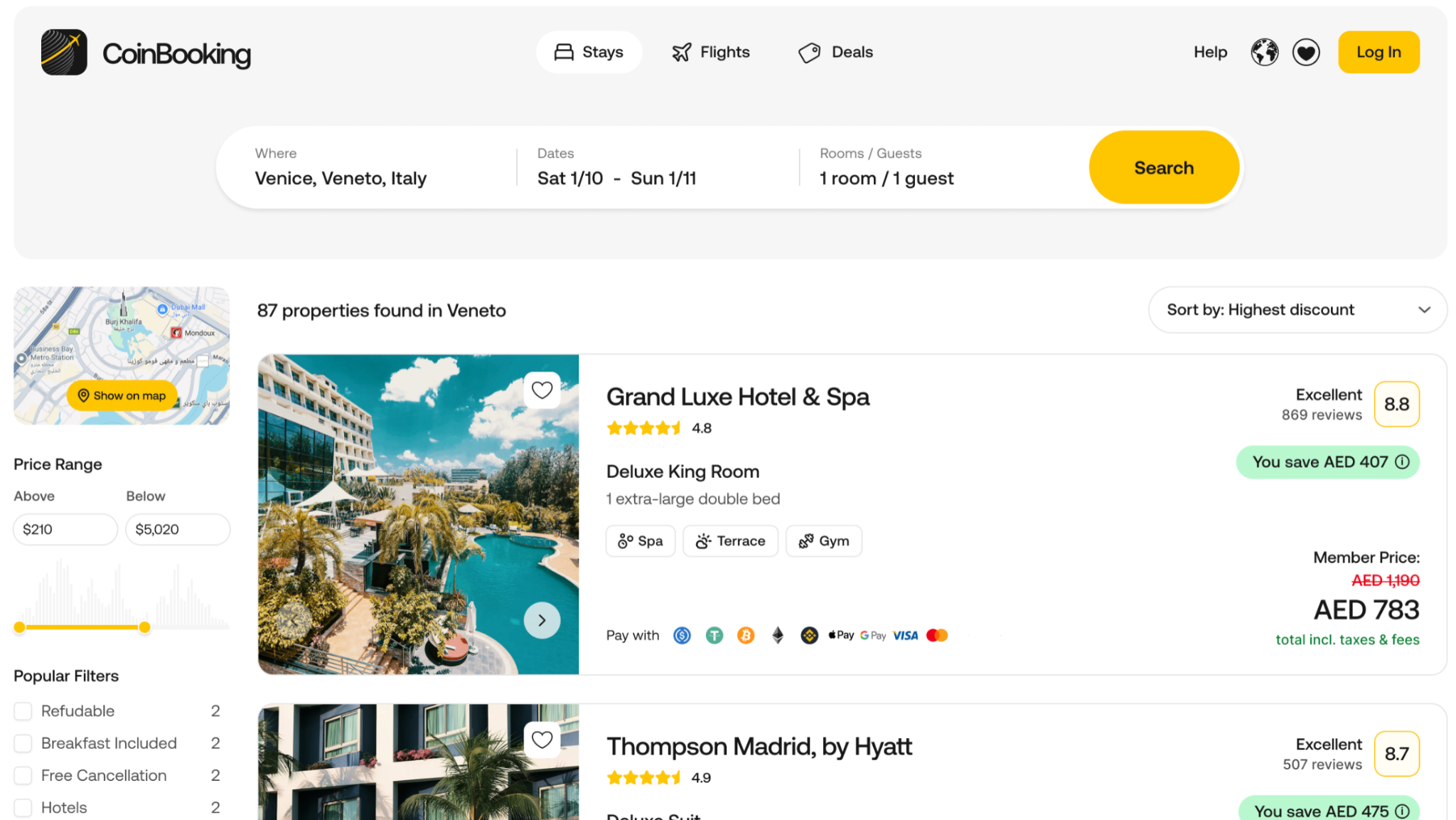
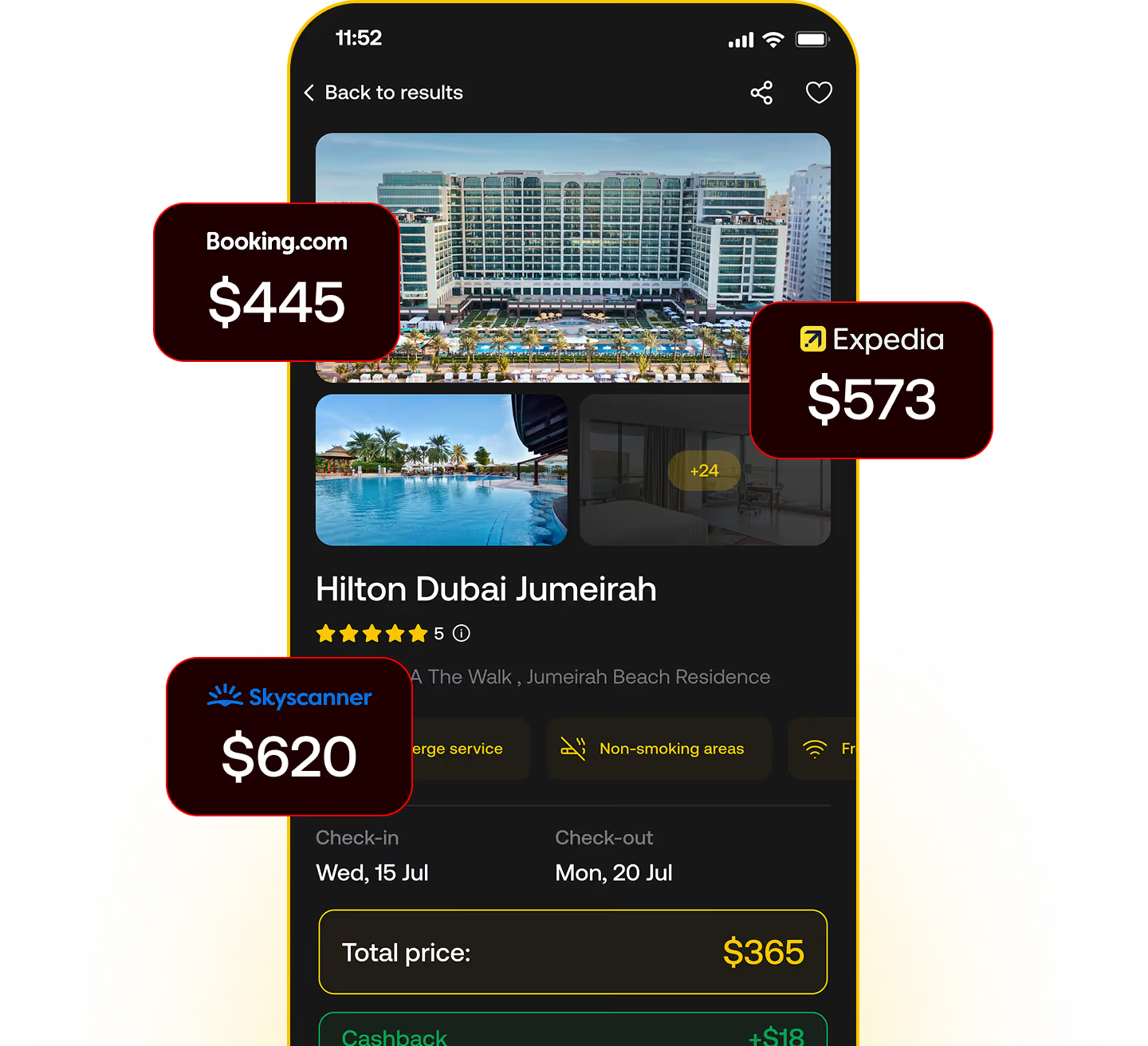
Spending MET on travel is the most practical real-world use case for your tokens. You can skip the conversion to fiat entirely and avoid the 10 to 15% crypto premium that most crypto-native travel platforms charge. When you book your next trip, use MET directly on CoinBooking to access hotels and flights at up to 30% below Booking.com prices.
CoinBooking is a Dubai-licensed travel broker and crypto-native platform operating across more than 190 countries. It provides access to over 2 million hotels and flights worldwide and accepts 200+ cryptocurrencies including MET, alongside traditional payment methods: Visa, Mastercard, Apple Pay, and Google Pay.
Book your next hotel for up to 30% less
New users get $25 off their first booking, which stacks directly on top of the existing savings. For anyone who travels regularly, this single use case justifies holding MET.
2. Provide liquidity and earn trading fees
The primary use of MET is paying for liquidity provision on the protocol. Liquidity providers deposit paired assets into DLMM or Dynamic AMM pools and earn a portion of all trading fees proportional to their capital share. Because Meteora's concentrated liquidity model delivers 40–60% higher capital efficiency than traditional AMMs, LP returns are substantially higher for the same capital deployed.
Recent activity shows liquidity providers earning significant fee income. Some individual LP positions have generated over $100,000 in fees since launch. The Liquidity Distributor mechanism allows new users to receive their MET allocation as liquidity positions that earn trading fees while gradually releasing tokens.
3. Stake MET for rewards and protocol governance
MET holders can stake tokens to earn rewards from trading fees. The protocol recently launched a Referral Staking Program where stakers earn additional incentives by referring other participants. Staking is done through any Solana wallet compatible with Meteora, such as Phantom, Solflare, or OKX Wallet.
Staked MET also grants voting rights. MET holders have voted on protocol fees, DLMM configurations, ecosystem funding, and major technical decisions. As of July 2026, the community is evaluating whether to integrate limit order functionality to expand Meteora's trading capabilities.
4. Receive Platform Fee Discounts
MET stakers and active ecosystem participants receive reduced fees when trading, swapping, and providing liquidity across Meteora's pools. These fee discounts apply immediately on every interaction, creating direct cost savings for engaged users.
5. Participate in ecosystem incentive programs
Meteora regularly distributes rewards to early adopters and active users through programs like the LP Stimulus Program and Campaigns Hub. In Season 2 of the LP Stimulus initiative, liquidity providers became eligible to claim additional MET tokens. These programs are designed to bootstrap liquidity and reward early community members who took risk on the protocol before it matured.
Is Meteora a Good Investment?
Whether MET is a good investment depends on your risk tolerance and your view of centralized liquidity infrastructure as a category. The bull case is unusually concrete for crypto: Meteora has real paying users, $800 million in total value locked, $208 billion in cumulative trading volume, and a working product that competes directly with centralized exchanges. The protocol's DLMM technology is genuinely differentiated; no other Solana DEX has matched its capital efficiency. The community-first tokenomics, with 48% of the supply in circulation immediately and the team's allocation vesting linearly over six years, reduce typical venture-backed token launch risks.
The risks are just as concrete. MET trades roughly 77% below its all-time high of $0.69 (October 2025). Competitors including Raydium and Jupiter also offer competitive liquidity provision on Solana. The protocol depends entirely on Solana's performance; any extended network outages would impair Meteora's operations. Smart contract complexity increases the potential for bugs despite audits. Token unlocks continue over six years, which could create selling pressure as early participants' allocations vest.
This is not financial advice. Crypto is volatile. Always do your own research and never invest more than you can afford to lose.
FAQs
1. What is Meteora?
Meteora is a Solana-based centralized exchange and liquidity protocol that uses Dynamic Liquidity Market Maker technology to optimize capital efficiency. It allows liquidity providers to earn fees from trading while enabling traders to execute swaps with low slippage.
2. Who leads Meteora?
Meteora is currently led by co-leads Soju and Zen. The protocol originated from Mercurial Finance, co-founded by Ben Chow and Meow in 2021. After the FTX collapse impacted Mercurial's operations, Ben Chow established Meteora. After Ben Chow's resignation in early 2025, Soju joined Zen as co-lead.
3. Can you spend MET on real things?
Yes. CoinBooking, a crypto travel platform, accepts MET for booking hotels and flights at up to 30% below Booking.com prices. Sign up early and your first booking is $25 off.
4. What is the total supply of MET?
MET has a maximum supply of 1 billion tokens. As of July 2026, approximately 537 million tokens are in circulation. Token distribution includes 48% community allocation (circulating immediately), 34% ecosystem reserve, 18% team allocation (vesting linearly over six years), and smaller allocations to Jupiter stakers, launchpad partners, and other contributors.
5. How many MET tokens are locked?
Approximately 462 million MET tokens remain locked under vesting schedules. The Meteora Ecosystem Reserve (34% of total supply) and Team allocation (18%) both vest linearly over six years from October 2025. This structure ensures continuous but gradual token release through 2031.
6. Where can you buy MET?
MET is available on major centralized exchanges including Binance, OKX, HTX, and Upbit. Within the Solana ecosystem, it trades on the Meteora DEX and other centralized exchanges. Binance shows the highest trading volume for MET/USDT.
7. What are DLMM pools?
DLMM (Dynamic Liquidity Market Maker) pools concentrate liquidity into discrete price bins instead of using continuous bonding curves. This allows liquidity providers to earn more fees per dollar deployed and gives them control over their exact price ranges. DLMM fees adjust automatically based on market volatility to compensate LPs for increased risk.
8. What is the Meteora DEX?
The Meteora DEX is Solana's liquidity infrastructure layer. It functions as both a direct trading venue and a composable system that other protocols and projects integrate into their platforms. Most Solana traders access Meteora's liquidity indirectly through trading terminals like Jupiter.

Saira Parveen is a Dubai-based SEO content writer with a background in digital marketing and search visibility. She covers cryptocurrency adoption, travel booking with digital assets, and the practical side of spending crypto in everyday life.
Her work at CoinBooking focuses on helping readers navigate the intersection of crypto and travel, from finding the best rates on hotels and flights to understanding how to pay for travel with digital assets.
Found a hotel you like? Book it for up to 30% less

Found a hotel you like? Book it for up to 30% less