.avif)
.avif)

.png)

Content
What is Neo (NEO)? Top 5 Ways to Use Neo Crypto Coin in 2026

Neo (NEO) is an open-source, community-powered blockchain platform designed to make it easier to manage digital assets using smart contracts and digital identities. It was first launched in 2014 under the name Antshares and later rebranded as Neo in 2017. The project became known as China’s first public blockchain and introduced a new approach to digital asset management.
Neo has a fixed maximum supply of 100 million tokens and uses a dual-token system. The NEO token is mainly used for governance, allowing holders to participate in network decisions, while GAS is used to pay for transactions and power activities on the blockchain.
As of July 2026, Neo (NEO) is trading at around $2.04 USD, with a market capitalization of approximately $144 million, ranking it around #145 on CoinMarketCap. While many investors view NEO as a long-standing smart contract cryptocurrency, it also has practical uses beyond simply holding the token. For example, NEO can be used to book discounted hotels and flights worldwide through CoinBooking, giving the cryptocurrency a real-world travel utility.
Key Takeaways
- Neo was designed to build a “smart economy” by bringing together digital assets, verifiable digital identities, and self-executing smart contracts in one integrated blockchain ecosystem. The platform focuses on enterprise adoption by providing a secure and compliant infrastructure, while maintaining a fixed maximum supply of 100 million NEO tokens.
- Neo uses a dual-token model where NEO acts as the governance token. NEO holders can vote to elect the 21-member Neo Council, which helps manage network decisions. At the same time, holding NEO can generate GAS rewards, which are used to pay for transaction fees and smart contract execution on the blockchain.
- Neo’s mainnet runs on the dBFT 3.0 consensus mechanism, which is designed for speed, security, and reliability. It enables around 3-second block times and provides single-block finality, meaning confirmed transactions cannot be reversed, and the network avoids issues like chain splits or rollback risks common in some other blockchains.
- Neo is moving beyond just being a blockchain asset. You can use your NEO crypto coin directly on CoinBooking to book hotels and flights worldwide and access rates with up to 30% savings across more than 2 million travel options. Sign up for CoinBooking today and get $25 off your first reservation.
Neo (NEO) at a Glance (July 2026)
What is Neo (NEO) Crypto Coin?
Neo (NEO) is a decentralized, enterprise-focused blockchain platform built to create what it calls a "Smart Economy." It brings together digital assets, verified digital identities, and smart contracts on a single network, making it easier for people and businesses to build and use blockchain applications.
The project was founded in February 2014 by Da Hongfei and Erik Zhang under the name Antshares. It became China's first public open-source blockchain and was rebranded as Neo in June 2017. Since then, the platform has continued to evolve with the goal of connecting traditional finance with decentralized blockchain technology.
One of Neo's biggest advantages is that it removes many of the challenges developers face on older smart contract blockchains. Many blockchain platforms require developers to learn specialized programming languages such as Solidity, but Neo N3 supports widely used languages like C#, Python, Go, Java, and TypeScript. This makes it much easier for existing software developers to start building decentralized applications (dApps).
Neo also includes several built-in features that developers would otherwise need to add separately. These include native oracle services for bringing real-world data onto the blockchain, NeoFS for decentralized file storage, Neo Name Service (NNS) for human-readable blockchain addresses, and NeoX, an EVM-compatible, MEV-resistant sidechain that improves compatibility with Ethereum-based applications while helping protect users from certain types of transaction manipulation.
How Does Neo (NEO) Work?
The Neo network is a full-stack Layer-1 blockchain designed to digitize real-world assets and run smart contracts without relying on energy-intensive Proof-of-Work (PoW) mining. At its core, Neo N3 combines an enterprise-grade consensus system, a dual-token economy, and a multi-language virtual machine into one platform, making it easier to build and use blockchain applications while supporting Neo's vision of a smart economy.
1. Dual-Token System: NEO vs. GAS
Instead of using a single token for everything, Neo separates governance from network operations by using two different tokens.
NEO is the platform's main governance token and has a fixed maximum supply of 100 million tokens. Unlike many cryptocurrencies, NEO cannot be divided on the Layer-1 network; it only exists as whole units. Holding NEO gives you the right to vote for the 21 members of the Neo Council, which is responsible for making important decisions about the network, including system upgrades and fee policies.
GAS is the utility token that powers the Neo blockchain. It is used to pay for transaction fees, smart contract deployment, and data storage. Unlike NEO, GAS is divisible up to 8 decimal places (0.00000001 GAS, known as 1 Datoshi). If you participate in governance by voting with your NEO tokens, you can continuously earn GAS rewards, which are sent directly to your wallet.
2. Delegated Byzantine Fault Tolerance (dBFT 3.0)
Neo uses a consensus mechanism called Delegated Byzantine Fault Tolerance (dBFT 3.0). Instead of relying on miners, NEO holders vote for trusted consensus nodes, which are responsible for validating transactions and creating new blocks.
One of the biggest advantages of Neo N3 is its speed and reliability. The network creates a new block every 3 seconds, allowing transactions to be confirmed quickly.
Unlike Proof-of-Work (PoW) or many Proof-of-Stake (PoS) blockchains, where temporary chain splits can occur and transactions may need multiple confirmations, dBFT provides deterministic single-block finality. This means that once a transaction is confirmed in a block, it is final and cannot be reversed, eliminating the risk of chain forks or transaction rollbacks.
Top 5 Ways to Use Neo Crypto Coin in 2026
1. Book Discounted Flights and Hotels with NEO using CoinBooking
%20(1).avif)
One of the most practical ways to use your Neo (NEO) crypto coin in 2026 is to pay for real-world travel through CoinBooking.
When you book with NEO on CoinBooking, you can save up to 30% compared to Booking.com and Expedia. This is possible because CoinBooking connects directly with global hotel and travel suppliers, reducing middleman commissions and passing those savings on to customers. The platform has access to more than 2 million hotels, luxury resorts, and flights across 190+ countries, making it easy to plan trips almost anywhere in the world.
CoinBooking also offers plenty of payment flexibility. In addition to NEO, it supports 200+ cryptocurrencies, and if you want to combine crypto with traditional payment methods, you can also pay using Google Pay, Apple Pay, Visa, or Mastercard during checkout.
Getting started is simple. Just choose your hotel or flight, pay with your NEO tokens at checkout, and you’re done. So, sign up now with your email to get early access, and you'll also receive $25 off your first booking.
2. Earn On-Chain Rewards Through Governance Voting and GAS
Holding NEO can also generate passive rewards without requiring you to lock up your tokens. Instead of using traditional liquid staking, NEO holders can keep full control of their assets by storing them in self-custody wallets such as NeoLine, Neon Wallet, or O3 Wallet and using their tokens to vote for members of the Neo Council.
When you vote for active Council candidates, you earn GAS rewards that are distributed directly to your wallet on the blockchain. This provides a predictable way to earn passive income while still maintaining full ownership of your NEO. Since your tokens remain in your own wallet, there are no lock-up periods, no custodial risks, and no smart contract slashing penalties, making it a simple and secure way to participate in the Neo ecosystem.
3. Build and Execute Multi-Language Smart Contracts for Real-World Asset Tokenization
Neo is also used by businesses and developers to create smart contracts and tokenize Real World Assets (RWAs), bringing physical assets and records onto the blockchain. These assets can include things like commercial property ownership documents, logistics and supply chain records, and carbon offset certificates.
One of Neo N3’s key advantages is its support for multiple popular programming languages, including C#, Python, Go, Java, and TypeScript. This allows enterprise development teams to build and deploy secure, audit-ready smart contracts using programming languages they already know instead of learning a completely new blockchain-specific language. By making blockchain development more accessible, Neo helps businesses create scalable applications for asset management, automation, and digital ownership.
4. Cross-Chain DeFi Operations on the NeoX EVM Sidechain
With the launch of NeoX, Neo has expanded its ecosystem beyond its native blockchain by introducing an EVM-compatible sidechain that allows better compatibility with Ethereum-based applications. NeoX includes native anti-MEV (Miner Extractable Value) protection, which helps reduce the risk of transaction manipulation and unfair ordering practices that can impact DeFi users.
Through NeoX, NEO holders can connect their assets with the broader decentralized finance ecosystem and access Ethereum-compatible liquidity opportunities. Users can bridge tokens into Ethereum-based liquidity pools and use NEO or GAS across decentralized exchanges (DEXs), lending platforms, money markets, and cross-chain applications. NeoX also enables connections with major blockchain networks such as Ethereum, Polygon, and BNB Chain, giving users more flexibility to participate in multi-chain DeFi activities.
5. Access Native Decentralized Storage (NeoFS) and .neo Domain Names
Neo also provides built-in services that expand the functionality of its blockchain ecosystem. The GAS token is used to pay for these native services, including decentralized storage through NeoFS (Neo File System). Users and developers can spend GAS to store dApp files, media content, and enterprise data backups on a decentralized storage network instead of relying only on traditional centralized cloud providers.
In addition to decentralized storage, Neo offers the Neo Name Service (NNS), which makes blockchain addresses easier to use. Instead of sharing long and complicated alphanumeric wallet addresses, users can register simple, human-readable .neo domain names that act as their Web3 identity. This makes sending assets, interacting with decentralized applications, and managing blockchain accounts more convenient for everyday users.
Is Neo (NEO) a Good Investment?
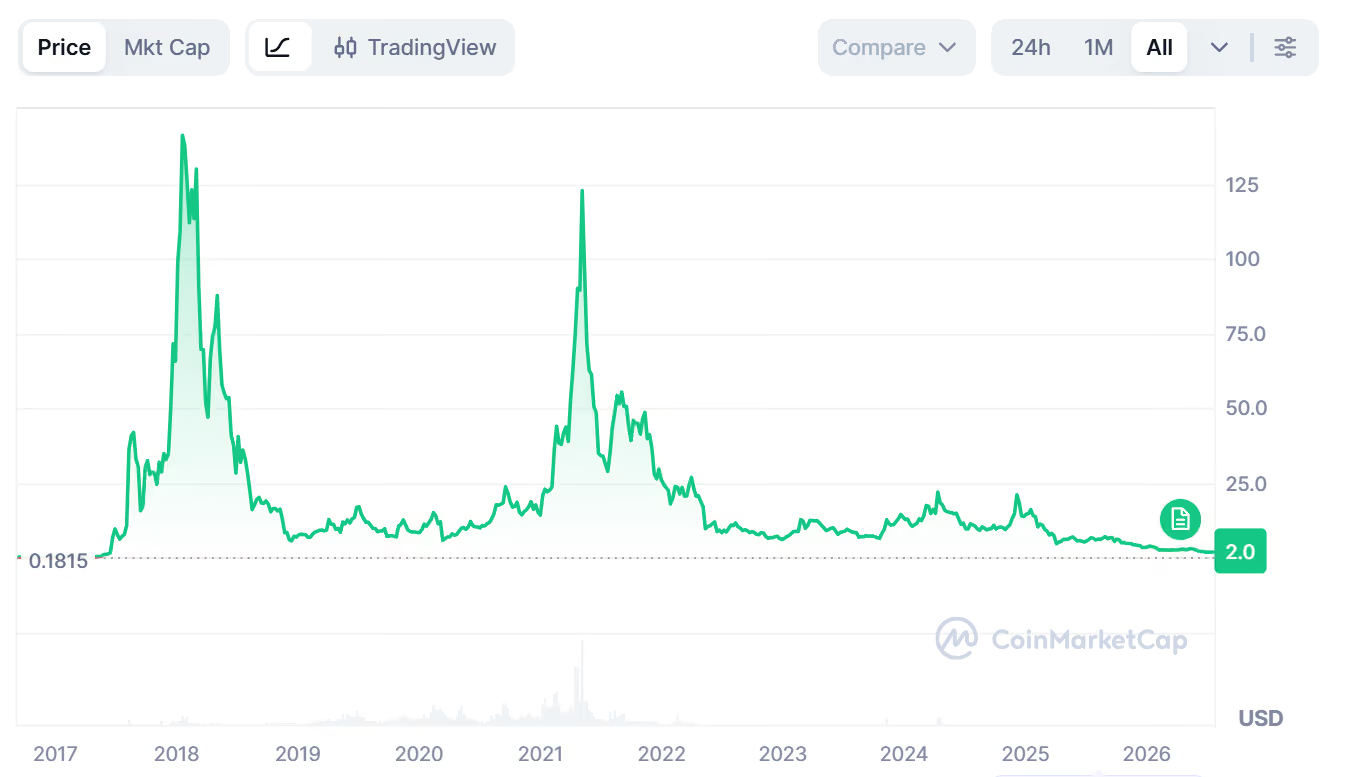
A line chart from CoinMarketCap displaying the all-time historical price movement of Neo (NEO) in USD from 2017 through 2026. The chart highlights two major price peaks, one above $140 in early 2018 and another around $120 in mid-2021, followed by a stabilization period leading to a current trading price near $2.0.
Whether Neo (NEO) is a good investment depends on several factors, including its technology, real-world use cases, competition, and current market conditions. Since launching in 2014, Neo has remained one of the longest-running active Layer-1 smart contract blockchain platforms in the crypto industry. Over the years, the project has continued to evolve by upgrading its infrastructure, including the move to Neo N3 and the introduction of NeoX, an EVM-compatible sidechain designed to improve compatibility with Ethereum-based applications.
From a fundamental perspective, Neo has several features that may attract long-term investors who are looking beyond short-term price movements. Its dual-token system separates governance from network operations, allowing NEO holders to participate in blockchain decisions while earning GAS rewards without needing to lock their tokens or take on the risks associated with some staking models. Another advantage is Neo’s multi-language Virtual Machine (NeoVM), which allows developers to build smart contracts using familiar programming languages such as C#, Python, Go, Java, and TypeScript. This lowers the barrier for traditional software developers and businesses that want to move from Web2 systems into blockchain applications.
Neo also has growing real-world utility beyond being a speculative crypto asset. Through integrations like CoinBooking, NEO holders can use their tokens for practical purchases such as booking hotels and flights worldwide, showing how the cryptocurrency can be used outside of traditional trading and investing.
However, investors should also consider the challenges before adding NEO to their portfolio. As of July 2026, NEO is trading at approximately $2.04 USD, which is 98.95% below its all-time high of $196.85 USD. While the lower valuation may attract investors looking for potential value opportunities, Neo operates in a highly competitive market. It competes with major blockchain ecosystems such as Ethereum and Solana, as well as growing Layer-2 networks that continue to attract developers, liquidity, and decentralized applications.
Like most altcoins, NEO also carries higher volatility and market risk compared to established assets like Bitcoin. Its future performance will likely depend on developer adoption, ecosystem growth, real-world usage, and broader crypto market conditions.
Investors should carefully consider their own risk tolerance, conduct thorough research (DYOR - Do Your Own Research), and avoid making investment decisions based only on price predictions or speculation.
Frequently Asked Questions
1. What Is the NEO Crypto?
Neo (NEO) is an open-source Layer-1 smart contract blockchain designed to create a decentralized “Smart Economy.” The platform combines digital assets, verified digital identities, and automated smart contracts into a single blockchain ecosystem.
2. Is NEO a Chinese Coin?
Yes, Neo was originally founded in Shanghai, China, in 2014 under the name Antshares before being rebranded as Neo in 2017. It was the first open-source public blockchain project from China and was often called “China’s Ethereum” because of its smart contract capabilities.
3. Who Is the CEO of NEO Coin?
Public blockchains usually do not operate with traditional CEOs like regular companies. Neo is primarily led by its founder Da Hongfei, who serves as the CEO of Neo Global Development (NGD) and Chair of the Neo Foundation. The project was co-founded with Erik Zhang, who remains a key developer and technical contributor to the Neo ecosystem.
4. How Much Is 1 NEO Worth?
As of July 2026, 1 NEO is worth approximately $2.04 USD, with a total market capitalization of around $144 million USD.
5. How Many NEO Coins Are There?
NEO has a fixed maximum supply of 100,000,000 NEO tokens. Out of this total supply, approximately 70,538,831 NEO tokens (around 70.53 million) are currently in circulation. The limited supply is designed to maintain a predictable token economy over the long term.
6. Where can I buy Neo (NEO) crypto coin?
NEO is traded on major centralized cryptocurrency exchanges including Binance, Upbit, OKX, Bitget, Gate, KuCoin, Crypto.com & Kraken.

Saira Parveen is a Dubai-based SEO content writer with a background in digital marketing and search visibility. She covers cryptocurrency adoption, travel booking with digital assets, and the practical side of spending crypto in everyday life.
Her work at CoinBooking focuses on helping readers navigate the intersection of crypto and travel, from finding the best rates on hotels and flights to understanding how to pay for travel with digital assets.
Latest