.avif)
.avif)

.png)

Content
What Is Ravencoin Coin (RVN)? Top 5 Ways to Use It in 2026

Ravencoin (RVN) is a crypto coin that powers a peer-to-peer blockchain designed for one specific function: creating and transferring digital assets directly between users without intermediaries or the risk of accidental destruction. Built on Bitcoin code, RVN lets anyone tokenize anything from real estate and securities to digital goods and intellectual property. Assets issued on Ravencoin are secured by a decentralized mining network and settle within minutes.
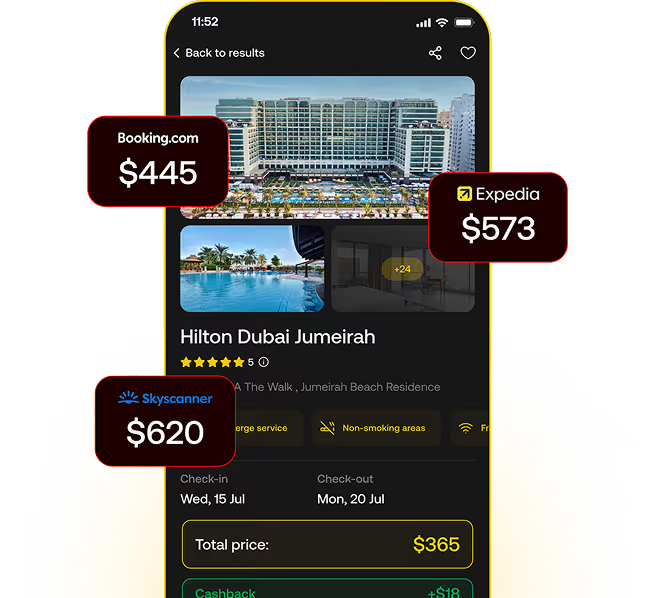
At the time of writing (July 2026), RVN trades near $0.0048, with a market capitalisation of roughly $78.5 million and a rank of #289 on CoinMarketCap. Beyond speculation, RVN has practical utility across asset tokenization, mining, and trading, and for those who already hold RVN or other cryptocurrencies, CoinBooking lets you book hotels and flights, with up to 30% savings compared to Booking.com and a $25 discount on your first booking upon sign-up.
See how much you
could save with $RVN
Answer 2 questions to get your personalized
savings estimate.
Question 1 of 2
Where do you want to go?
Question 2 of 2
How many nights?
Your result
Get similar deals when we go live.
Get $25 off your first trip.
Key Takeaways
- Ravencoin launched with a fair start in January 2018: no premine, no ICO, and no founder rewards, giving all participants equal access from day one.
- The network uses KAWPOW, a GPU-friendly mining algorithm designed to resist ASIC centralization and keep mining accessible to everyday participants.
- RVN is purpose-built for asset tokenization, allowing users to create tokens representing anything from real estate to intellectual property.
- RVN trades on major exchanges including Binance, OKEx, Bybit, and Bitget.
- Book hotels and flights with RVN on CoinBooking at up to 30% below Booking.com prices. Get $25 off your first booking.
RVN at a Glance (July 2026)
What Is Ravencoin?
Ravencoin is a decentralized blockchain optimized for a single function: the efficient creation and peer-to-peer transfer of digital assets. Unlike general-purpose blockchains that handle thousands of different operations, Ravencoin focuses entirely on asset tokenization and movement between parties. The network's name references George R.R. Martin's "A Song of Ice and Fire" series, where ravens serve as messengers carrying truth a fitting metaphor for a network designed to transmit digital ownership.
The problem it solves is straightforward but significant. On Bitcoin and other general networks, if someone created a token asset, that asset could be accidentally destroyed if the coins carrying it were transferred or traded away. Ravencoin separates asset creation from coin transfers, making the process safe and reliable. To create assets, users burn RVN tokens a mechanism that ensures asset creation is intentional while controlling supply.
The network launched on January 3, 2018, with a fair start philosophy: no coins were premined, no ICO was held, and no coins were reserved for founders or developers. Everyone began on equal footing. The project was created by Bruce Fenton, Tron Black, and Joel Weight all seasoned developers and business leaders with decades of experience in software, finance, and blockchain.
Ravencoin is built on a fork of Bitcoin's code, which means it inherits Bitcoin's security model and UTXO architecture while adding modifications optimized for asset transfer. The network's Asset Layer protocol supports custom properties, unique asset names (preventing duplication), metadata, sub-asset ownership, and built-in messaging between issuers and holders. Asset issuers can distribute RVN dividends directly to holders through a single command, and the network includes a voting system allowing token holders to poll others and express opinions on proposals features well-suited for DAO organizations and shareholder voting.
Real-world adoption exists. In 2018, digital securities company Chainstone Labs issued 12.4 million digital shares on Ravencoin, demonstrating the network's use for actual asset tokenization. The platform has become home to thousands of tokenized assets ranging from real-world objects and securities to digital collectibles and intellectual property.
How Does Ravencoin Work?
The process of creating and transferring assets on Ravencoin is straightforward.
First, anyone can create a new asset by burning RVN coins. The amount burned is minimal, but it ensures that asset creation is intentional and has a nominal cost. Once burned, the asset is issued on the blockchain and can be transferred peer-to-peer without a middleman.
Second, assets exist independently of the coins used to issue them. If you create an asset called "Gold Token," that token exists as its own entity. You can transfer Gold Tokens to others without risking the tokens being destroyed if someone trades the RVN coins attached to them. This separation is the core innovation.
Third, transfers happen on-chain within minutes, secured by the Ravencoin mining network. The network uses proof-of-work mining with KAWPOW, an algorithm designed specifically to be resistant to ASIC (specialized mining hardware). This keeps mining decentralized and accessible to anyone with a capable GPU.
RVN serves as the network's internal currency. Miners earn RVN for securing the network. Users burn RVN to create assets. The 21 billion coin cap ensures scarcity, and the one-minute block time keeps settlements fast.
Mining Rewards & Halving Schedule: The block reward has decreased over time through scheduled halvings. Starting at 5,000 RVN per block in January 2018, the reward was cut in half to 2,500 RVN in January 2022 at block 2,100,000. In January 2026, the second halving reduced the reward to 1,250 RVN per block. This halving pattern continues approximately every 4 years (every 2.1 million blocks), similar to Bitcoin's approach to ensuring long-term scarcity.
Top 5 Ways to Use Ravencoin Crypto Coin (RVN)
1. Book discounted hotels and flights with RVN on CoinBooking

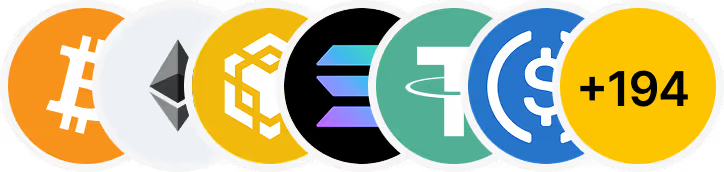
The easiest and most practical way to spend RVN is through CoinBooking. Book hotels and flights up to 30% lower than Booking.com. CoinBooking is a crypto-native travel platform operating across 190+ countries. It connects users to over 2 million hotels and flights globally and accepts 200+ cryptocurrencies, including RVN, alongside traditional payment methods: Visa, Mastercard, Apple Pay, and Google Pay.
Book your next hotel for up to 30% less
New users receive $25 off their first booking, which stacks on top of CoinBooking's existing savings. For Ravencoin holders, this use case transforms RVN from a speculative asset into one with immediate utility: the ability to spend your holdings on travel without conversion friction.
2. Create and tokenize digital assets
The primary technical use of RVN is creating tokenized assets on the Ravenchain. A developer can tokenize real estate by issuing property deeds as RVN-based tokens. A company can tokenize equity as security tokens. An artist can tokenize digital work. A logistics company can tokenize shipment tracking as NFT-like assets. Once created, these tokens are transferred peer-to-peer instantly, secured by the blockchain, and never at risk of accidental destruction.
3. Mine RVN for rewards
Anyone with a capable graphics processing unit (GPU) can participate in Ravencoin mining. The network currently rewards miners with 1,250 RVN per block (as of the January 2026 halving), incentivizing network security. Unlike Bitcoin mining, which requires expensive ASIC hardware, Ravencoin mining remains accessible to ordinary participants using consumer-grade GPUs. Mining difficulty adjusts automatically, so rewards stay competitive regardless of network size.
4. Trade RVN on major exchanges
RVN is freely traded on Binance, Huobi Global, OKEx, ZG.com, VCC Exchange, and other venues. It trades against fiat currencies, stablecoins like USDT, and other cryptocurrencies. Daily trading volume typically ranges from millions of dollars, providing liquidity for traders and investors who want to enter or exit positions.
5. Transfer assets peer-to-peer
Once an asset is created on Ravencoin, holders can transfer ownership instantly to others without intermediaries. A property owner can transfer a tokenized deed directly to a buyer. A shareholder can transfer equity tokens to an investor. Transfers settle on-chain within minutes, eliminating delays and third-party risk.
Is Ravencoin a Good Investment?
Whether RVN is a good investment depends on your risk tolerance and your view of asset tokenization on blockchain as a category. The bull case is concrete: Ravencoin solves a real problem in asset creation and transfer, has the longest track record in tokenized assets, launched fairly with no founder premine, and operates a secure, decentralized mining network. Real-world adoption exists; tokenized assets for real estate, securities, and digital property have been created on Ravencoin since its launch. The fixed 21 billion supply ensures scarcity, the one-minute block time keeps settlement fast, and the network has survived multiple market cycles.
The risks are just as concrete. RVN trades roughly 98% below its 2021 all-time high of $0.2854. Competitors pursuing the same asset tokenization narrative are increasingly funded and vocal in marketing. The 2020 security incident exposed vulnerabilities when attackers minted 315 million RVN coins (about 1.5% of the supply cap), though the network has since patched the exploit, and no user funds were lost. Broader adoption of real-world asset tokenization remains slow compared to the hype cycle, and regulatory frameworks around tokenized securities are still taking shape.
This is not financial advice. Crypto is volatile. Always do your own research and never invest more than you can afford to lose.
FAQs
1. Is Ravencoin a good investment?
Ravencoin solves a real problem in asset tokenization with a fair, decentralized approach. However, RVN remains a volatile small-cap coin trading far below its all-time high. Treat it as a high-risk asset and do your own research before buying.
2. What is Ravencoin?
Ravencoin is a blockchain designed specifically for creating and transferring digital assets peer-to-peer. It allows users to tokenize anything from real estate to intellectual property without the risk of accidental destruction.
3. Who created Ravencoin?
Ravencoin was created by Bruce Fenton, Tron Black, and Joel Weight. All three are experienced developers and business leaders with decades of professional background in software, finance, and blockchain technology.
4. Can you mine Ravencoin?
Yes. Anyone with a capable GPU can mine RVN using the KAWPOW algorithm. The network currently rewards miners with 1,250 RVN per block (following the January 2026 halving), and mining difficulty adjusts to keep rewards competitive as more miners join.
5. Where can you buy RVN?
RVN is available on major exchanges including Binance, Huobi Global, OKEx, ZG.com, and VCC Exchange. It trades against USD, USDT, BTC, and other pairs.
6. What is the max supply of RVN?
RVN has a maximum supply of 21 billion coins. As of July 2026, approximately 16.27 billion coins are in circulation, meaning about 77.5% of the total supply has been mined.
7. How fast are Ravencoin transactions?
Ravencoin blocks are mined every one minute, making settlements significantly faster than Bitcoin's ten-minute block time. Asset transfers typically confirm within minutes.
8. Is Ravencoin secure?
Ravencoin is secured by a decentralized proof-of-work mining network using the KAWPOW algorithm. The network uses the same cryptographic security model as Bitcoin, enhanced for asset-specific operations.

Saira Parveen is a Dubai-based SEO content writer with a background in digital marketing and search visibility. She covers cryptocurrency adoption, travel booking with digital assets, and the practical side of spending crypto in everyday life.
Her work at CoinBooking focuses on helping readers navigate the intersection of crypto and travel, from finding the best rates on hotels and flights to understanding how to pay for travel with digital assets.
Found a hotel you like? Book it for up to 30% less

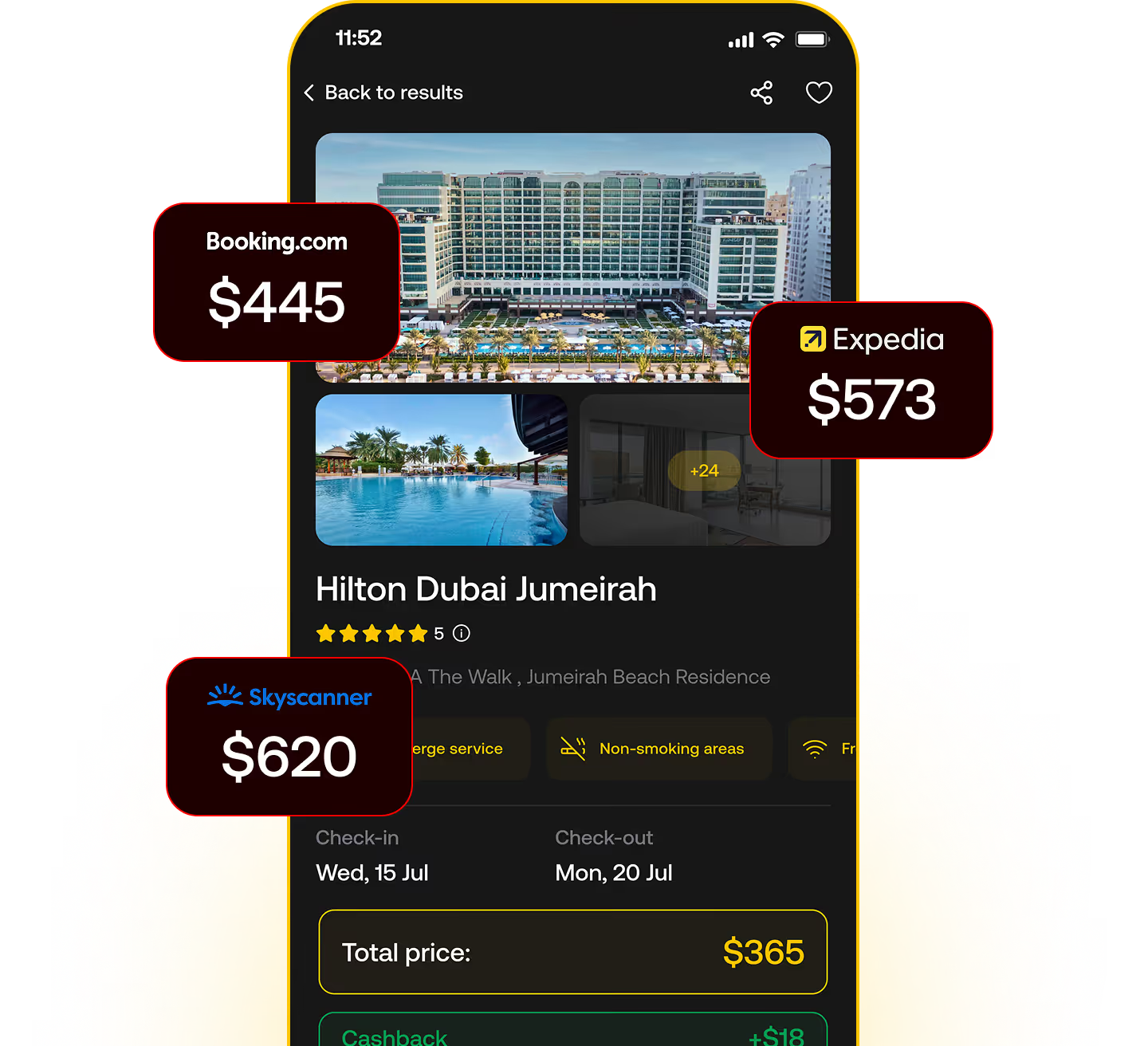
Found a hotel you like? Book it for up to 30% less