.avif)
.avif)

.png)

Content
What is Sonic? Top 5 Ways to Use Sonic Crypto Coin in 2026

Sonic (S) is a high-performance Layer-1 cryptocurrency built on a Directed Acyclic Graph (DAG) architecture. It is the next evolution of the Fantom network, designed to make blockchain transactions much faster and more efficient. With sub-second transaction finality, Sonic can handle up to 10,000 transactions per second (TPS) and supports more than 180 million transactions every day, making it one of the fastest blockchain networks available.
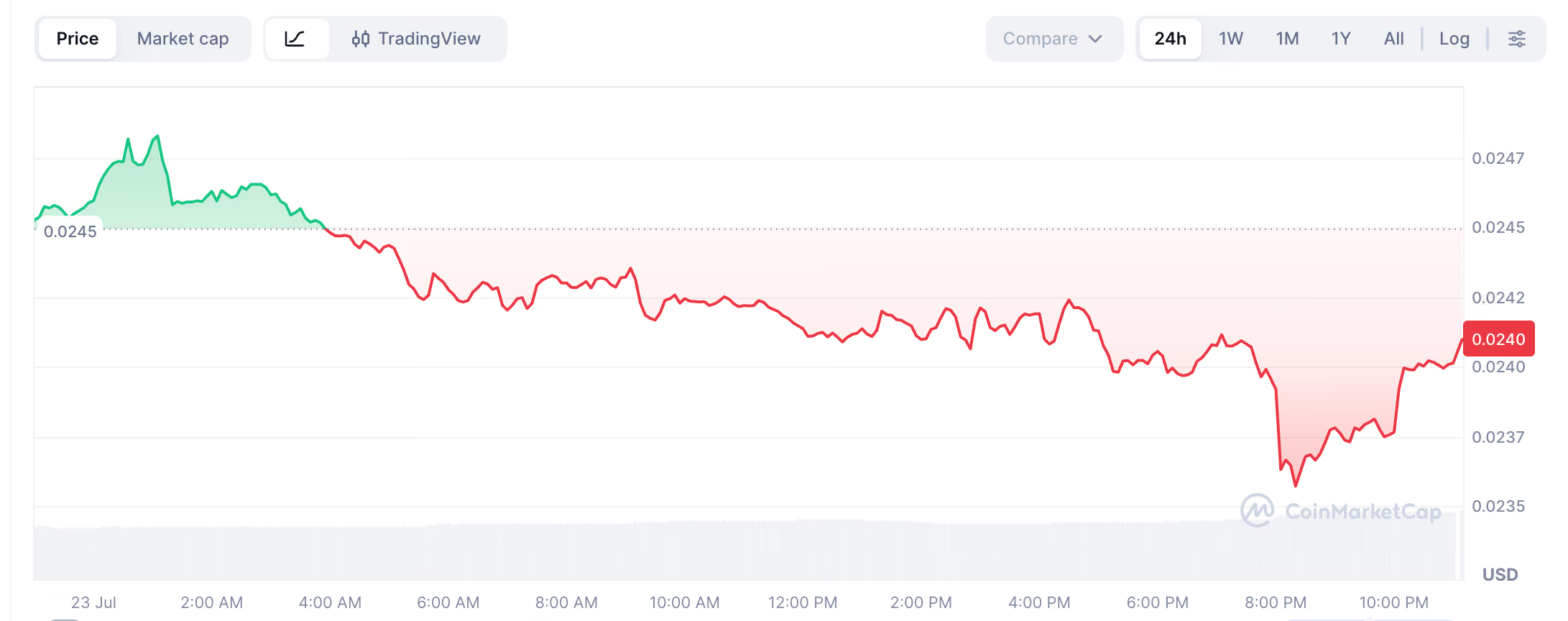
As of July 2026, Sonic (S) is trading at $0.024, with a market capitalization of around $69 million, placing it among the top 301 cryptocurrencies in the world. While many people buy and hold Sonic as an investment, the token also has real-world uses. You can use Sonic (S) across decentralized applications (dApps), DeFi services, and even to book discounted hotels and flights worldwide through CoinBooking.
See how much you
could save with $S
Answer 2 questions to get your personalized
savings estimate.
Question 1 of 2
Where do you want to go?
Question 2 of 2
How many nights?
Your result
Get similar deals when we go live.
Get $25 off your first trip.
Key Takeaways
- Sonic (S) is the upgraded version of the Fantom Opera network. Existing FTM holders can swap their tokens to S at a 1:1 ratio, while benefiting from faster transactions and lower storage requirements.
- Powered by the Lachesis aBFT consensus engine and SonicDB, the network delivers sub-second transaction finality and can process up to 10,000 transactions per second (TPS).
- Sonic's Fee Monetization (FeeM) system lets developers earn up to 90% of the gas fees generated by users of their decentralized applications (dApps).
- The Sonic Gateway is a secure, trustless bridge that allows assets and liquidity to move easily between Ethereum and the Sonic network.
- You can use Sonic (S) to book over 2 million hotels and flights on CoinBooking, often at prices up to 30% lower than Booking.com and Expedia. New users also get $25 off their first booking.
Sonic (S) at a Glance (July 2026)
What is Sonic (S) Crypto Coin?
Sonic (S) is an EVM-compatible Layer-1 blockchain built to deliver high speeds, better rewards for developers, and lower storage requirements. It is the next generation of the Fantom Opera network, which was upgraded in late 2024. Using an advanced Directed Acyclic Graph (DAG) architecture, Sonic can process up to 10,000 transactions per second (TPS) with sub-second finality, making it one of the fastest blockchain networks available.
The original Fantom Opera network became one of the first major hubs for decentralized finance (DeFi). As the ecosystem grew, the team realized that wider Web3 adoption would require major improvements in storage efficiency, gas fee distribution, and Ethereum compatibility. To achieve this, they secured strategic funding in May 2024 and launched Sonic Labs, formerly known as the Fantom Foundation. Led by ex CEO Michael Kong and well-known DeFi developer Andre Cronje, Sonic was built from the ground up to solve common Layer-1 blockchain problems such as state bloat (where blockchain data grows too large over time) and transaction bottlenecks.
Existing Fantom (FTM) holders can easily migrate their tokens to the new Sonic (S) token through a 1:1 token swap. Because Sonic is fully Ethereum Virtual Machine (EVM) compatible, developers can move Ethereum-based smart contracts to the network without rewriting their code. Combined with its custom storage engine, this gives developers access to much faster transaction speeds and gas fees that cost only a fraction of a cent.
How Does Sonic Work?
Sonic is built to handle a huge number of transactions without slowing down. It achieves this through four key technologies that work together to make the network fast, efficient, and developer-friendly.
1. Lachesis aBFT Consensus Engine: At the core of Sonic is the Lachesis Asynchronous Byzantine Fault Tolerance (aBFT) consensus engine, which uses Directed Acyclic Graph (DAG) technology. Unlike traditional blockchains that process blocks one after another, Sonic allows network nodes to process and validate transaction events independently. This means multiple transactions can be confirmed at the same time instead of waiting in a queue, enabling sub-second finality and transaction speeds of up to 10,000 TPS.
2. SonicDB (Storage Optimization): One of the biggest challenges for Layer-1 blockchains is state bloat, where the blockchain's data keeps growing, making validator nodes expensive to run. Sonic solves this with SonicDB, a custom storage engine that reduces database read and write operations and cuts validator storage requirements by more than 60%. This allows validators to operate on lighter hardware while keeping transaction costs extremely low, with gas fees starting at around $0.001 per transaction.
3. The Sonic Gateway: Sonic includes a built-in, trustless Layer-2 bridge that connects directly to Ethereum. Called the Sonic Gateway, it lets users transfer ERC-20 tokens between Ethereum and Sonic in just a few minutes instead of several hours, while still benefiting from Ethereum's base-layer security.
4. Fee Monetization (FeeM): Sonic also introduces an innovative Fee Monetization (FeeM) system. Instead of all gas fees going only to validators, developers can earn up to 90% of the transaction fees generated by users of their decentralized applications (dApps). It's similar to how content creators earn a share of advertising revenue based on the traffic they generate, giving developers a strong financial incentive to build and grow applications on the Sonic network.
Top 5 Ways to Use Sonic Crypto Coin in 2026
1. Book Discounted Hotels and Flights Worldwide with Sonic on CoinBooking (Up to 30% Off)
%20(1).avif)
The most practical real-world use of Sonic ($S) in 2026 is using it to pay for travel through CoinBooking. Instead of keeping your crypto locked in a Web3 wallet or paying expensive conversion fees to turn your tokens into fiat currency, Sonic holders can directly use their assets to book hotels and flights around the world.
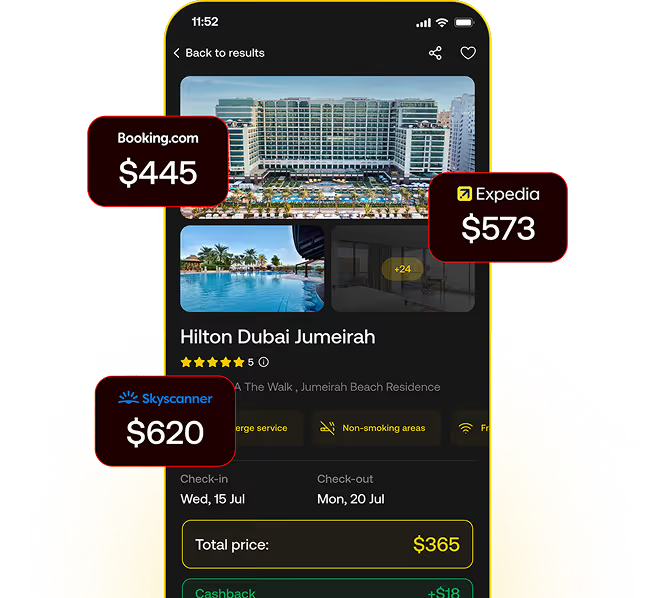
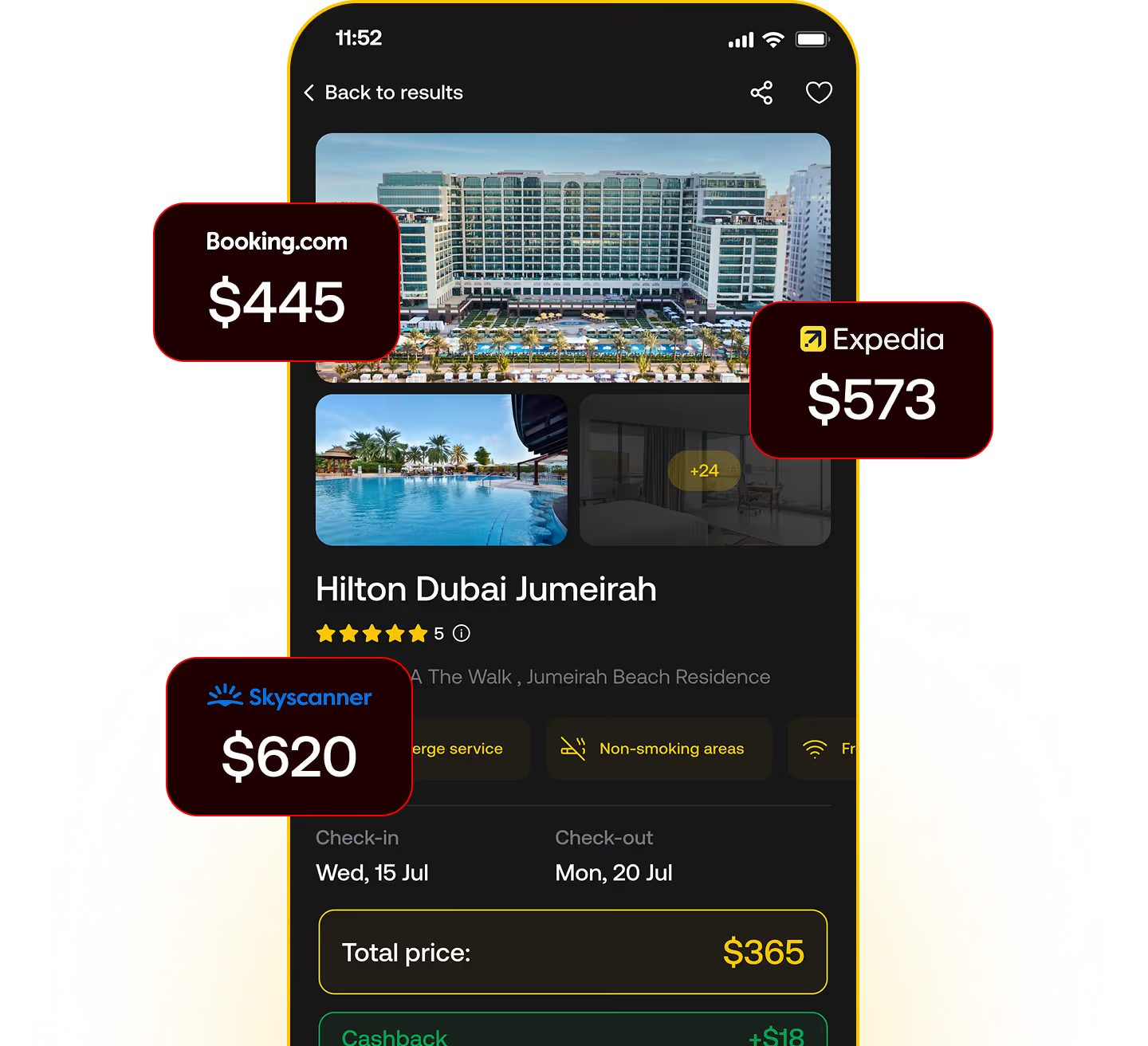
CoinBooking is a Dubai-licensed crypto travel platform that connects Web3 payments with global travel. It has access to more than 2 million hotels, resorts, and vacation rentals across 190+ countries, along with flights from major international airlines. By accepting direct cryptocurrency payments and reducing unnecessary intermediaries, CoinBooking provides travelers with accommodation prices that can be up to 30% cheaper than Booking.com and Expedia.
Using Sonic ($S) on CoinBooking offers several advantages. Sonic's sub-second transaction speeds and low gas fees make payments fast and affordable, allowing travelers to complete bookings almost instantly without waiting for long blockchain confirmations. Along with Sonic, CoinBooking supports more than 200 cryptocurrencies as well as traditional payment options like Google Pay, Apple Pay, Visa, and Mastercard, giving users greater flexibility when paying for their trips.
Book your next hotel for up to 30% less
New CoinBooking users can also receive an exclusive $25 discount on their first booking, helping make vacations, business trips, or future travel plans more affordable. To book a trip with Sonic, simply visit CoinBooking, choose your destination, select your preferred hotel or flight, select Sonic ($S) at checkout, and approve the payment directly from your Web3 wallet.
2. Staking S to Secure the Network and Earn Yield
Another major use case for Sonic ($S) is staking, which allows long-term holders to earn rewards while helping secure the network. By staking Sonic tokens with trusted network validators, users contribute to the security and stability of the Lachesis aBFT consensus mechanism that powers the Sonic blockchain.
When you stake your $S tokens, you are essentially supporting validators that confirm transactions and maintain the network. In return for locking up your tokens and participating in network security, you can earn staking rewards generated from transaction fees and network emissions. This creates an opportunity for holders to earn additional income instead of simply keeping their tokens unused in a wallet.
Sonic staking can be managed through official Web3 wallets, liquid staking platforms, or supported non-custodial wallet applications, giving users different options depending on their preferred level of flexibility and control.
3. Participating in Decentralized Finance (DeFi) & Liquidity Pools
Another important use case for Sonic ($S) is participating in decentralized finance (DeFi). Thanks to its EVM compatibility, high speed, and low transaction costs, Sonic has become a suitable environment for fast and efficient DeFi applications.
Sonic holders can use their $S tokens in different DeFi activities, such as providing liquidity to automated market maker (AMM) pools, lending assets through decentralized money markets to earn interest, or participating in yield farming opportunities across decentralized exchanges built on the Sonic network. These options allow users to put their crypto assets to work instead of simply holding them.
With sub-second transaction finality, Sonic helps improve the DeFi experience by making token swaps faster and more reliable. The network's speed also reduces price slippage during trades and helps minimize risks like front-running, which can occur on slower blockchain networks where transactions take longer to confirm.
4. Monetizing Web3 Applications via Fee Monetization (FeeM)
For Web3 developers and application creators, Sonic ($S) offers a unique way to generate revenue through its Fee Monetization (FeeM) system. Instead of relying only on external funding, token incentives, or traditional business models, developers building on Sonic can earn directly from the activity their applications generate.
By deploying smart contracts on the Sonic network and attracting users to their decentralized applications (dApps), developers can receive up to 90% of the gas fees created by their users' transactions. This creates a sustainable income stream based on actual network usage, rewarding developers for building useful applications and growing the Sonic ecosystem.
FeeM gives Web3 builders a stronger financial incentive to create long-term projects on Sonic, as successful dApps can generate continuous revenue from user activity without depending heavily on venture capital funding or excessive token inflation.
5. Ecosystem Governance & Voting Rights
Another key use of Sonic ($S) is participating in the network's governance system. As a decentralized blockchain, Sonic gives its community a role in making important decisions about the future direction of the ecosystem.
By holding native $S tokens, users gain governance rights that allow them to participate in decision-making processes. Token holders can submit and vote on Sonic Improvement Proposals (SIPs), which help shape changes related to network upgrades, protocol parameters, treasury allocations, and ecosystem development.
Through governance participation, the Sonic community can influence important areas such as incentive distribution, bridge security settings, and future technology updates, ensuring that the network continues to evolve based on the needs and priorities of its users and developers.
Is Sonic (S) Crypto Coin a Good Investment?
Whether Sonic ($S) is a good investment depends on your personal risk tolerance, investment goals, and confidence in the long-term growth of Layer-1 blockchain infrastructure. Like any cryptocurrency, Sonic has potential growth opportunities, but it also comes with risks that investors should carefully consider before making a decision.
Sonic has several factors that could support its long-term potential. The project builds on the foundation of Fantom, one of the more established and battle-tested DeFi ecosystems in the crypto industry. Its technical performance is another major advantage, with the ability to process up to 10,000 transactions per second (TPS), achieve sub-second finality, and maintain extremely low transaction fees.
Another important growth driver is Sonic's focus on developers. Through its Fee Monetization (FeeM) model, developers can earn up to 90% of the gas fees generated by their decentralized applications, creating a strong incentive for builders to launch and grow projects on the network. Sonic also has real-world utility beyond speculation, with integrations such as CoinBooking, where users can use Sonic ($S) to book hotels and flights globally.
However, Sonic also faces challenges. The Layer-1 blockchain market is highly competitive, with established networks such as Solana, Avalanche, Sui, and Aptos, along with Ethereum Layer-2 solutions, competing for developers, users, and liquidity. Sonic's long-term success will also depend on how effectively it attracts users, developers, and capital during the transition from the previous Fantom ecosystem.
Cryptocurrency investments involve significant market volatility and financial risk. This content is provided for informational purposes only and should not be considered financial or investment advice. Always conduct your own research (DYOR) before investing in any digital asset.
Frequently Asked Questions (FAQs)
1. What is Sonic crypto Coin?
Sonic ($S) is the native token of the Sonic Layer-1 blockchain, formerly known as Fantom Opera. The network was rebuilt to solve issues like blockchain state bloat while improving speed, efficiency, and scalability through its DAG architecture and SonicDB storage system.
2. Is Sonic a good crypto?
Whether Sonic ($S) is a good cryptocurrency depends on your investment goals and risk tolerance. From a technology perspective, Sonic has strong fundamentals as the upgraded version of Fantom Opera, featuring a DAG-based aBFT consensus system capable of processing up to 10,000 TPS with sub-second finality. Its Fee Monetization (FeeM) model, which allows developers to earn up to 90% of dApp gas fees, also creates incentives for ecosystem growth. However, like all cryptocurrencies, Sonic carries market risks and faces competition from other high-speed Layer-1 networks.
3. Can Sonic coin reach $1?
Sonic ($S) could potentially reach $1 in future market cycles, but this depends on factors such as overall crypto market conditions, ecosystem growth, and user adoption. Experts project that Sonic crypto could reach a maximum price of $1.33 (+155%) per coin, while even at its estimated minimum, it is expected to hold above $1 at $1.11 (+115%).
4. What is Sonic coin price prediction?
Sonic ($S) price predictions vary depending on market conditions, adoption, and overall crypto sentiment. At its current levels, analysts expect relatively slow growth in the near term, with some forecasts estimating a price range of around $0.025 to $0.040 by 2027. Long-term projections are more optimistic, with models suggesting Sonic could potentially trade between $0.03 and $0.28 by 2030 if the ecosystem continues to grow and adoption increases.
5. Where can I buy Sonic (S) tokens?
Sonic ($S) is available on several major cryptocurrency exchanges, including Binance, Coinbase, OKX, ByBit, Bitget, Gate, KuCoin, Crypto.com and Kraken. It can also be traded through decentralized exchanges operating within the Sonic ecosystem.
6. Can I use Sonic ($S) to book travel and hotels?
Yes. Sonic ($S) can be used directly on CoinBooking to pay for more than 2 million hotels and flights worldwide. CoinBooking allows travelers to use crypto for global bookings while offering rates that can be up to 30% cheaper than Booking.com and Expedia, along with no foreign currency conversion fees and an exclusive $25 discount on the first booking for new users.

Saira Parveen is a Dubai-based SEO content writer with a background in digital marketing and search visibility. She covers cryptocurrency adoption, travel booking with digital assets, and the practical side of spending crypto in everyday life.
Her work at CoinBooking focuses on helping readers navigate the intersection of crypto and travel, from finding the best rates on hotels and flights to understanding how to pay for travel with digital assets.
Found a hotel you like? Book it for up to 30% less

Found a hotel you like? Book it for up to 30% less