.avif)
.avif)

.png)

Content
What Is Threshold Crypto Coin (T)? Top 5 Ways to Use It in 2026

Threshold (T) is a crypto coin that powers tBTC, a decentralized bridge bringing Bitcoin into Ethereum, Arbitrum, Sui, and other blockchains without requiring a custodian. You send Bitcoin to a network-generated deposit address and receive tBTC 1:1, giving you a tokenized version to use across DeFi protocols and real-world services. On CoinBooking, you can spend T or tBTC directly on hotels and flights.
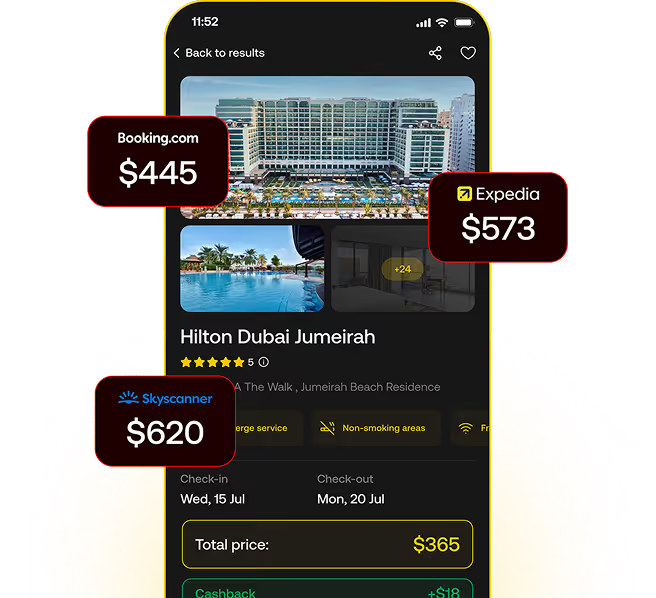
At the time of writing (August 2026), T trades near $0.003540, with a market capitalisation of roughly $39.5 million and a rank of #404 on CoinMarketCap. Beyond speculation, T has practical utility across governance participation, offsetting tBTC bridge fees, and supporting the network that bridges Bitcoin for DeFi use. For travellers who already hold T or tBTC, CoinBooking lets you book hotels and flights directly with crypto, with up to 30% savings compared to Booking.com and Expedia and a $25 discount on your first booking upon sign-up.
See how much you
could save with $T
Answer 2 questions to get your personalized
savings estimate.
Question 1 of 2
Where do you want to go?
Question 2 of 2
How many nights?
Your result
Get similar deals when we go live.
Get $25 off your first trip.
Key Takeaways
- Threshold emerged from the on-chain merger of Keep Network and NuCypher on January 1, 2022, combining their cryptographic expertise into a single network and introducing the T token.
- tBTC is a decentralized, 1:1 Bitcoin-backed token secured by a distributed network of nodes, not by a centralized custodian.
- Threshold uses threshold cryptography to distribute control across nodes, requiring a majority to cooperate to mint or redeem tBTC.
- Book hotels and flights with T or tBTC on CoinBooking at up to 30% below Booking.com prices. First-time users receive $25 off.
- T token holders govern the network through the Threshold DAO via on-chain voting, with day-to-day protocol development handled by Threshold Labs since February 2025.
Threshold at a Glance (August 2026)
What Is Threshold Network?
Threshold Network is a decentralized protocol created by the merger of Keep Network and NuCypher on January 1, 2022. The network enables Bitcoin to be used in decentralized finance without centralized custodians.
Most Bitcoin in DeFi today relies on centralized custodians like Wrapped Bitcoin (WBTC), which require trusting a company to hold your Bitcoin and mint the token. Threshold provides a decentralized alternative that has never lost user funds since the 2022 merger, though it has patched several disclosed vulnerabilities along the way.
tBTC is a 1:1 Bitcoin-backed token secured by a distributed network of independent nodes using threshold cryptography across 10+ blockchains: Ethereum, Arbitrum, Optimism, Base, Polygon, Solana, Sui, Starknet, BOB, and Mezo. When you deposit Bitcoin, the network collectively mints tBTC without any single entity controlling the underlying Bitcoin. When you redeem, you burn tBTC and receive native Bitcoin directly to your wallet. As of August 2026, tBTC has approximately 4,767 tokens in circulation, worth roughly $310 million. At its Q1 2026 peak, tBTC supply reached 5,900 with $481 million in DeFi TVL, led by Aave V3 ($138M), Curve ($71M), and YieldBasis ($66M).
Both minting and redeeming tBTC carry a 0.2% fee (20 basis points). The mint fee was waived to support early adoption and was reinstated on 15 April 2026 following a governance vote. T token holders can offset both fees: for every 100,000 T locked, users can waive up to 0.001 tBTC in fees over a rolling 30-day window.
The network is governed by the Threshold DAO, where T token holders vote on protocol parameters, fee structures, treasury allocation, and strategic direction. Signer node operators stake T to secure the tBTC bridge. A 51-of-100 threshold signature model ensures no single node operator can unilaterally control Bitcoin reserves. Signers are selected from a sortition pool weighted by staked T, and wallets rotate roughly every 14 days.
How Does Threshold Network Work?
Threshold uses threshold cryptography to eliminate single points of control. The network's nodes each hold a cryptographic share of the signing key. A predefined majority of nodes (51 out of 100) must cooperate to approve actions like minting or redeeming tBTC. One node acting alone cannot execute transactions.
The deposit and minting process works in three steps:
- A user visits app.threshold.network/bridge and generates a unique Bitcoin deposit address, then downloads a JSON receipt file (required to recover funds if issues occur).
- The user sends Bitcoin (minimum 0.01 BTC) to the generated deposit address from their own Bitcoin wallet and signs a confirmation transaction in their Ethereum wallet (or other supported chain).
- The user receives 1 tBTC for every 1 BTC deposited. Minting currently takes around 6-7 hours: Threshold paused its optimistic minting mechanism in May 2026 after a failed attack attempt, so deposits now route through the slower sweeping process. Minting carries a 0.2% fee, reinstated in April 2026. Upgrades in November 2025 introduced gasless and direct minting, letting users mint straight to a chosen chain from a single BTC deposit.
Once received, tBTC can be traded, loaned, farmed in DeFi protocols, or spent directly on CoinBooking for travel bookings.
Redemption reverses the process: A user burns tBTC in their wallet, the majority of nodes approves the withdrawal (0.2% fee, waivable for T stakers), and native Bitcoin is returned to the user's wallet, typically within several hours.
Cross-chain flexibility: Since the November 2025 upgrade, you can mint tBTC directly to Arbitrum, Base, Solana, or any supported chain from a single Bitcoin deposit, with no Ethereum round-trip required. tBTC uses a canonical token deployed on each chain rather than generic third-party bridge wrappers, maintaining the same 1:1 Bitcoin backing across all chains.
T is the network's utility and governance token. Signer node operators stake T to participate in the permissioned signer set. T holders vote in the Threshold DAO by delegating their token weight, and staking is not required to vote. Every 100,000 T locked unlocks 0.001 tBTC in mint and redemption fee waivers over a rolling 30-day window, creating direct utility for holders who use the bridge.
Top 5 Ways to Use Threshold Crypto Coin (T)
1. Book hotels and flights with Threshold (T) on CoinBooking
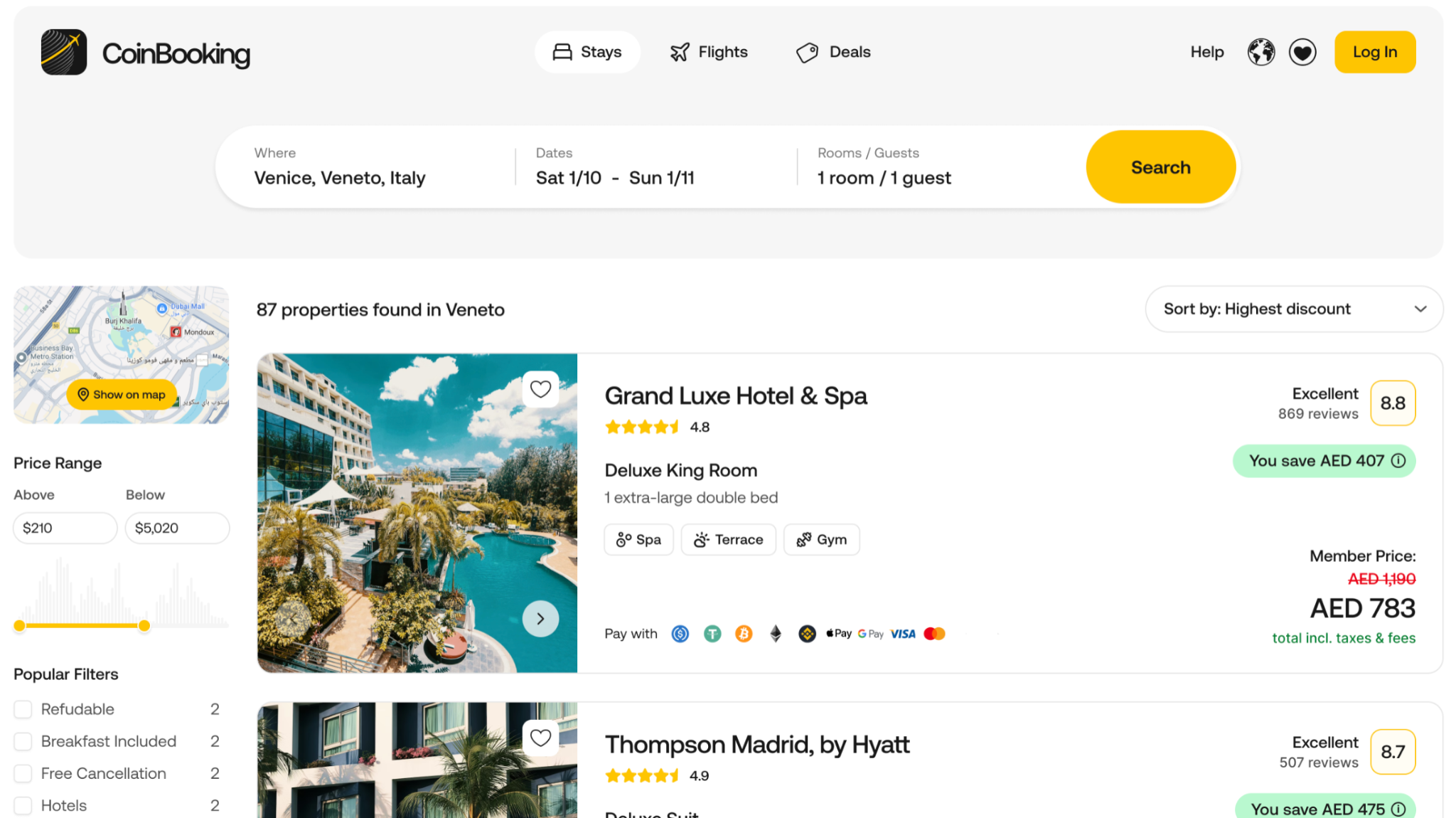
The most practical way to use Threshold is booking travel on CoinBooking. You can book hotels and flights with T and tBTC on CoinBooking, at up to 30% below Booking.com prices. CoinBooking, a Dubai-licensed platform accepting 200+ cryptocurrencies, including T and tBTC. Use T to book hotels and flights at up to 30% below Booking.com prices. First-time users receive $25 off their first booking.
Book your next hotel for up to 30% less
2. Bridge Bitcoin into DeFi and earn yield
If you hold Bitcoin and want DeFi yield without trusting a custodian, deposit BTC to mint tBTC. Use tBTC on protocols like Aave, Curve, and YieldBasis to farm yield, provide liquidity, or borrow against your Bitcoin while maintaining self-custody.
Unlike Wrapped Bitcoin (WBTC), which requires trusting a custodian company, tBTC is decentralized. No single entity controls it. The network is secured by distributed nodes, not a company.
3. Lock T to offset tBTC bridge fees
T holders can lock their tokens to offset tBTC bridge fees. Every 100,000 T locked waives up to 0.001 tBTC in mint and redemption fees over a rolling 30-day window, a direct discount on fees you would otherwise pay rather than a share of protocol revenue.
Locked T is subject to a 30-day rolling lock plus a 30-day cooldown before tokens can be withdrawn. Threshold ended staking emissions in February 2025 under TIP-092, so there is no APY and no periodic reward distribution. Running a tBTC signer node is separate and not open to all: the signer set is permissioned, and professional staking providers must request DAO approval to join.
4. Participate in Threshold DAO governance
T holders vote in the Threshold DAO by delegating their token weight, either to themselves or to a third party, and staking is not required. Token holders vote on protocol upgrades, fee structures, treasury spending, and strategic direction. Proposals require 0.25% of supply to submit, a 10-day vote, and 1.5% quorum, followed by a two-day timelock.
The DAO has decided protocol parameters, fee activation, and network priorities since the 2022 merger. Two limits are worth knowing: the elected Threshold Committee can veto on-chain proposals, and tBTC Guardians can pause optimistic minting unilaterally, a power exercised in May 2026 without a preceding vote.
5. Trade T on major exchanges
T trades across roughly 50-70 market pairs on around 30-50 exchanges, including Binance, Coinbase, OKX, Upbit, Gate, KuCoin, Bitget, MEXC, HTX, Kraken, and Paribu, as well as on-chain via Curve. Trading pairs include T/USDT, T/USD, T/KRW, T/TRY, and WETH/T. Daily volume varies based on market conditions, with Paribu (T/TRY), Binance, HTX, and Upbit typically showing the highest liquidity.
T typically moves with the broader crypto market and the decentralized Bitcoin bridge narrative. As tBTC adoption grows, network fees increase, attracting more traders seeking exposure to decentralized Bitcoin infrastructure.
Is Threshold a Good Investment?
Whether T is a good investment depends on your risk tolerance and conviction in decentralized Bitcoin bridges. The case for T is built on tBTC utility: if Bitcoin DeFi grows, demand for a decentralized bridge increases, which grows network fees that now fund token buybacks.
The risks are substantial. T trades roughly 98.4% below its 2022 all-time high of $0.2245. The network faces competition from centralized bridges (WBTC holds roughly $7.4 billion in TVL and Coinbase's cbBTC around $5.9 billion, against tBTC's ~$310 million) as well as from other decentralized solutions. tBTC adoption remains small relative to total Bitcoin supply. The regulatory environment for tokenized Bitcoin is uncertain. Threshold is young (launched January 2022), and distributed node systems require continuous security audits.
Threshold restructured substantially in 2025: the protocol narrowed to a tBTC-only focus, its TACo product was spun out as an independent protocol, thUSD moved to maintenance mode, and day-to-day development passed to Threshold Labs. Staking emissions ended in February 2025 and were replaced with fee-funded token buybacks, with an initial buyback of roughly 30 million T completed. Q1 2026 protocol fees annualised to around $712,000, with the DAO projecting roughly $2.3 million now that both mint and redemption fees are active.
Success depends on whether tBTC can scale adoption beyond niche DeFi users to broader institutional and retail markets while maintaining security and decentralization.
This is not financial advice. Crypto is volatile. Always do your own research and never invest more than you can afford to lose.
FAQs
1. What is tBTC?
tBTC is a decentralized, 1:1 Bitcoin-backed token minted by the Threshold network. The underlying Bitcoin is held by a distributed network of independent nodes using threshold cryptography, not by a centralized custodian. This eliminates the single point of failure present in solutions like WBTC.
2. How does threshold cryptography work?
Threshold cryptography splits sensitive operations across multiple independent parties. A predefined threshold must cooperate to approve any action. If one party acts alone or fewer than the threshold cooperate, the operation fails. This ensures no single entity can control tBTC minting, redemption, or the underlying Bitcoin.
3. Can I spend T directly or only tBTC?
T and tBTC are separate assets with no conversion mechanism between them. tBTC is minted only by depositing Bitcoin and redeemed only for Bitcoin, and it is the asset used in DeFi lending, liquidity pools, and yield farming. T is used for governance and for offsetting tBTC bridge fees.
4. Who created Threshold Network?
Threshold Network was created through the merger of Keep Network and NuCypher on January 1, 2022. Both projects had independent communities and tokens (KEEP and NU). The merger unified their cryptographic expertise and governance under a single protocol, represented by the T token.
5. Where can I buy T?
T is available on around 30-50 exchanges globally. Major centralized exchanges include Binance (T/USDT), Coinbase (T/USD), Upbit (T/KRW), OKX (T/USDT), Bitget (T/USDT), Gate (T/USDT), KuCoin (T/USDT), MEXC (T/USDT), HTX (T/USDT), and Kraken (T/USD, T/EUR). On-chain, T trades on Curve (WETH/T on Ethereum). Check CoinMarketCap for the complete list of trading pairs and current liquidity.
6. What is the maximum supply of T?
T has a total supply of 11.155 billion coins, all currently in circulation. The bootstrapping mint that followed the 2022 merger is complete and staking emissions ended in February 2025, so the token is fully diluted with no ongoing issuance and no unlock schedule.
7. Can I stake T without running a node?
You can lock T through the Threshold app to earn tBTC bridge fee waivers without running a node. This is a fee discount rather than a yield-bearing reward, and locked tokens are subject to a 30-day lock plus a 30-day cooldown. Governance voting is separate and does not require locking T at all: liquid holders vote by delegating their token weight.
8. How do I mint tBTC?
Visit app.threshold.network/bridge, connect your Ethereum or other supported chain wallet, and generate a deposit address. Send Bitcoin (minimum 0.01 BTC) from your own wallet to the address provided. Sign the minting transaction in your wallet. Minting currently takes around 6-7 hours while optimistic minting is paused, and carries a 0.2% fee. Always download and save the JSON receipt file during setup to recover your funds if needed.
9. What is the minimum Bitcoin deposit to mint tBTC?
The minimum deposit is 0.01 BTC. There is no maximum limit.
10. How long does minting take?
Minting currently takes around 6-7 hours. Threshold paused its optimistic minting mechanism in May 2026 following a failed attack attempt, so deposits route through the standard sweeping process rather than the faster optimistic path. You can track minting status at https://app.threshold.network/explorer.
11. Can I use tBTC on multiple chains?
Yes. Since November 2025 you can mint tBTC directly to Arbitrum, Base, Solana, Sui, or other supported chains from a single Bitcoin deposit, without an Ethereum round-trip, while maintaining the same 1:1 Bitcoin backing and decentralized security model across all chains.
12. What are the fees to mint and redeem tBTC?
Both minting and redemption cost 0.2% (20 basis points). The mint fee was reinstated on 15 April 2026 after a period of being waived. Both can be offset by staking T: for every 100,000 T locked, you can waive up to 0.001 tBTC in fees over a rolling 30-day window.
13. Is tBTC safe?
tBTC's security is based on threshold cryptography distributing control across independent nodes, with 51 of 100 signers required to cooperate and wallets rotating roughly every 14 days. The network has operated since January 2022 and has undergone twelve security audits, including work by ChainSecurity, CertiK, Least Authority, Zellic, and Certora. It is covered by an Immunefi bug bounty with a maximum payout of $150,000. No user funds have been lost, though several disclosed vulnerabilities have been patched and optimistic minting was paused in May 2026 after a failed attack attempt.
If technical issues occur during minting, your JSON receipt file allows you to recover your Bitcoin. Node operators stake T tokens, ensuring economic incentive for honest behavior.
However, like all cryptocurrency systems, tBTC carries technical and economic risks. Always conduct thorough research and never deposit more Bitcoin than you can afford to lose.

Saira Parveen is a Dubai-based SEO content writer with a background in digital marketing and search visibility. She covers cryptocurrency adoption, travel booking with digital assets, and the practical side of spending crypto in everyday life.
Her work at CoinBooking focuses on helping readers navigate the intersection of crypto and travel, from finding the best rates on hotels and flights to understanding how to pay for travel with digital assets.
Found a hotel you like? Book it for up to 30% less

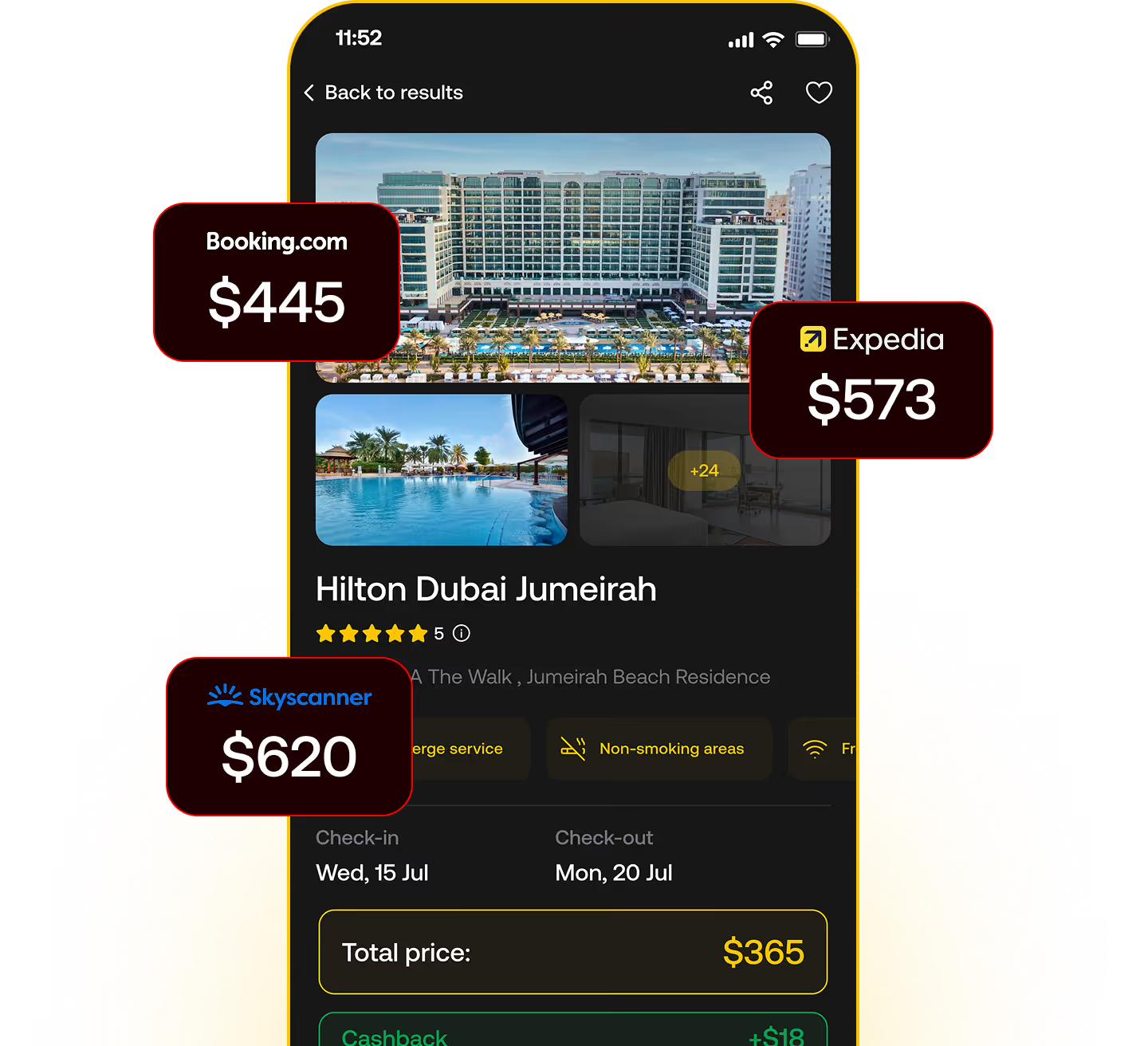
Found a hotel you like? Book it for up to 30% less