.avif)
.avif)

.png)

Content
What Is ZetaChain (ZETA)? Top 5 Ways to Use It in 2026

ZetaChain (ZETA) is a crypto coin powering a Layer 1 blockchain built on Cosmos that focuses on AI interoperability and encrypted private memory for decentralized applications. Launched in 2024 as a cross-chain protocol, ZetaChain pivoted in January 2026 to prioritize AI infrastructure through ZetaChain 2.0, which introduced an AI Portal for routing between multiple AI model providers without vendor lock-in, and a Private Memory Layer that keeps conversation history encrypted and user-owned.
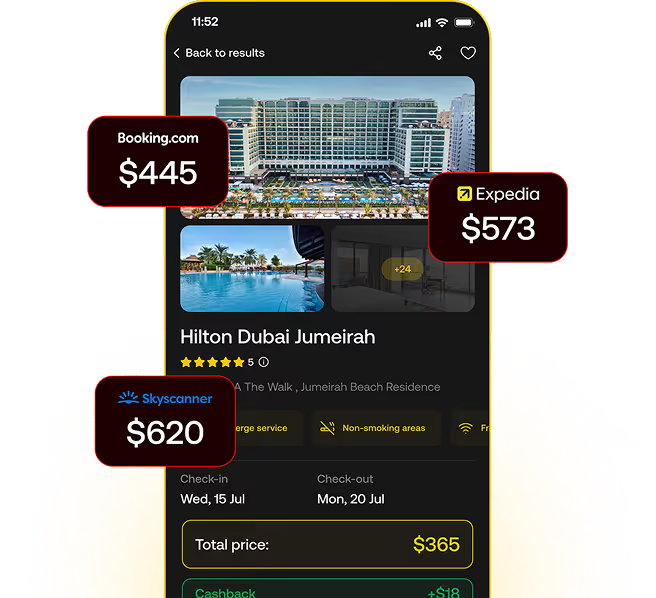
At the time of writing 31 July 2026 (per CoinMarketCap), ZETA trades at $0.02848 USD with a market capitalisation of $42.99 million and a rank of #364. ZETA holders can stake for network validation rewards, lock tokens for AI service credits on the Anuma consumer app, and pay network gas fees. For travellers who already hold ZETA+ or other cryptocurrencies, CoinBooking lets you book hotels and flights, with up to 30% savings compared to Booking.com and Expedia and a $25 discount on your first trip upon sign-up.
See how much you
could save with $ZETA
Answer 2 questions to get your personalized
savings estimate.
Question 1 of 2
Where do you want to go?
Question 2 of 2
How many nights?
Your result
Get similar deals when we go live.
Get $25 off your first trip.
Key Takeaways
- ZetaChain is a Cosmos-based Layer 1 that shifted its core focus from cross-chain interoperability (now sunsetting) to AI interoperability and encrypted private memory for AI applications.
- ZetaChain 2.0, launched 27 January 2026, introduced an AI Portal for multi-provider AI access and a Private Memory Layer that encrypts and persists user context across sessions.
- ZETA is used for staking to secure the network, locking for AI service credits through the Anuma interface (launched April 2026, now at 60,000+ users), and paying gas fees on ZetaChain.
- The project was founded by Ankur Nandwani (ex-Coinbase, BAT co-creator), Panruo Wu (early THORChain contributor), and Brandon Truong, backed by major market makers including Jane Street and GSR.
- The network has been independently audited by Trail of Bits, Zellic, Halborn, Cantina and Veridise, with a public audit contest run by Sherlock in July 2025.
- Book hotels and flights with $ZETA on CoinBooking, at up to 30% below Booking.com prices. Get $25 off your first booking.
ZETA at a Glance (July 2026)
What Is ZetaChain?
ZetaChain is a Layer 1 blockchain designed to provide AI infrastructure and encrypted memory for decentralized applications. The network was originally positioned as a cross-chain interoperability solution, but on 1 June 2026 ZetaChain announced it is sunsetting its cross-chain features (support for Bitcoin, Solana, Arbitrum, Base, BSC, Polygon, Avalanche, Sui, and TON) to focus exclusively on the AI stack.
The current product is AI interoperability: the ability for developers and users to access multiple AI models (GPT, Claude, Gemini, Grok, DeepSeek) through a unified interface, with conversation history and personal context encrypted, permissioned, and user-owned rather than logged by individual AI companies.
The network was founded in August 2023 by Ankur Nandwani (early Coinbase employee and co-creator of Basic Attention Token), Panruo Wu (early THORChain contributor), and Brandon Truong. Its $27M seed round (17 August 2023) was backed by Blockchain.com, Human Capital, Vy Capital, Sky9 Capital, market makers Jane Street and GSR, and angels including Dan Romero, Sam Rosenblum, and John Yi (early Coinbase and Binance employees). Advisors include Nathalie McGrath, Coinbase's first Head of People (scaled the team from 10 to 800+), and Juan Suarez, who served as in-house counsel at Coinbase from 2013 to 2022.
How Does ZetaChain Work?
ZetaChain 2.0 operates as a Proof of Stake blockchain (CometBFT consensus) that provides two core components for AI interoperability:
AI Portal: A unified routing and execution layer that allows applications and end users to access multiple AI model providers without lock-in to any single provider. Developers can build once and let users choose their preferred AI backend; users can switch models without losing context or history.
Private Memory Layer: A protocol-level memory system that is encrypted (client-side AES-GCM), permissioned (users control access), and persistent across sessions and AI models. Unlike traditional AI apps where your conversation history lives on OpenAI's servers or Anthropic's servers, the Private Memory Layer stores encrypted context on-chain, owned by the user and portable across applications.
Anuma is ZetaChain's first-party consumer interface, launched publicly on 27 April 2026. Anuma routes across GPT, Claude, Gemini, Grok and DeepSeek, and crossed 60,000 total users by the time of the 1 June 2026 announcement. Users access Anuma through wallet login, subscriptions, or credit packs purchased with ZETA or fiat.
Top 5 Ways to Use ZetaChain Crypto Coin (ZETA)
1. Book Discounted Hotels and Flights with ZETA on CoinBooking
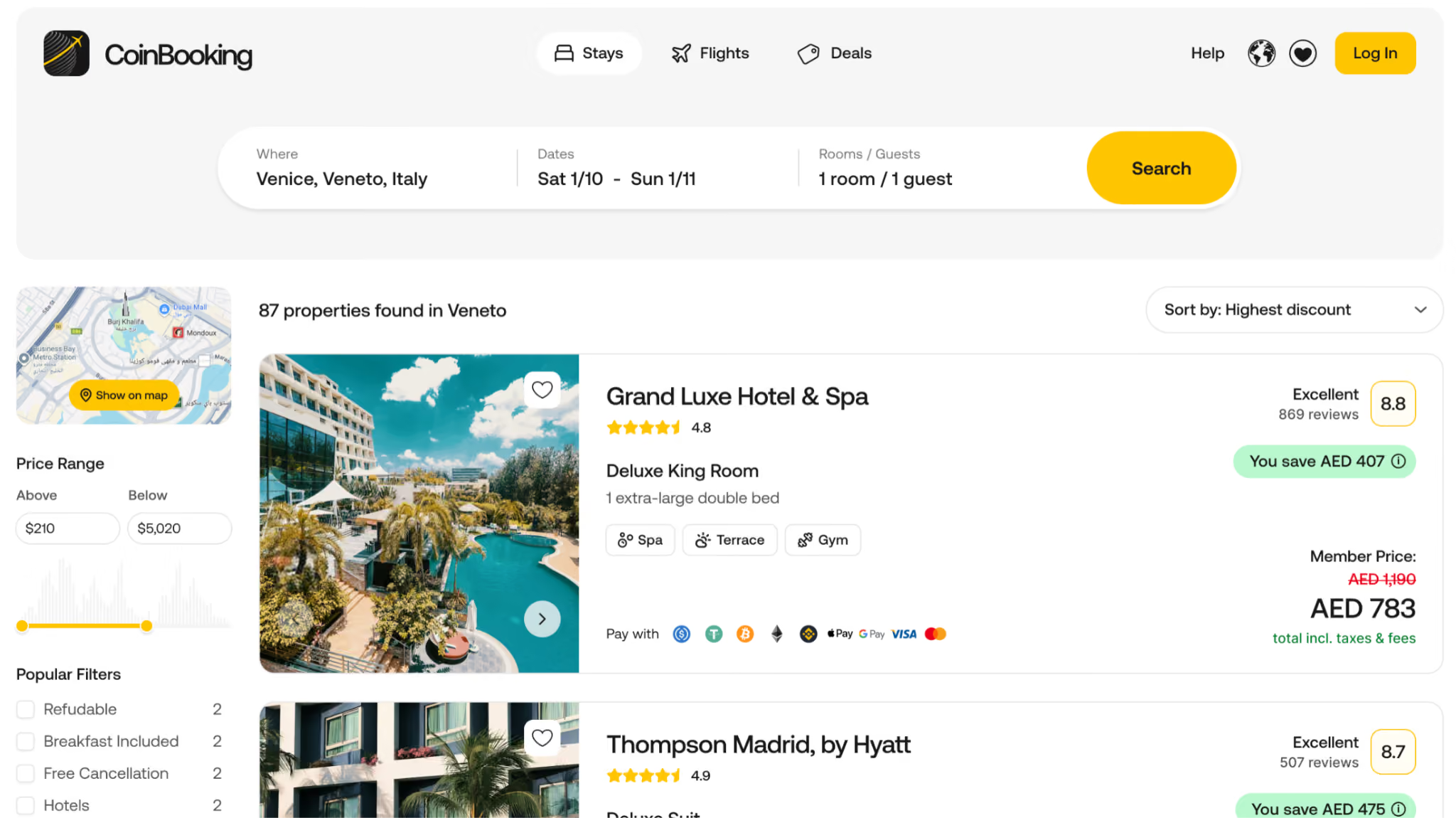
One of the most practical uses of ZETA is booking travel through CoinBooking. The platform has access to more than 2 million hotels and flights across 190+ countries, and you can pay directly with ZETA or 200+ other cryptocurrencies.
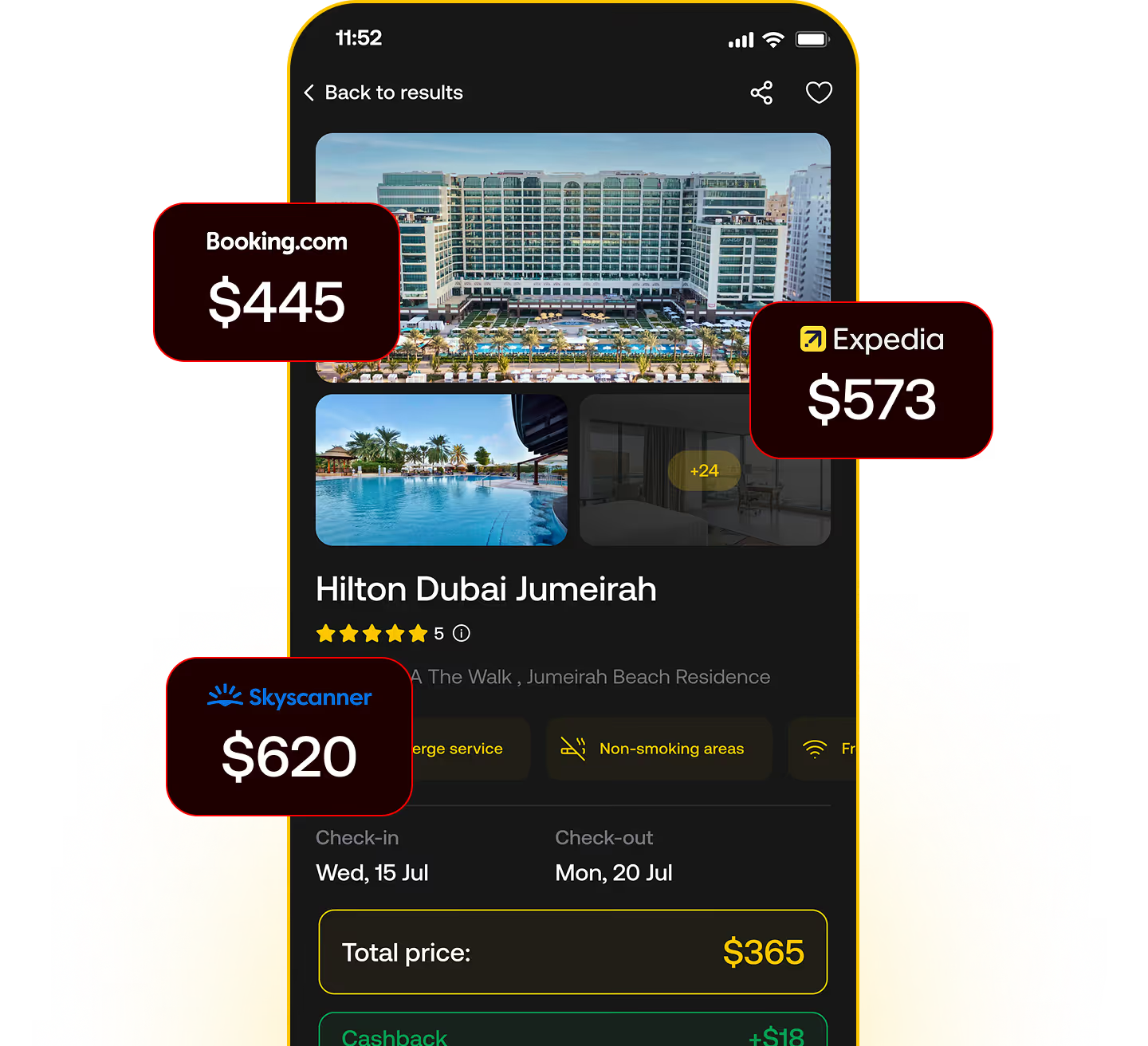
The best part? CoinBooking offers savings of up to 30% compared to Booking.com and Expedia on hotel and flight bookings.
Book your next hotel for up to 30% less
New users also receive a $25 discount on their first booking. This makes CoinBooking an easy way to use your ZETA for real-world purchases.
2. Stake ZETA for Rewards
With ZetaChain 2.0 (launched 27 January 2026) and Anuma (launched 27 April 2026), users can lock ZETA to access private AI services across multiple model providers. Users own their conversation history and context through the Private Memory Layer instead of sharing data with individual AI companies. This use case is live as of June 2026, but remains in growth phase; monitor ZetaChain's official docs for token-utility updates as additional features (decentralized inference, Memory Guardian nodes) move from exploration to mainnet.
3. Use ZETA for Cross-Chain Smart Contracts
Developers and users can pay ZETA to execute transactions and smart contracts on ZetaChain itself. Unlike the cross-chain execution that characterized earlier versions of the protocol, current gas usage is limited to operations on the ZetaChain Layer 1.
4. Lock ZETA for AI Service Credits
ZETA is listed on multiple centralized and decentralized exchanges. Major venues include Coinbase, MEXC, Kraken, Gate.io, and Upbit. As of 31 July 2026, ZETA has $3.65 million in 24-hour trading volume across all venues. Note that ZETA's liquidity is concentrated, with a single mid-tier exchange holding approximately 25% of global trading volume. ZETA is not spot-listed on Binance (Binance offers perpetual futures and Launchpool programs only).
5. Trade ZETA
ZETA token holders participate in governance decisions affecting the protocol, though specific governance mechanisms are still under development. Governance use cases appear in the official token-utility documentation but are not yet live on mainnet.
Is ZetaChain a Good Investment?
Whether ZETA is a good investment depends on your view of AI interoperability and encrypted private memory as investment categories.
The bull case rests on concrete execution. ZetaChain has shipped working AI infrastructure: Anuma (consumer app, 60,000+ users as of April 2026), the Private Memory Layer (encrypted, user-owned conversation history), and the AI Portal (multi-model routing without vendor lock-in). The team includes founder credibility (BAT co-creator, early Coinbase employee, THORChain contributor) and investor credibility (market makers Jane Street and GSR, early Coinbase staff). The network has undergone substantive audits from Trail of Bits, Zellic, Halborn, Cantina and Veridise, plus a public audit contest through Sherlock in July 2025. The Private Memory Layer addresses a real privacy gap in AI infrastructure where users currently have no choice but to log conversations with proprietary vendors.
The risks are equally concrete. ZETA trades approximately 99% below its all-time high of $2.85 (February 2024). The AI interoperability stack is in very early stages; Anuma's 60,000-user figure does not yet establish product-market fit. Competitors including other Cosmos chains and standalone AI infrastructure projects are shipping stacks at similar pace. Governance mechanisms and some token utilities (decentralized inference, Memory Guardian nodes) are documented but not yet shipped on mainnet. On 1 June 2026, ZetaChain announced it would wind down cross-chain interoperability features over the coming months meaning existing validator and bridge infrastructure will be deprecated, introducing operational and network-security complexity during a transition period. The network's ability to scale and retain users against both established AI platforms and other decentralized alternatives remains unproven.
This is not financial advice. Crypto is volatile. Always do your own research and never invest more than you can afford to lose.
FAQs
1. Is ZetaChain a good investment?
ZetaChain has credible founders, substantive audit coverage, and working AI infrastructure (Anuma at 60K users). But it is a small-cap token that recently pivoted entirely away from its original cross-chain positioning, in a competitive AI infrastructure market, with governance and infrastructure features still under development. Treat it as a high-risk bet and do your own research before buying.
2. What is ZetaChain?
ZetaChain is a Cosmos-based Layer 1 focused on AI interoperability and encrypted private memory. Its AI Portal routes across multiple AI model providers without lock-in; its Private Memory Layer encrypts and stores user context on-chain rather than on centralized AI company servers. The network previously offered cross-chain smart contract execution but announced on 1 June 2026 that it is sunsetting those features to focus on AI.
3. Who founded ZetaChain?
ZetaChain was founded by Ankur Nandwani (early Coinbase employee, BAT co-creator), Panruo Wu (early THORChain contributor), and Brandon Truong. The project is backed by market makers Jane Street and GSR, and early Coinbase and Binance employees including Dan Romero, Sam Rosenblum, and John Yi.
4. Can you spend ZETA on real things?
ZETA is primarily used on-chain for staking, gas fees, and locking for AI service credits on Anuma. It is also traded actively on major exchanges (Coinbase, MEXC, Kraken, Gate.io, Upbit) for speculation.
5. How does ZetaChain secure assets?
ZetaChain operates as a Proof of Stake blockchain with Validators securing the network through bonded ZETA. The protocol uses the GG20 Threshold Signature Scheme (secp256k1 ECDSA), meaning no single validator node holds a complete private key at any time, preventing any single point of failure from compromising the network.
6. Where can you buy ZETA?
ZETA is available on Coinbase, MEXC, Kraken, Gate.io, and Upbit, with significant volume also on LBank.
7. What is the max supply of ZETA?
ZETA has a maximum supply of 2.1 billion coins. As of 31 July 2026, approximately 1.5 billion ZETA are circulating.
8. What happened to ZetaChain's cross-chain features?
On 1 June 2026, ZetaChain announced it is sunsetting its cross-chain interoperability features to focus exclusively on AI infrastructure. Over coming months the network will wind down support for Bitcoin, Solana, Arbitrum, Base, BSC, Polygon, Avalanche, Sui, and TON.

Saira Parveen is a Dubai-based SEO content writer with a background in digital marketing and search visibility. She covers cryptocurrency adoption, travel booking with digital assets, and the practical side of spending crypto in everyday life.
Her work at CoinBooking focuses on helping readers navigate the intersection of crypto and travel, from finding the best rates on hotels and flights to understanding how to pay for travel with digital assets.
Found a hotel you like? Book it for up to 30% less

Found a hotel you like? Book it for up to 30% less