.avif)
.avif)

.png)

Content
Stader Coin (SD): 5 Ways to Spend It in 2026

Stader Labs operates a non-custodial, multi-chain liquid staking platform, with ETHx on Ethereum and HBARX on Hedera among its flagship products. Its native SD token is an ERC-20 governance asset used for voting, validator participation and ecosystem incentives.
SD holders can vote on protocol upgrades and treasury decisions, provide collateral for ETHx node operators, and participate in the SD Utility Pool. Stader also captures fees from staking rewards, giving SD utility beyond governance.
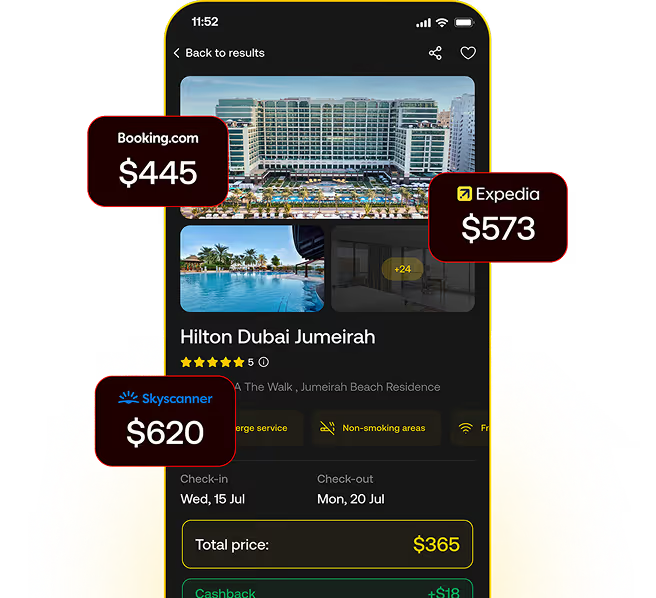
Spending SD directly remains limited, but travel provides a practical workaround. CoinBooking accepts 200+ cryptocurrencies for flights and hotels, with prices up to 30% below Booking.com. First-time users can get $25 off their booking.
See how much you
could save with $SD
Answer 2 questions to get your personalized
savings estimate.
Question 1 of 2
Where do you want to go?
Question 2 of 2
How many nights?
Your result
Get similar deals when we go live.
Get $25 off your first trip.
1. Book Discounted Hotels and Flights With SD on CoinBooking
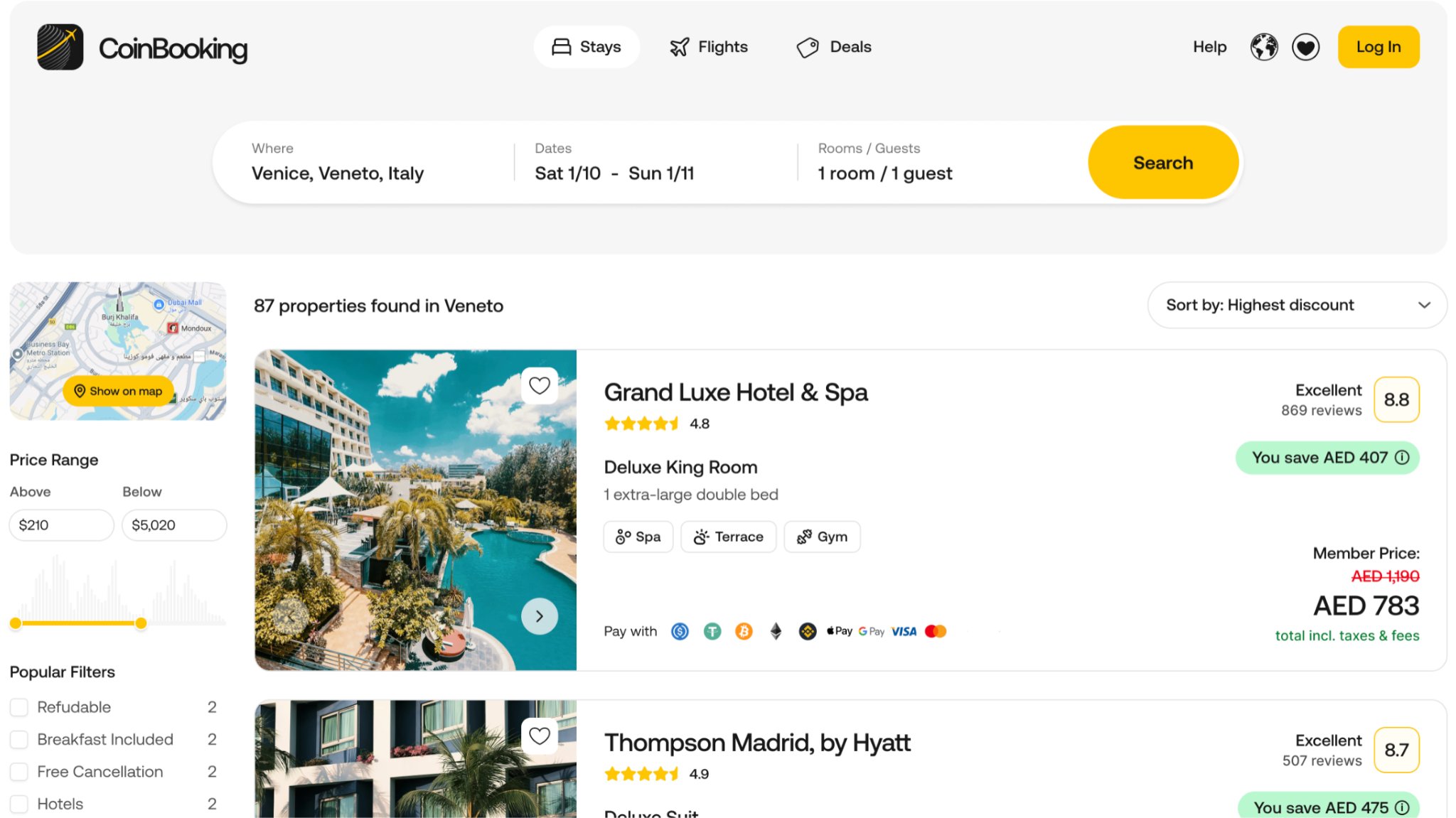
Booking a trip is one of the simplest ways to put SD to work today. CoinBooking is a crypto-native travel booking platform that supports 200+ cryptocurrencies and offers flights and hotels at prices up to 30% lower than Booking.com, with no additional surcharge for paying in crypto.
If you hold SD in an ERC-20 wallet, you can send it directly at checkout without converting it to fiat first. CoinBooking also accepts Visa, Mastercard, Apple Pay and Google Pay, so you can choose whichever payment method works best for you.
Book your next hotel for up to 30% less
New to CoinBooking? Sign up and get $25 off your first booking.
2. Put SD to Work Natively: Utility Pool, Governance and Node Bonding
The strongest native use for SD sits inside Stader's own stack, and it breaks into three things: the SD Utility Pool, node-operator bonding, and governance-linked revenue share.
Start with the Utility Pool. Delegators lock SD into a specialised pool that supports Ethereum decentralisation by backstopping permissionless ETHx node operators. In return, they earn double-digit rewards paid from protocol emissions and node-operator fees. It's the closest thing SD has to a productive parking spot: no hardware, no validator to run, just delegate and monitor.
Node-operator bonding is the second layer. Anyone can spin up an ETHx validator without permission, but each one requires a minimum bond of 0.4 ETH worth of SD alongside the ETH stake. That bond acts as slashing collateral, which is what keeps validator behaviour honest across the ~$494 million in TVL currently sitting inside ETHx.
If you're operationally minded, this is where SD earns its keep as working capital rather than a passive holding. The governance layer sits above both. SD stakers vote on validator whitelisting, reward policies, treasury allocations and network upgrades, and they receive a share of the 3–10% fee Stader charges on staking rewards.
The 2024 tokenomics overhaul burned 30 million SD (20% of supply) and directed 20% of protocol revenue into quarterly buybacks, which tightens the float around active stakers. Yields aren't fixed, so treat them as variables and check current rates plus any un-bonding window before you commit.
3. Buy Physical Collectibles With SD Through Polkastarter
If you would rather turn SD into a real, physical object, Polkastarter is a crypto-native marketplace worth a look. Trading cards headline the catalogue: Pokémon cards, graded singles, sealed booster boxes, and other hobby-market stock, alongside retro video games and sports memorabilia. Every listing is genuine inventory that ships once payment clears, not a tokenised placeholder, and higher-value pieces can sit in professional custody if you would rather not take delivery yourself.
Polkastarter's checkout runs on cryptocurrency across a mix of Layer 1 and Layer 2 chains, which keeps fees down and gives buyers a choice of settlement network. SD itself isn't on the accepted list, so a single swap solves it.
Full path: exchange SD for a Polkastarter-supported coin on a centralised venue like OKX, Bybit, Gate or Coinbase, or through a DEX such as Uniswap; withdraw the swapped balance to a self-custody wallet the marketplace can read; browse the drop; add the collectible; and confirm the purchase. As soon as the transaction settles, the item is on its way.
Since SD lives natively on Ethereum with a bridged version on Polygon, you can pick whichever chain your funds already sit on. Polygon keeps gas cheaper for anyone already routing through it, though Ethereum stays the deeper liquidity pool for the initial swap. Collectibles also trade on their own resale markets that don't move in lockstep with crypto prices, which gives the holding a diversification angle a pure token doesn't offer.
It isn't a direct SD payment, but it is the shortest bridge between a governance token and a real object on a shelf.
Check Polkastarter's Marketplace physical collectibles listings for current stock.
4. Buy Gift Cards, eSIMs and Mobile Top-Ups After Converting SD
Bitrefill is the standing choice for turning crypto into consumer purchases. It stocks digital gift cards, eSIMs, mobile refills, and adjacent products, and delivery lands by email or redemption code within minutes of payment clearing. Supported coins include Bitcoin, Ethereum, USDC, USDT, Litecoin, Dogecoin, Solana, and more. Coinsbee covers similar ground for anyone who wants a second option.
SD is not directly accepted, so step one is a swap into something Bitrefill takes. USDT or USDC on Ethereum is the tidy pairing, since SD already lives on that chain and both stablecoins are Bitrefill regulars. If Ethereum gas runs high when you swap, routing through a CEX like OKX or Bybit and withdrawing on a cheaper network such as Polygon or Arbitrum trims the total cost.
The catalogue is wide. It spans retail gift cards, gaming credit, streaming subscriptions, eSIMs, and mobile top-ups across most major markets. Country availability shifts, but the perennials include Amazon, Apple, Netflix, Airbnb, Uber, eBay, Spotify, Roblox, and PlayStation Store. Travellers get particular mileage out of the eSIM section: a data plan for the next trip can sit in the same checkout window as an epic hotel reservation. Bitrefill's UPI rail is a further bonus for anyone in India, since it removes the need to hand over a card for every transaction.
The sequence: SD → Bitrefill-supported coin → gift card, eSIM, or mobile top-up.
Not a direct SD payment, but the outcome lines up. The token converts into a product with a real-world use, and fulfillment is measured in minutes.
5. Convert SD to Fiat or Stablecoins for Everyday Spending
The most flexible option is also the plainest: turn SD into something the wider market accepts and spend that. As an ERC-20 asset, SD trades on centralised venues including Coinbase, Kraken, OKX, Bybit, Gate, HTX and Bithumb, with Uniswap and Polygon-native pools covering the on-chain side for holders who prefer to keep custody.
Spot pairs typically quote against USDT or fiat, depending on the venue. From either route, swap SD into USDT, USDC, or fiat where the pair exists. Proceeds can then flow out through an exchange-issued payment card, a third-party crypto card such as Crypto.com Visa, Bybit Card or Wirex, or straight to a bank account for regular card and transfer spending.
Those rails already sit inside almost every merchant terminal, so the question shifts from "does this shop accept SD" to "does this shop accept Visa or Mastercard," which is a far easier one to answer. The trade-offs: an extra step, KYC if a centralised exchange is in the mix, and the loss of SD price exposure the moment the swap clears.
For a single small purchase that is fine. For anything larger or repeated, plotting out which stablecoin and which card gives the best net cost in advance turns the habit into a routine rather than a scramble each time. Worth flagging too that Stader Labs doesn't run its own card programme or merchant gateway, so any spending outside the Stader ecosystem always routes through this swap-and-load flow.
When a merchant will not take SD directly, this is the shortest and most dependable route to a completed sale.
Explore Other CoinBooking Supported Tokens:
Frequently Asked Questions
1. What is Stader (SD) crypto?
Stader is a non-custodial, multi-chain liquid staking platform that issues LSTs like ETHx and HBARX for use across 40+ DeFi protocols. SD is its native ERC-20 governance and value-accrual token, used for voting, node-operator bonding, delegation into the SD Utility Pool, and capturing a share of protocol staking-reward fees.
2. Where can I buy SD?
SD is listed on Coinbase, Kraken, OKX, Bybit, Gate, HTX and Bithumb. On-chain, you can pick it up on Uniswap on Ethereum, or trade the bridged version on Polygon.
3. Can I pay for hotels with SD?
Yes. CoinBooking accepts 200+ cryptocurrencies for hotel and flight bookings at prices up to 30% below Booking.com. New users also get $25 off their first booking.
4. What network is SD on?
SD is issued as an ERC-20 on Ethereum with contract address 0x30D20208d987713f46DFD34EF128Bb16C404D10f. A bridged version circulates on Polygon at 0x1d734a02ef1e1f5886e66b0673b71af5b53ffa94.
5. Does SD have any real-world utility?
Yes. SD grants governance rights over the Stader protocol, acts as slashing collateral for permissionless ETHx node operators (0.4 ETH worth per validator), earns rewards through the SD Utility Pool, and captures a portion of the 3–10% fee Stader charges on staking rewards via quarterly buybacks and stakers' share.

Saira Parveen is a Dubai-based SEO content writer with a background in digital marketing and search visibility. She covers cryptocurrency adoption, travel booking with digital assets, and the practical side of spending crypto in everyday life.
Her work at CoinBooking focuses on helping readers navigate the intersection of crypto and travel, from finding the best rates on hotels and flights to understanding how to pay for travel with digital assets.
Found a hotel you like? Book it for up to 30% less

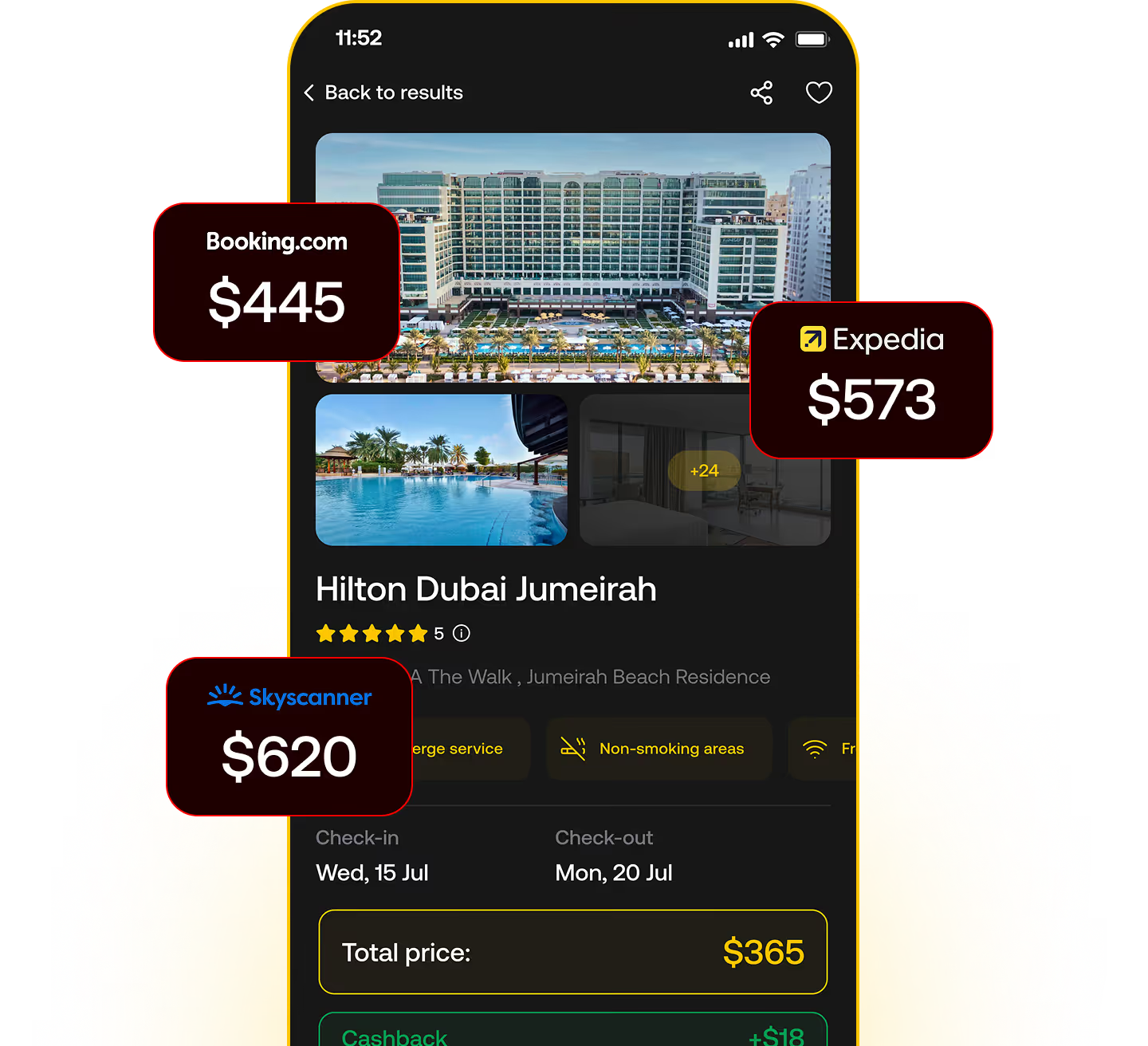
Found a hotel you like? Book it for up to 30% less