.avif)
.avif)

.png)

Content
What Is Acurast Coin (ACU)? Top 5 Ways to Use It in 2026

Acurast (ACU) is a crypto coin that powers a decentralised compute network built on smartphones, where anyone can rent processing power from a global pool of phones instead of a data centre. The network turns idle consumer devices into secure compute nodes, with no cloud company in the middle.
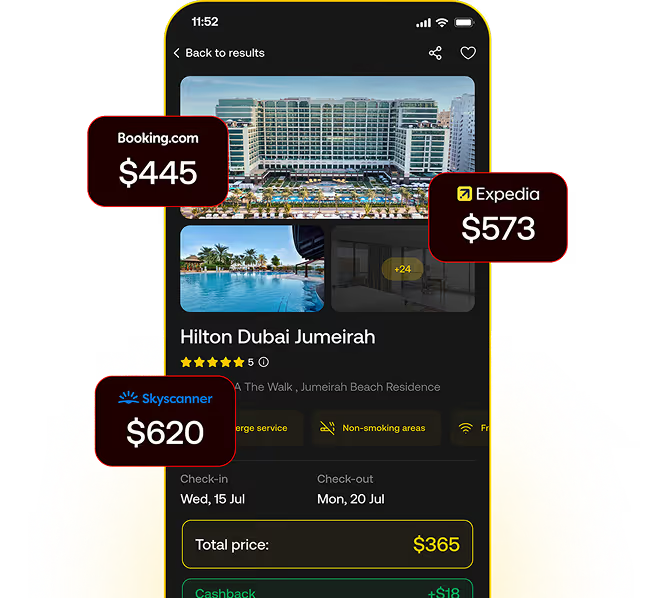
At the time of writing (August 2026), ACU trades near $0.095, with a market capitalisation of roughly $20.6 million and a rank of #608 on CoinMarketCap. Beyond speculation, ACU has practical utility across compute payments, rewards for connecting a phone, staking, and governance within the Acurast ecosystem. For travellers who already hold ACU or other cryptocurrencies, CoinBooking lets you book hotels and flights with up to 30% savings compared to Booking.com and a $25 discount on your first trip upon sign-up.
See how much you
could save with $ACU
Answer 2 questions to get your personalized
savings estimate.
Question 1 of 2
Where do you want to go?
Question 2 of 2
How many nights?
Your result
Get similar deals when we go live.
Get $25 off your first trip.
Key Takeaways
- Acurast bills itself as the first decentralised verifiable compute network powered by smartphones, with over 169,000 phones onboarded by the time its mainnet launched in January 2026, a figure Acurast now puts at more than 272,000 across 175 countries.
- The ACU token went live on 20 January 2026 with a low backer allocation: only 6.5% of supply was allocated to early backers, and annual inflation of up to 5% rewards stakers, compute providers, and the on-chain treasury.
- Anyone can earn ACU by connecting a spare Android or iOS phone to the network, with no upfront token purchase required.
- ACU trades on exchanges including Kraken, KuCoin, Gate, and MEXC, with Binance Alpha and LBank also live, and the bridged token trading on PancakeSwap.
- Spend ACU on travel with CoinBooking: book hotels and flights up to 30% lower than Booking.com across 190+ countries. New users get $25 off their booking.
ACU at a Glance (August 2026)
What Is Acurast?
Acurast is a decentralised network that sources computing power from smartphones rather than data centres. People who need compute, such as developers running applications, AI workloads, or blockchain infrastructure, rent capacity directly from individuals who connect their phones to the network. These phone owners, called processors, earn ACU for the work their devices complete.
The idea targets a distribution problem. Hundreds of millions of powerful phones already exist, already manufactured and already paid for, yet most of that hardware sits idle after a few years of use. Acurast connects that stranded capacity to demand. Because modern smartphones ship with dedicated hardware security modules, the network can verify each device is genuine and run workloads confidentially, which is the property Acurast calls verifiable compute.
The project was founded by Alessandro De Carli and Pascal Brun and is stewarded by the Swiss-based Acurast Association. After running an incentivised test network called Canary, which onboarded more than 169,000 phones and processed over 589 million on-chain transactions, Acurast launched its mainnet and Token Generation Event on 20 January 2026. The project has raised $11 million in total across grants and token rounds since 2023, including a $5.4 million public sale on CoinList in May 2025, with Polkadot founder Gavin Wood among its investors. A 2024 IEEE workshop paper, co-authored by University of Zurich researchers together with Acurast's CEO and head of research and part-funded by the Acurast Association, found the network completed a prime-sieve benchmark faster on average than AWS, Google Cloud, and Azure, though it was still slower than the two ordinary local machines tested, and the authors noted they discovered only 30 nodes across 14 countries.
How Does Acurast Work?
Acurast runs as its own Layer 1, built with Substrate and connected to Polkadot as a parachain, which means it taps into Polkadot's shared security. The ACU token is native to this chain and is also bridged to Ethereum, Base, BSC, and Peaq, so it can be held in both Substrate wallets such as SubWallet and Talisman and standard EVM wallets such as MetaMask.
A deployment works in three steps:
- A developer defines their workload and submits it to the network.
- The protocol matches the job to phones that meet the requirements, verified through each device's hardware attestation.
- The workload runs across one or more processors, and the phone owners earn rewards for completing it.
Reliability comes from Staked Compute, Acurast's version of proof of stake. Processors commit hardware and stake ACU behind their performance, and delegators can back committers with their own stake to share in rewards. Underperforming or dishonest behaviour risks the stake, which aligns incentives around uptime and honest computation. The same stake also counts as voting weight in on-chain governance, so tokens do not need to be locked twice.
On tokenomics, the initial supply is 1 billion ACU, with 6.5% allocated to early backers, 24% to the community treasury, 24% to team and advisors, 23% to community activation, 11.5% to the Association's operational funds, and 10% to liquidity provision. There is no maximum supply; instead, annual inflation of up to 5% is distributed to the Staked Compute pool (70%), the compute onboarding pool (10%), the on-chain treasury (15%), and collators (5%).
Top 5 Ways to Use Acurast Crypto Coin (ACU)
1. Book discounted hotels and flights with ACU on CoinBooking
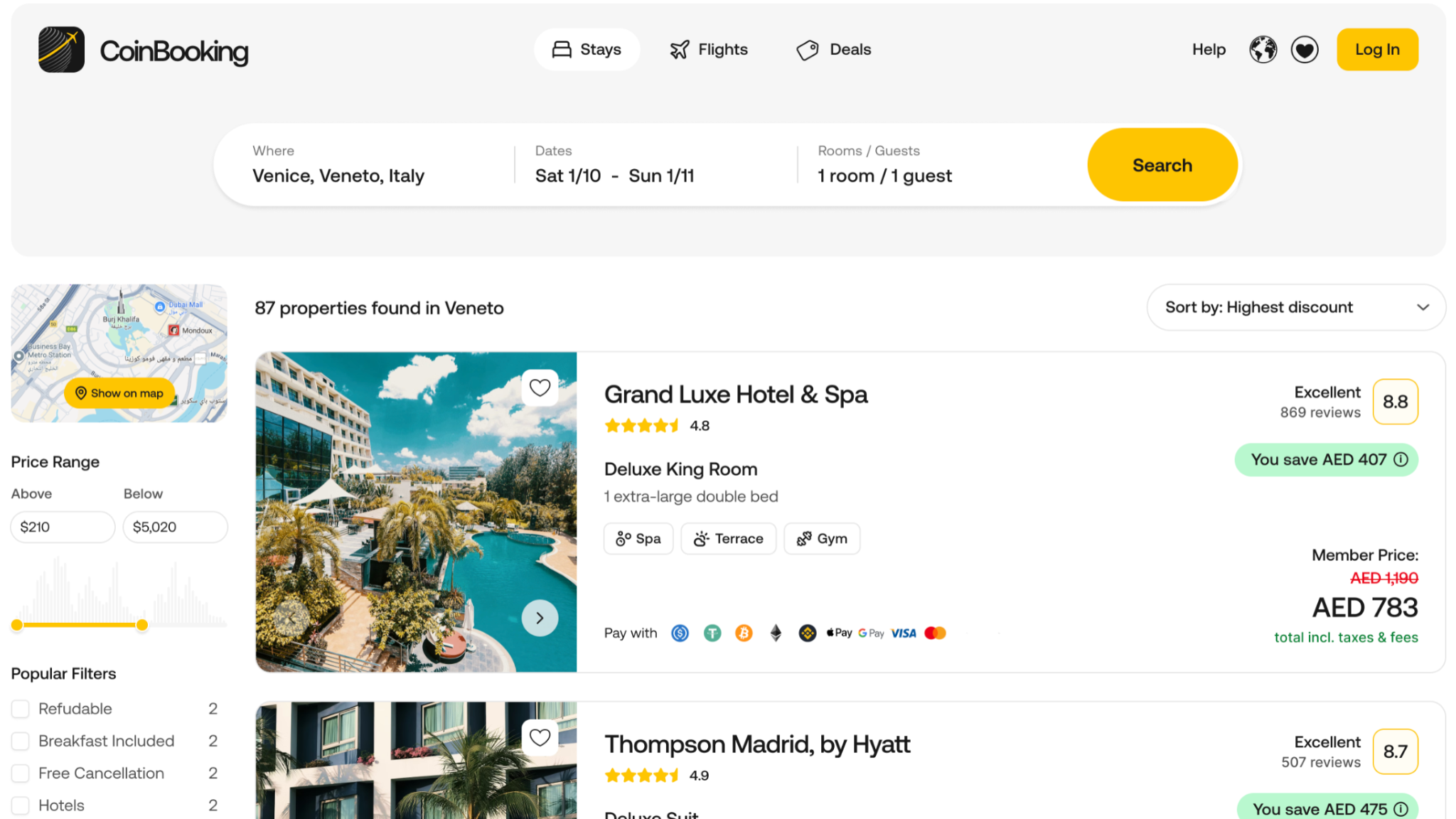
The easiest and most practical way to spend ACU is through CoinBooking. Book hotels and flights up to 30% lower than Booking.com. CoinBooking is a crypto-native travel platform operating across 190+ countries. It connects users to over 2 million hotels and flights globally and accepts 200+ cryptocurrencies, including ACU, as well as traditional payment methods such as Visa, Mastercard, Apple Pay, and Google Pay. New users get $25 off their booking.
Book your next hotel for up to 30% less
2. Rent decentralised compute, or earn by providing it
The primary use of ACU is the compute marketplace itself. Developers deploy workloads to the network, from application backends and blockchain infrastructure to AI tasks, paid for through the protocol. The marketplace also works in reverse, and this is Acurast's signature feature: anyone can earn ACU by connecting a spare Android or iOS phone as a processor, with no upfront token purchase required. A phone gathering dust in a drawer becomes a revenue-generating compute node.
3. Stake ACU for rewards
ACU holders can participate in Staked Compute either as committers, who stake behind their own hardware, or as delegators, who back existing committers and share in the rewards. Stakers can add tokens, extend duration, and compound or withdraw rewards over time. The Staked Compute pool receives 70% of the network's annual inflation, making it the largest reward stream in the protocol. One mechanic to know before you start: exiting requires a cooldown period chosen when the stake is created, ranging from 28 days to roughly 3.68 years on mainnet, during which both reward weight and governance vote weight drop to 50%, with tokens only withdrawable once it ends. Plan around it.
4. Vote on the network's future
Staked ACU doubles as governance weight. On-chain governance went live on 19 March 2026 using OpenGov, with conviction voting, and token holders vote on protocol upgrades, network parameters, and treasury spending, including whether to fund community proposals or burn treasury tokens outright. Because staking and governance share the same stake, participating in network security automatically gives holders a voice in its direction.
5. Trade ACU
ACU is listed on exchanges including Kraken, KuCoin, Gate, MEXC, LBank, and Binance Alpha, trading primarily against USDT, with daily volume of roughly $3 million as of August 2026, a figure that includes substantial Binance Futures activity. The bridged token's largest single market is a PancakeSwap pool on BNB Chain, with further liquidity on Aerodrome on Base. Traders group ACU with the DePIN and AI-compute sector, alongside names like Akash, Render, and io.net.
Is Acurast a Good Investment?
Whether ACU is a good investment depends on your risk tolerance and your view of decentralised infrastructure as a category. The bull case rests on a working network that Acurast says has grown to over 272,000 phones across 175 countries, a low 6.5% allocation to early backers, backing from Polkadot founder Gavin Wood, $11 million raised in total since 2023, and a 2024 IEEE workshop paper co-authored by Acurast's own CEO and head of research alongside University of Zurich researchers, in which the network beat AWS, Google Cloud, and Azure on a single prime-sieve benchmark. In February 2026, Acurast activated its smartphone network on Base for confidential on-chain AI inference, with an Acurast mini app live in the Base ecosystem. It has since shipped dynamic, supply-and-demand-based compute pricing, a decentralised VPS product, and a partnership with Teneo running over 760 AI trading agents inside smartphone secure enclaves.
The risks are equally concrete. ACU trades roughly 72% below its all-time high of $0.3365, set four days after its January 2026 launch, though it has recovered about 45% from its June low of $0.06534. At around $20.6 million, it is a small-cap asset with daily volume near $3 million, so price swings are sharp. Only 217 million of the 1 billion initial supply circulates, per CoinMarketCap, leaving significant future unlocks, and annual inflation of up to 5% means supply grows every year with no cap. Acurast's Substrate chain was audited by Monethic ahead of mainnet, with 26 findings including one critical and six high-severity issues; 19 were resolved, and seven were acknowledged without being fixed. The network also publishes no revenue or paid-compute figures, so the split between commercial workloads and incentivised activity is not externally verifiable. The mainnet is also less than a year old, and Acurast competes for the same AI-compute narrative as larger, longer-established networks, with Render at around $643 million, Akash at $155 million, and io.net at $44 million, against ACU's roughly $21 million. The whole sector is also deeply drawn down, with io.net about 98% off its high, Render 91%, and Akash 94%.
This is not financial advice. Crypto is volatile. Always do your own research and never invest more than you can afford to lose.
Explore Other DePIN and Decentralised Compute Coins
If you found this guide useful, explore these other decentralised infrastructure coin guides:
- What Is Render (RENDER) Crypto Coin? Top 5 Ways to Use It in 2026
- What Is Grass Coin (GRASS)? Top 5 Ways to Use It in 2026
- What Is Allora Coin (ALLO)? Top 5 Ways to Use Allora Crypto Coin
FAQs
1. s Acurast a good investment?
Acurast has a working smartphone compute network and a low allocation to early backers, but ACU remains a volatile small-cap coin trading about 72% below its all-time high, with ongoing supply inflation. Treat it as a high-risk asset and do your own research before buying.
2. What is Acurast?
Acurast is a decentralised verifiable compute network powered by smartphones. It lets developers run secure workloads on a global pool of phones instead of data centres, using the hardware security built into modern devices.
3. Who founded Acurast?
Acurast was founded by Alessandro De Carli and Pascal Brun and is stewarded by the Swiss-based Acurast Association. The network is governed on-chain by ACU stakers rather than by any single company.
4. Can you spend ACU on real things?
Yes. CoinBooking is a crypto-native travel platform that accepts ACU for hotels and flights at up to 30% below Booking.com prices, across 190+ countries. New users get $25 off their booking.
5. Can I earn ACU with my own phone?
Yes. Anyone can connect a compatible Android or iOS phone as a processor and earn ACU for completing compute workloads. No upfront token purchase is required to start providing.
6. Where can you buy ACU?
ACU is available on exchanges including Kraken, KuCoin, Gate, MEXC, LBank, and Binance Alpha. The bridged token also trades on decentralised exchanges, with its largest pool on PancakeSwap on BNB Chain.
7. What is the max supply of ACU?
ACU launched with an initial supply of 1 billion coins and has no maximum supply. Annual inflation of up to 5% is distributed to stakers, compute providers, the on-chain treasury, and collators, with about 217 million ACU circulating as of August 2026.

Saira Parveen is a Dubai-based SEO content writer with a background in digital marketing and search visibility. She covers cryptocurrency adoption, travel booking with digital assets, and the practical side of spending crypto in everyday life.
Her work at CoinBooking focuses on helping readers navigate the intersection of crypto and travel, from finding the best rates on hotels and flights to understanding how to pay for travel with digital assets.
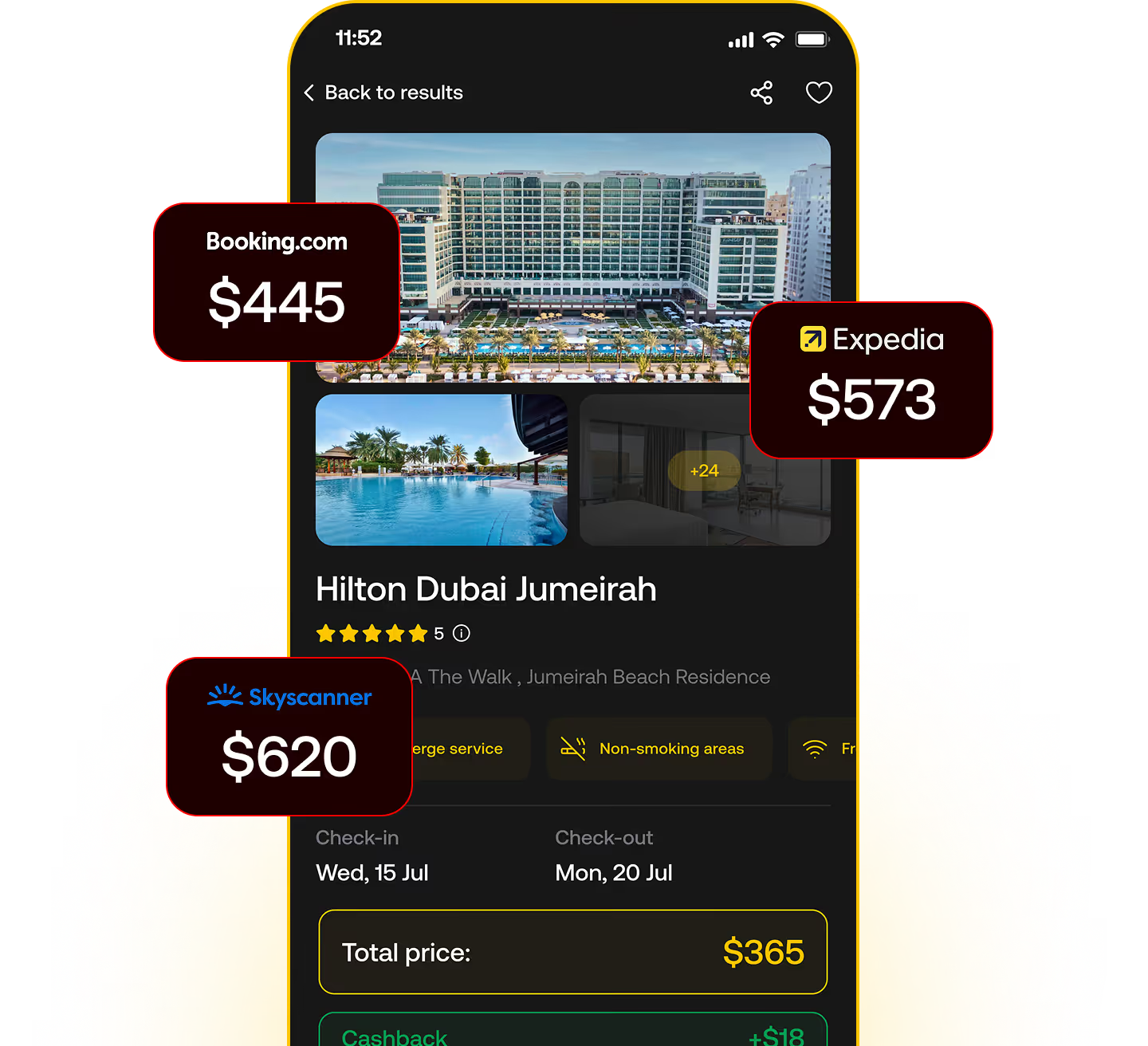
Found a hotel you like? Book it for up to 30% less

Found a hotel you like? Book it for up to 30% less