.avif)
.avif)

.png)

Content
What Is Aleo Coin (ALEO)? Top 5 Ways to Use Aleo Crypto Coin in 2026

Aleo (ALEO) is a crypto coin that powers a privacy-focused Layer 1 blockchain using zero-knowledge cryptography to enable private smart contracts and decentralised applications. Unlike traditional blockchains where transaction details are visible to all, Aleo allows users to execute transactions locally off-chain and submit only a succinct zero-knowledge proof to validators, keeping sensitive data shielded.
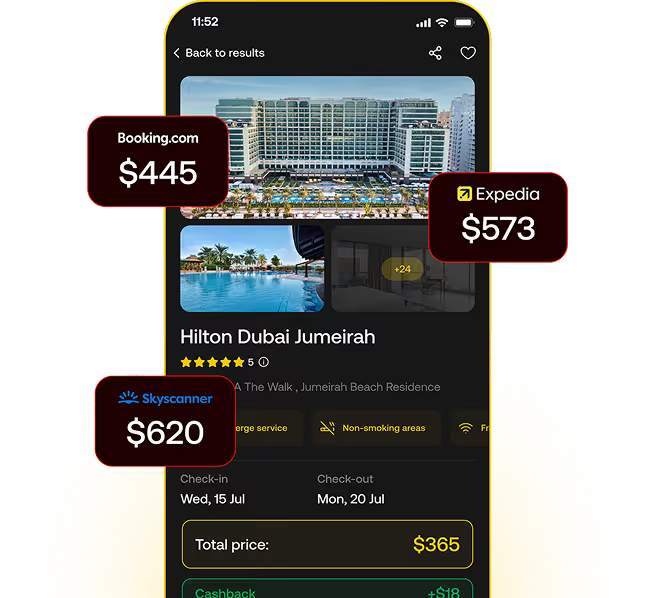
At the time of writing (August 2026), ALEO trades near $0.01578, with a market capitalisation of roughly $21.07 million and a rank of #599 on CoinMarketCap. Beyond speculation, ALEO has practical utility across private applications, staking with validators to earn a share of block rewards, and network participation; for travellers who already hold ALEO or other cryptocurrencies, CoinBooking lets you book hotels and flights, with up to 30% savings compared to Booking.com and Expedia and a $25 discount on your first trip upon sign-up.
See how much you
could save with $ALEO
Answer 2 questions to get your personalized
savings estimate.
Question 1 of 2
Where do you want to go?
Question 2 of 2
How many nights?
Your result
Get similar deals when we go live.
Get $25 off your first trip.
Key Takeaways
- Aleo mainnet launched on 18 September 2024, one of the first Layer 1 blockchains designed for fully private programmable applications.
- The ALEO token rewards two separate roles: validators earn block rewards for securing the network and reaching consensus, while provers earn puzzle rewards for solving computational puzzles.
- The network uses a proof-of-stake consensus mechanism called AleoBFT, combining zero-knowledge verification with Byzantine Fault Tolerance.
- Aleo's Leo programming language allows developers to write private applications without deep cryptographic expertise.
- According to Aleo, the network supports fully private transactions on Ledger hardware wallets, combining cold storage security with zero-knowledge privacy.
- Book hotels and flights with $Aleo on CoinBooking, at up to 30% below Booking.com prices. Get $25 off your first booking.
ALEO at a Glance
What Is Aleo?
Aleo is a Layer 1 blockchain built from the ground up to enable privacy by default in smart contracts and decentralised applications. The network solves a core problem in blockchain adoption: the conflict between transparency (required for verification) and confidentiality (required by users and enterprises).
Traditional blockchains expose transaction inputs, outputs, balances, and smart contract logic to all participants. This transparency prevents adoption in sectors requiring confidentiality, such as private finance, institutional payments, and identity systems. Aleo uses zero-knowledge proofs, a cryptographic technique, to allow transactions to be verified without revealing underlying data.
The project was founded on research dating to 2018, specifically the ZEXE (Zero-Knowledge EXEcution) protocol, which demonstrates how users can execute stateful computations privately and produce succinct proofs attesting to correctness. Aleo's co-founder Howard Wu co-authored the ZEXE paper. He is a co-founder of Aleo and CEO of Provable, the research and development company within the Aleo ecosystem, formerly Aleo Systems. His research contributions include ZEXE, the protocol underlying Aleo, and DIZK, a distributed system for zero-knowledge proof generation developed at UC Berkeley. The ZEXE paper was co-authored with cryptographers from Zcash and Zerocash.
Aleo mainnet launched on 18 September 2024, marking the transition from testnet to live production. The ALEO token was deployed alongside the mainnet with an initial supply of 1.5 billion tokens. According to Aleo's official tokenomics, ALEO has no fixed maximum supply; the circulating supply is designed to grow to roughly 2.6 billion over ten years and to double in about 21 years as rewards are issued to validators and provers. The inflation rate is designed to decrease over time, from around 12% in year one to 2% in year ten, approaching 0% thereafter.
How Does Aleo Work?
Aleo's execution model differs fundamentally from conventional blockchains. Rather than validators executing all transactions, users perform computation locally and submit only a zero-knowledge proof to the network.
The transaction flow works in four steps:
- Off-chain execution: A user executes their transaction locally on their machine using snarkVM (the Aleo Virtual Machine). This execution generates inputs, outputs, and state transitions specific to their transaction.
- Proof generation: The user's local machine generates a compact zero-knowledge proof (zk-SNARK) that mathematically attests to the correctness of the computation without revealing the underlying data.
- Proof submission: The user submits the proof to the network via a transaction. The proof is now public, but the inputs, outputs, and logic remain encrypted.
- Validation and consensus: Validators verify the submitted proof using the AleoBFT consensus mechanism. Once verified, the transaction is recorded on the blockchain ledger.
Key architectural components:
- SnarkVM: The Rust implementation of the Aleo Virtual Machine (AVM), and the off-chain execution environment where users run programs and generate proofs. SnarkVM handles zero-knowledge proof generation using an optimised zk-SNARK scheme called Varuna.
- SnarkOS: The blockchain node client, running AleoBFT, a DAG-based Byzantine Fault Tolerant consensus protocol inspired by the Narwhal mempool and Bullshark ordering protocols, with delegated proof of stake and instant finality.
- Leo: A purpose-built programming language for writing private applications. Leo abstracts away complex cryptography, allowing developers to write contracts using intuitive syntax while maintaining privacy by default.
- Records: A special data type in Aleo's programming model that facilitates encrypted private data. Records can be privately transferred and selectively disclosed to authorised parties.
The ALEO token fuels the network across two distinct roles. Validators stake ALEO to secure the chain and participate in AleoBFT consensus, earning block rewards. Provers earn separate puzzle rewards for solving computational puzzles that support the network. Coin holders who do not run their own infrastructure can delegate their stake to a validator to earn a share of block rewards. This is separate from the transaction proofs that users generate locally on their own machines when executing a private transaction.
Top 5 Ways to Use Aleo (ALEO)
1. Book discounted hotels and flights with ALEO on CoinBooking
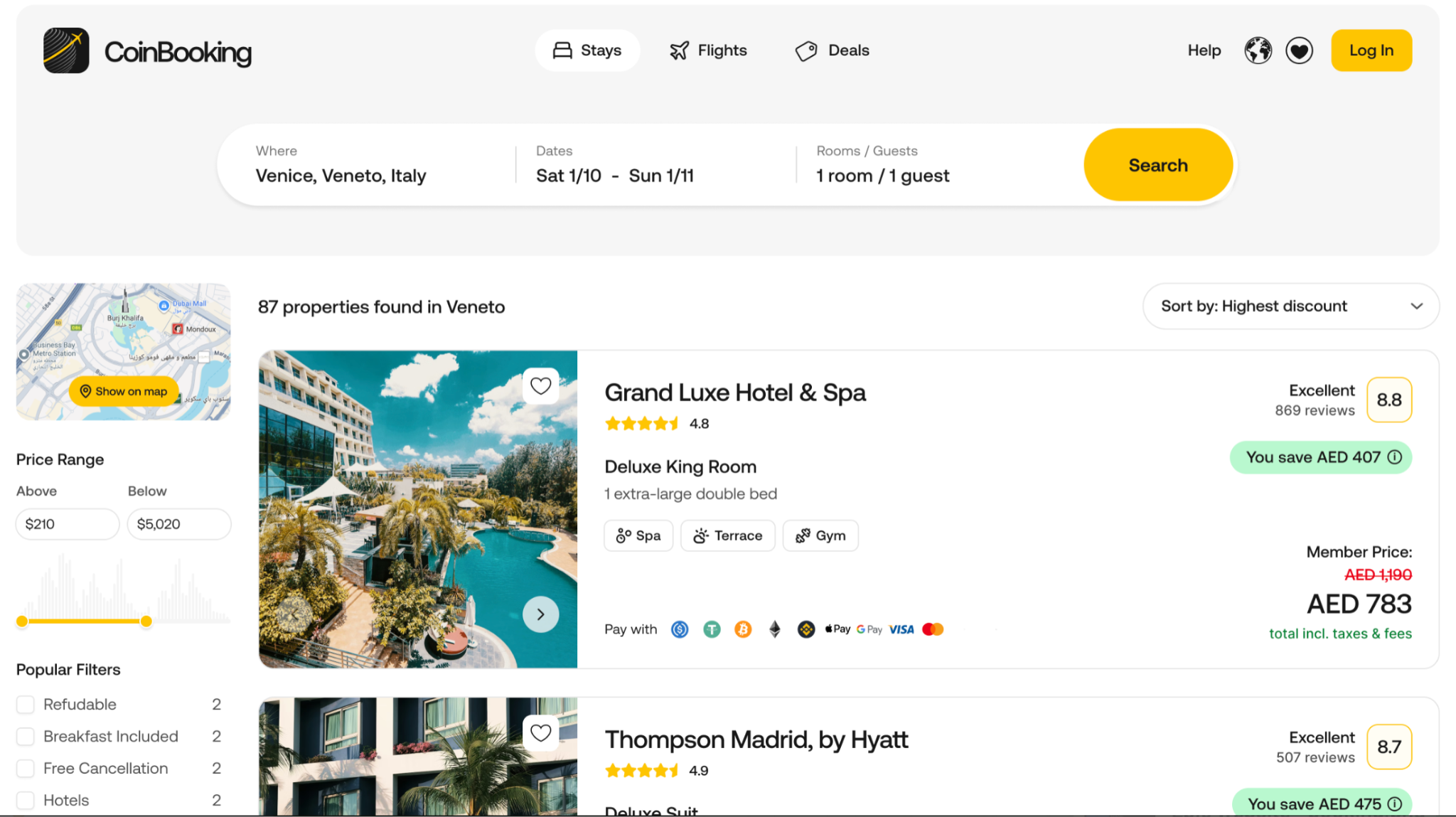
This is by far the easiest and best way to actually use your ALEO. The next time you book a trip, you do not have to cash out to fiat first, and you do not pay extra for paying in crypto.
Book your next hotel for up to 30% less
You can book hotels and flights with ALEO on CoinBooking, at up to 30% below Booking.com prices, with no extra charge for paying in crypto.
Join the early access list now and get $25 off your first booking.
2. Build or deploy private applications
Beyond travel, ALEO serves as the fuel for private decentralised applications. Developers use Aleo to build privacy-first dApps in sectors requiring confidentiality: private DeFi protocols, confidential stablecoin transfers, identity and credentialing systems, private voting systems, and blockchain-based confidential payment networks.
Unlike older privacy coins such as Monero and Zcash, which focus solely on anonymous payments, Aleo enables fully-featured programmable applications where transaction logic, user identities, and state transitions remain encrypted by default.
Applications built on Aleo can selectively disclose transaction details to authorised parties using viewing keys, enabling compliance without breaking default privacy. The Aleo Network Foundation partnered with Paxos Labs to launch USAD, a US dollar stablecoin that went live on Aleo mainnet in February 2026 with wallet addresses and transaction amounts encrypted end-to-end. Circle's USDCx, a USDC-backed stablecoin issued through Circle xReserve, is live on Aleo mainnet.
3. Stake ALEO with validators for rewards
ALEO holders can stake their tokens by delegating to a validator, contributing to network security and earning a share of the block rewards those validators receive for participating in AleoBFT consensus. Validators earn a block reward for each block they help produce, and delegators share in those rewards in proportion to their stake.
This is distinct from Aleo's separate prover role. Provers earn separate puzzle rewards for solving computational puzzles, keeping two-thirds of each reward while a third goes to the validator that includes their solution. Since ARC-0046 took effect in July 2025, provers must also stake ALEO (currently 100,000 credits, escalating to 2.5 million by July 2027), so the role now requires both specialised hardware and capital. Staking through a validator does not require running prover hardware, making it the accessible option for most coin holders.
Delegation requires a minimum of 10,000 ALEO, with a 360-block unbonding period; validators need 10 million ALEO in total stake to participate in consensus. Provable's explorer currently shows a staking yield of around 10.9%. Verify current parameters before committing funds, as they are set by protocol governance.
4. Trade ALEO on crypto exchanges
ALEO trades on centralised exchanges including Coinbase, which added spot trading shortly after mainnet in September 2024, and Kraken, which listed ALEO on 27 January 2026, typically against USDT and USD pairs. Trading is thin: CoinMarketCap shows 24-hour volume of roughly $777,000, and CoinGecko tracks around 16 exchanges. Verify current listings and pairs on the CoinMarketCap Markets tab before trading.
ALEO's low liquidity means its price and market metrics can move quickly on relatively small order flow. As a privacy-focused Layer 1, its price tends to correlate with broader sentiment around zero-knowledge and privacy narratives, but the thin market makes it more volatile than higher-liquidity tokens.
5. Use ALEO for private payments
Aleo's Ledger integration, live since May 2026, supports both public and shielded ALEO transactions signed from a hardware wallet, with users choosing privacy per transaction. It currently covers the native ALEO asset on Ledger's desktop app; token and stablecoin support is on the roadmap. Users can send ALEO whilst keeping transaction amounts, recipient addresses, and transaction history encrypted.
This use case appeals to users prioritising financial privacy and organisations requiring confidential payment infrastructure. Unlike centralised privacy solutions, Aleo's privacy is protocol-level, not dependent on a company or intermediary.
Is Aleo a Good Investment?
Aleo operates in a nascent but growing market segment: privacy-focused blockchains. The bull case rests on several concrete factors. The network has moved from testnet to live mainnet production with a functioning privacy layer. Enterprise interest exists, evidenced by the Aleo Network Foundation's partnership with Paxos Labs to launch the USAD stablecoin and Aleo's Ledger hardware wallet integration. Provable and the Aleo Network Foundation launched Shield Wallet in February 2026, a self-custodial wallet encrypting balances, amounts and counterparties by default, and Aleo shipped the first private stablecoin payroll product with Toku and Paxos Labs in January 2026. The team has deep cryptographic expertise and published peer-reviewed research underlying the protocol. Zero-knowledge technology continues to advance.
Risks are equally concrete. ALEO trades near $0.01578, roughly 99.8% below its all-time high of $6.79 set on 28 September 2024. ALEO also set an all-time low of $0.01552 on 8 August 2026 and trades barely 2% above it. The market is thin and illiquid, with 24-hour volume around $777,000, which amplifies volatility. On-chain activity remains very limited: DefiLlama records essentially no total value locked on Aleo, with a single protocol listed, and the network runs around 28 active validators against 174 registered. Regulatory uncertainty surrounds privacy technologies in many jurisdictions, creating potential policy risk. Competing privacy-focused chains and zero-knowledge rollup Layer 2s offer alternative privacy infrastructure. The network is young; mainnet launched in September 2024, and real-world adoption metrics remain modest by comparison to mature blockchains. Prover puzzle-solving requires specialised computational resources that may not be accessible to casual participants. The token launch drew criticism from provers, who said tokenomics disclosed only two days before mainnet materially changed mining payback expectations, and from airdrop recipients subject to a one-year lock-up that validators were not. Aleo also disclosed a February 2024 incident in which unencrypted KYC data belonging to a small number of Learn and Earn participants was exposed through an email error.
This is not financial advice. Crypto assets are volatile. Always conduct your own research and never invest more than you can afford to lose.
Explore Other Layer 1 Blockchain Coins
If you found this guide useful, explore these other Layer 1 blockchain coin guides:
- What Is Berachain (BERA)? Top 5 Ways to Use BERA Crypto Coin in 2026
- What Is MANTRA (MANTRA)? Top 5 Ways to Use It in 2026
- What Is Irys Coin (IRYS)? Top 5 Ways to Use It in 2026
Frequently Asked Questions
1. What is Aleo?
Aleo is a Layer 1 blockchain designed to enable private, verifiable smart contracts and decentralised applications using zero-knowledge cryptography. The network allows users to execute transactions off-chain and submit only succinct cryptographic proofs to validators, preserving data privacy while maintaining verifiability.
2. How does Aleo ensure privacy?
Aleo uses zero-knowledge proofs, specifically zk-SNARKs, to allow transaction verification without revealing underlying data. Users execute transactions locally, generating a proof that attests to correctness. Only the proof is submitted on-chain; inputs, outputs, and logic remain encrypted.
3. What is the purpose of the ALEO token?
ALEO is the native asset used to pay for services on the network and to reward its participants. Validators stake ALEO to secure the chain and earn block rewards for reaching consensus, and provers earn separate puzzle rewards for solving computational puzzles. Coin holders can delegate stake to validators to share in block rewards.
4. Can I stake ALEO?
Yes. ALEO holders can delegate their tokens to a validator to earn a share of the block rewards the validator receives for participating in AleoBFT consensus. This is separate from Aleo's prover role, where provers earn puzzle rewards for solving computational puzzles using specialised hardware. Check current staking parameters through an Aleo-compatible wallet before delegating.
5. Who founded Aleo?
Aleo was co-founded by Howard Wu, who co-authored the ZEXE research paper underlying the protocol. He is CEO of Provable, the research and development company within the Aleo ecosystem, formerly Aleo Systems. Alex Pruden served as CEO of Aleo Systems from 2022 until late 2023, then as Executive Director of the Aleo Network Foundation until December 2024; he remains involved as board chairman. Other co-founders include Raymond Chu and Collin Chin.
6. When did Aleo mainnet launch?
Aleo mainnet launched on 18 September 2024. Before mainnet, the project ran four testnets between 2020 and 2024 to validate the protocol, with Testnet 3 adding prover and deployment incentive programmes in 2023.
7. What is the Leo programming language?
Leo is a domain-specific language designed by Aleo for writing private applications. Leo abstracts away low-level cryptographic complexity, allowing developers to write contracts using intuitive syntax while maintaining privacy by default. Leo code compiles to Aleo instructions, which compile to AVM bytecode; snarkVM then executes that bytecode off-chain to generate the zero-knowledge proof.
8. What is the maximum supply of ALEO?
According to Aleo's official tokenomics, ALEO has no fixed maximum supply. The network launched with an initial supply of 1.5 billion tokens, and the circulating supply is designed to grow to roughly 2.6 billion over ten years and to double in about 21 years as rewards are issued to validators and provers. Some aggregators list a 5 billion token figure, but this is used for fully diluted valuation calculations and is not an official hard cap.
9. Can I use Aleo with a hardware wallet?
Yes. According to Aleo, the network supports fully private transactions on Ledger hardware wallets, combining cold storage security with zero-knowledge privacy. Users can keep balances and transaction history shielded while signing transactions from cold storage.
10. Where can I buy ALEO?
Coinbase added ALEO spot trading shortly after mainnet in September 2024, and Kraken listed it on 27 January 2026. ALEO also trades on other centralised exchanges including Gate, MEXC, BingX, XT.COM, and CoinW, and on the decentralised exchange PancakeSwap v3 on BNB Smart Chain; CoinGecko tracks around 16 markets. Check the CoinMarketCap Markets tab for the current list of exchanges and trading pairs.

Saira Parveen is a Dubai-based SEO content writer with a background in digital marketing and search visibility. She covers cryptocurrency adoption, travel booking with digital assets, and the practical side of spending crypto in everyday life.
Her work at CoinBooking focuses on helping readers navigate the intersection of crypto and travel, from finding the best rates on hotels and flights to understanding how to pay for travel with digital assets.
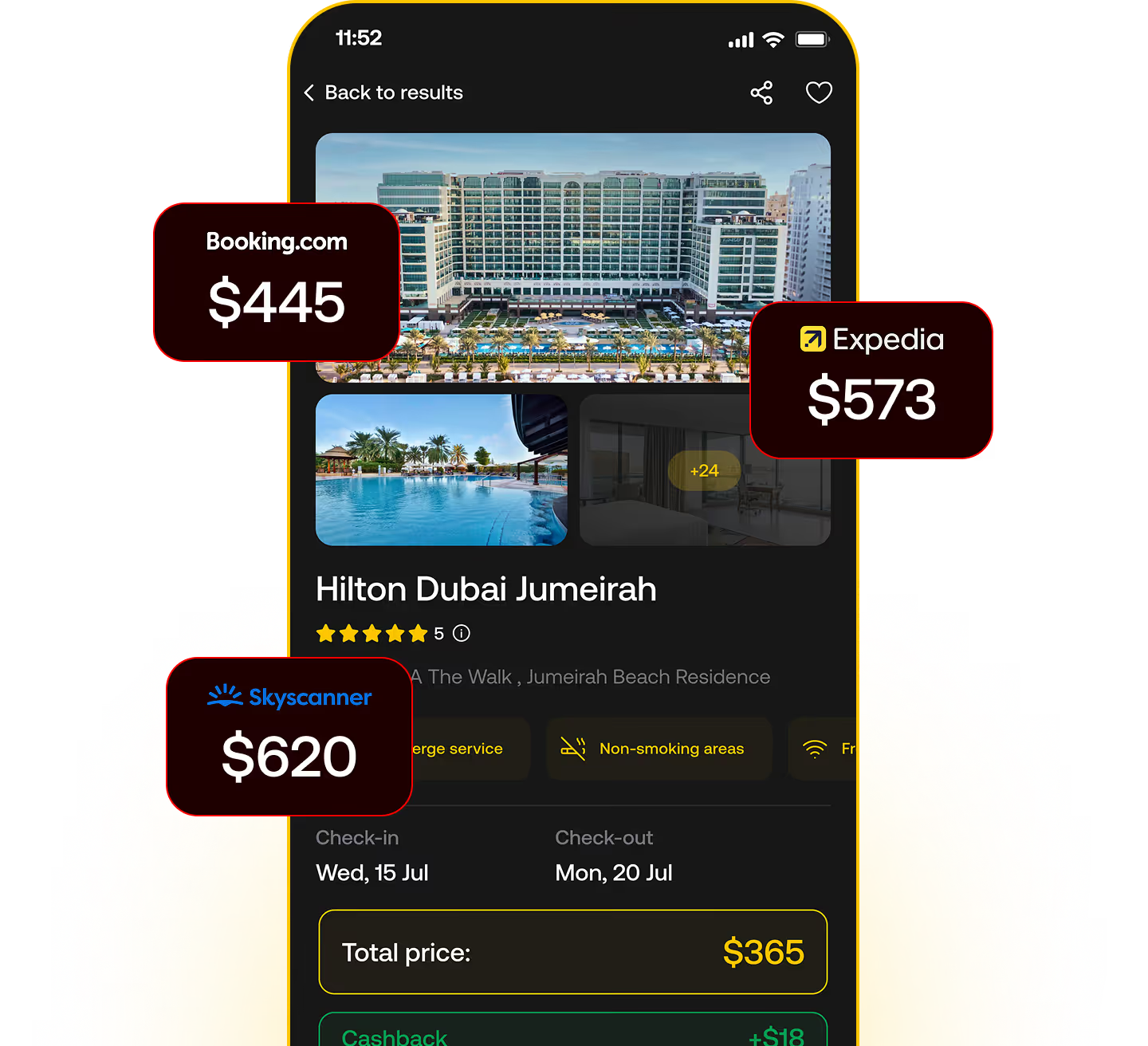
Found a hotel you like? Book it for up to 30% less

Found a hotel you like? Book it for up to 30% less