.png)
.png)

.png)

Content
Top 10 Ways to Book a Hotel Without a Credit Card in Ethiopia

Ethiopia recorded nearly 1.3 million international arrivals in 2024, a 40% increase over the past five years, making it Africa’s fastest-growing tourist destination according to the UN World Tourism Organization. The country’s ancient churches, highland landscapes, Omo Valley tribes, and the other-worldly Danakil Depression are drawing more visitors than at any point in its history. Most of them arrive without a credit card in their wallet, and most of Ethiopia’s hotels do not expect one.

Cash is the default across the country, and Telebirr, Ethio Telecom’s mobile money platform, has reached 54.84 million users and processed over 2.38 trillion birr in transactions in the past fiscal year. Mobile money is increasingly accepted at hotel front desks in Addis Ababa and larger towns. If you also want to lock in a confirmed booking before you arrive, CoinBooking accepts Apple Pay, Google Pay, and over 100 other payment options at checkout with no card required.
Not stopping at Ethiopia? See how card-free hotel booking works in other destinations.
Do Hotels in Ethiopia Require a Credit Card?
For the vast majority of hotels in Ethiopia, no. Credit card penetration in the country sits below 5%, and the hospitality industry has operated on cash as its foundation for decades.
International chain hotels in Addis Ababa, including the Sheraton, Hilton, and Radisson Blu, typically require a Visa or Mastercard debit or credit card at check-in for the security deposit. Some will accept a cash deposit in lieu of a card if arranged in advance. Outside Addis, this expectation largely disappears.
Properties in Lalibela, Gondar, Axum, and across the Omo Valley rarely have card terminals at all. Mid-range lodges, guesthouses, and eco-camps in remote areas operate entirely on cash, sometimes supplemented by Telebirr where connectivity allows. For destinations outside the capital, the practical question is not whether a credit card is accepted, but how much cash and in what currency to carry.
Top 10 Ways to Book a Hotel in Ethiopia Without a Credit Card
1. Book Hotels with CoinBooking
Most travelers arriving in Ethiopia have already worked out the cash question before they land. The booking question is harder. Card terminals outside Addis are rare, and walking into a hotel in Lalibela or Gondar without a reservation already in hand is a gamble.
CoinBooking handles that ahead of time. It's a Dubai-licensed travel platform that lists the same hotels at up to 30% less than Booking.com or Expedia, with Apple Pay, Google Pay, and 100+ cryptocurrencies accepted at checkout. Coverage spans Addis Ababa, Lalibela, Gondar, Axum, and 190+ countries beyond.

Early users receive $25 off their first booking.
Tip: CoinBooking covers flights as well as hotels. If you are flying into Addis Ababa and then traveling to Lalibela or Gondar, the entire trip can be booked and paid for without a card from one platform.
Going to West Africa next?. See how card-free hotel booking works in Nigeria.
2. Pay at the Hotel on Arrival (Cash)
Cash is the most reliable payment method across Ethiopia’s hotel market. Outside Addis Ababa, it is often the only option. Budget guesthouses and mid-range lodges in Lalibela, Gondar, Axum, and Arba Minch expect payment in Ethiopian birr on arrival, either for the full stay upfront or per night. Walk-in rates at smaller properties are frequently competitive with what you would find on OTA platforms.
Carry enough birr before leaving Addis or any major town. ATMs exist in Addis Ababa and in some larger regional towns, but availability in Lalibela and more remote destinations is limited and machines can run dry. Withdrawing a working supply before you travel to any UNESCO or off-the-beaten-track site removes the most common source of payment stress in Ethiopia.
3. Use Telebirr for Mobile Money Payments
Telebirr is Ethiopia’s dominant mobile money platform, launched by Ethio Telecom in 2021. It has grown to 54.84 million users and processed over 2.38 trillion birr in transactions in the most recent fiscal year. The platform supports QR code payments, merchant transfers, and person-to-person transfers. A growing number of mid-range hotels and guesthouses in Addis Ababa accept Telebirr at the front desk, and acceptance is expanding in larger regional towns.
Coverage thins considerably outside urban centres, so Telebirr is most reliable as a payment method in Addis and major cities. For Lalibela, Danakil, and the Omo Valley, cash remains the fallback. For Ethiopians traveling domestically, Telebirr is the most practical digital payment option available. For international visitors, the platform requires an Ethiopian phone number and NID to register fully, which limits its use for those visiting on a short trip.
4. Pay via CBE Birr or Mobile Banking
CBE Birr is the mobile banking app from the Commercial Bank of Ethiopia, the country’s largest bank by assets. It supports direct bank transfers, QR code payments, and bill payments. Hotels in Addis Ababa that accept digital payments from Ethiopian bank account holders will often accept CBE Birr transfers alongside or instead of Telebirr. For Ethiopian travelers who bank with CBE, this is a practical route for hotel payments without a credit card.
For international visitors, CBE Birr requires an Ethiopian bank account, which limits this option to those with local banking relationships or long-term residents. Short-stay international visitors are better served by cash, a debit card, or CoinBooking for the booking stage.
From Ethiopia to India, the payment rules change completely. Here is how hotel booking without a card works there.
5. Use a Debit Card Where Accepted
Visa and Mastercard debit cards work at international chain hotels in Addis Ababa and at a small number of larger mid-range properties in the capital. ATMs in Addis accept international debit cards, though fees vary by bank and machine availability outside the capital is inconsistent. If your card carries either Visa or Mastercard logo, it will cover you for the booking stage on most international OTA platforms and at check-in at five-star properties in Addis.
Card terminal coverage drops sharply outside the capital. Properties in Lalibela, Gondar, Axum, Harar, and throughout the Omo Valley and Afar region typically have no card infrastructure at all. Treat your debit card as a tool for Addis and the international chains, and rely on cash for everywhere else in the country.
6. Book Directly Through the Hotel
Contacting the hotel directly by phone, email, or WhatsApp is one of the most effective booking methods in Ethiopia, particularly for mid-range lodges, eco-camps, and guesthouses outside Addis. Many properties in Lalibela, Gondar, and the Omo Valley are not comprehensively listed on international OTA platforms, and those that are often have outdated availability or pricing. A direct inquiry gets you current rates and the flexibility to arrange payment in whatever form the property accepts.
Most mid-range and boutique properties in Ethiopia respond to WhatsApp or email within a day. Ask the team to confirm payment terms in writing before you travel. For popular lodges near historical sites during peak season, direct contact also lets you confirm availability before it sells out on the platform.
7. Use a Prepaid Travel Card (Wise, Revolut)
For international visitors, Wise and Revolut prepaid Visa and Mastercard cards work at ATMs and hotel terminals in Addis Ababa that accept international cards. Both carry significantly lower foreign transaction fees than most standard bank-issued cards. Load your home currency before traveling and withdraw birr from ATMs in Addis on arrival.
These cards will not help you at properties in Lalibela or remote destinations that have no card infrastructure. Their primary value in Ethiopia is for ATM withdrawals in Addis and for online bookings on international platforms before you travel. Combine a prepaid card with a strong cash supply for the most reliable coverage across the country.
8. Arrange a Bank Transfer with the Hotel
For extended stays, group bookings, or eco-lodge arrangements in remote areas, many Ethiopian properties accept an advance bank transfer in place of any card payment. This is common at boutique lodges in the Bale Mountains, Simien Mountains trekking camps, and some larger heritage hotels in Gondar and Axum.
Contact the property by email or WhatsApp, confirm their bank account details, and transfer the amount in advance. Request written confirmation once the payment clears and carry it to check-in on your phone or printed. It removes any ambiguity at the desk and is particularly useful when you are arriving at a remote property with limited connectivity.
9. Book Through a Local Travel Agency
Local travel agencies in Ethiopia are particularly well-suited to destinations outside Addis Ababa. Operators in Addis with established relationships in Lalibela, Gondar, Axum, the Danakil Depression, and the Omo Valley handle accommodation, guides, and transport as a package and accept cash or bank transfers without requiring a credit card. For first-time visitors to Ethiopia navigating remote itineraries, a local agency removes every card-related friction point in a single step.
Agencies concentrated in Addis Ababa respond well to advance email or WhatsApp inquiries, and most can arrange multiday itineraries to UNESCO sites on short notice. For Omo Valley tours, Danakil expeditions, and Bale Mountains trekking, agency-arranged accommodation is often the most practical option available regardless of payment method.
10. Pay in USD at Tourist-Area Properties
Some lodges near major historical sites and eco-camps in remote areas accept US dollars directly. This is most common at tourist-facing properties near Lalibela, in the Simien Mountains, and at some camps near the Danakil Depression. Always confirm in advance whether a property accepts USD before arriving with it as your primary payment plan.
Carry small bills. Properties that accept USD rarely have change for large denominations, and the exchange rates offered in these circumstances are typically unfavorable. USD acceptance is a convenience at some properties, not a reliable system across the market. Ethiopian birr remains the safest and most widely accepted currency everywhere in the country.
What to Expect at Check-In Without a Credit Card
Outside international chains in Addis Ababa, check-in in Ethiopia is informal. Most smaller and mid-range hotels expect cash payment on arrival, either for the first night or the full stay. The process is straightforward at properties accustomed to domestic and budget travelers, which is the vast majority of the market.
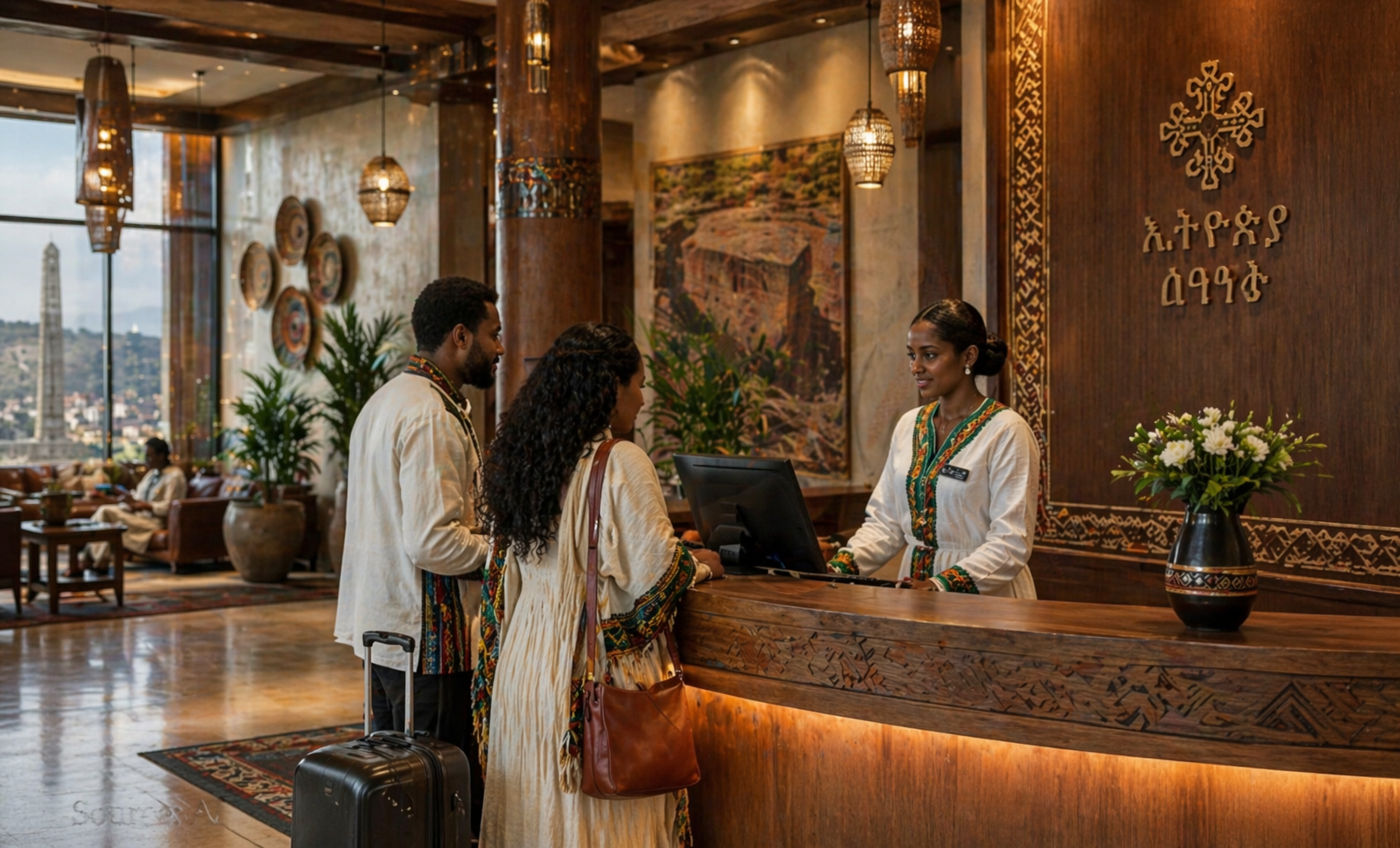
All foreign visitors are required to present a valid passport at check-in under Ethiopian hotel registration rules. Ethiopian nationals need a government-issued ID. Keep your passport accessible throughout your stay, particularly at properties in smaller towns and heritage areas where registration rules are enforced.
Security deposits are uncommon outside Addis Ababa’s international hotels. Smaller properties may ask for full payment upfront rather than a deposit and balance on checkout. Confirm the payment structure when you book, particularly if you are arranging payment by bank transfer or Telebirr in advance.
Tips for a Smoother Booking
- Always confirm payment acceptance before you arrive, especially for properties outside Addis. Phone or WhatsApp contact with the hotel is standard practice in Ethiopia and usually gets a response within the day. Do not assume a property accepts any payment method other than cash unless you have confirmed it directly.
- Carry Ethiopian birr in cash and withdraw more than you think you need before leaving Addis or any major town. ATMs in Lalibela can run out of cash and go offline for days at a time. Running short of birr at a remote UNESCO site with no card terminal and no functioning ATM is one of the most common logistical problems travelers encounter in Ethiopia.
- Book peak season travel well in advance. October through January is the best weather window for historical sites in the north, and mid-range options in Lalibela in particular fill up weeks ahead during this period. The Omo Valley is most accessible between June and September. The payment method you plan to use makes no difference if the room is already taken.
- USD is accepted at some tourist-facing lodges and eco-camps in remote areas, but do not rely on it as your only plan. Carry small denomination notes if you plan to use dollars, and always confirm acceptance with the property before arrival. Ethiopian birr is the safest fallback for every destination in the country.
Frequently Asked Questions
1. Do hotels in Ethiopia accept debit cards?
International chain hotels in Addis Ababa, including the Hilton, Sheraton, and Radisson Blu, accept Visa and Mastercard debit cards at check-in. Coverage drops sharply outside the capital. Mid-range and budget properties in Lalibela, Gondar, Axum, and across the Omo Valley and Afar region rarely have card terminals. For all destinations outside Addis, plan to pay in Ethiopian birr cash and carry enough to cover the full stay.
2. Can you use mobile money to pay for hotels in Ethiopia?
Yes, at a growing number of properties in Addis Ababa and larger towns. Telebirr, Ethio Telecom’s mobile money platform, is increasingly accepted at mid-range hotel front desks in Addis. CBE Birr from the Commercial Bank of Ethiopia is accepted at some properties as well. Coverage is much more limited outside major urban centres. Always confirm with the specific property before arrival if mobile money is your intended payment method, and carry cash as a backup for destinations in the north and south of the country.
3. Is Telebirr accepted at hotels in Ethiopia?
Telebirr is accepted at a growing number of mid-range and budget hotels in Addis Ababa, and acceptance is expanding in larger regional towns. Properties in Lalibela, Gondar, and remote destinations are less likely to have Telebirr set up, though some do. Telebirr requires an Ethiopian phone number and NID for full registration, which limits its use for short-stay international visitors. Domestic Ethiopian travelers will find it the most practical digital payment option available at hotel front desks in urban areas.
4. Do Addis Ababa hotels require a credit card?
International chain hotels in Addis Ababa, including the Sheraton, Hilton, and Radisson Blu, typically require a card at check-in for the security deposit. Many will accept a cash deposit in lieu of a card if arranged in advance. Mid-range and budget properties across the city do not require a credit card and routinely handle cash and Telebirr payments at check-in. Confirm the deposit policy directly with the property before arrival if you do not have a card.
5. Can I book a hotel in Ethiopia with Bitcoin or USDT?
Yes. CoinBooking lists the same hotels at up to 30% less than Booking.com or Expedia and accepts Bitcoin, USDT, Apple Pay, Google Pay, and over 100 other payment options for hotel and flight bookings across Ethiopia and 190+ countries. No credit card and no bank account is required at any stage. Early users receive $25 off their first booking.
6. Can a debit card be used to book a hotel in Ethiopia?
Yes, for international chain hotels in Addis Ababa and for the booking stage on international OTA platforms. Visa and Mastercard debit cards are accepted at the Hilton, Radisson Blu, Sheraton, and similar properties in the capital. Outside Addis, card infrastructure is very limited. For remote destinations including Lalibela, Gondar, and the Danakil Depression, plan to pay in cash. If you prefer no pre-authorization hold on your card at any stage, CoinBooking requires no card and no pre-authorization. Pay at booking and arrive with nothing outstanding.

Yaryna Dobrianska is a Dubai-based business and technology writer with a background in fintech and digital services. She covers cryptocurrency adoption, cross-border payments, and the practical realities of spending digital assets across emerging markets.
Her work at CoinBooking focuses on helping readers navigate crypto travel, compare rates, and make smarter booking decisions — whether they're paying in BTC, USDT, or Apple Pay.
Latest