.avif)
.avif)

.png)

Content
What Is Constellation (DAG) Coin? Top 5 Ways to Use DAG in 2026

Constellation (DAG) is a crypto coin that powers the Hypergraph, a network built on a directed acyclic graph rather than a traditional blockchain, where businesses and applications run their own customisable subnetworks, called metagraphs, to validate and process data. It is designed for large-scale, real-world data rather than typical crypto transactions, and transfers of DAG across the network are feeless by default.
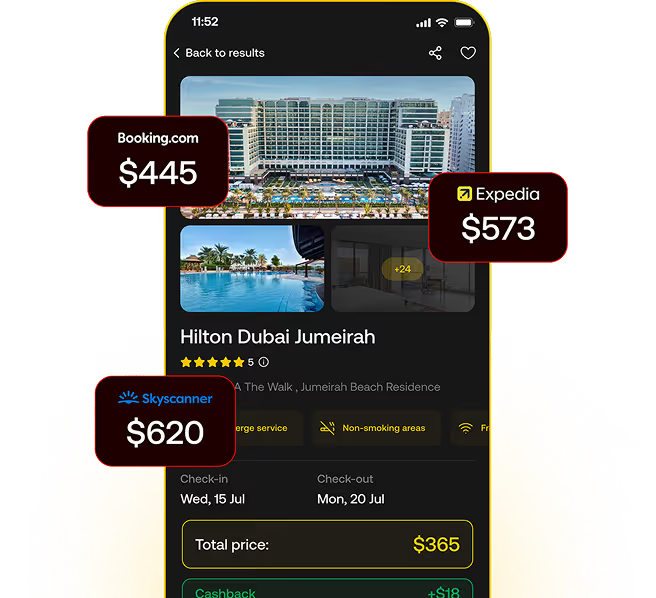
At the time of writing (August 2026), DAG trades at $0.006994, with a market capitalisation of roughly $20.09 million and a rank of #614 on CoinMarketCap. Beyond speculation, DAG has practical utility across peer-to-peer transfers, network security, validator staking and delegated staking within the Constellation ecosystem. For travellers who already hold DAG or other cryptocurrencies, CoinBooking lets you book hotels and flights with up to 30% savings compared to Booking.com and a $25 discount on your first trip upon sign-up.
See how much you
could save with $DAG
Answer 2 questions to get your personalized
savings estimate.
Question 1 of 2
Where do you want to go?
Question 2 of 2
How many nights?
Your result
Get similar deals when we go live.
Get $25 off your first trip.
Key Takeaways
- DAG is Constellation Network's native utility token, used for peer-to-peer transfers, network security and metagraph operations.
- Constellation Network was acquired by AIAI Holdings Corporation (Nasdaq: AIAI) in May 2026. The company's official channels state the acquisition "brings growth capital to scale our products"; financial terms were not disclosed.
- Constellation was founded in 2017 and is built around the Hypergraph Transfer Protocol (HGTP), a decentralised network made up of a global Layer 0 Hypergraph and application-specific metagraphs, secured by a layered Layer 0 and Layer 1 consensus model, with node behaviour tracked by a reputation system called Proof of Reputable Observation (PRO Score).
- Validators stake 250,000 DAG per node, while DAG holders can delegate their tokens to a validator without running their own node and earn a fixed 3% annualised incentive plus a share of network emissions.
- The Hypergraph has documented enterprise and government engagements, including a partnership with Common Crawl to validate web-scale AI training data and joining the Panasonic Connect XCELERATE developer program in October 2024 with the stated aim of integrating HGTP into TOUGHBOOK devices.
- CoinMarketCap lists DAG at $0.006994 and a $20.09 million market capitalisation as of 13 August 2026. Its recorded all-time high is $0.4624 from 26 August 2021; the current price sits roughly 98.5% below that high.
- Spend DAG on travel with CoinBooking: book hotels and flights up to 30% lower than Booking.com across 190+ countries. New users get $25 off their booking.
DAG at a Glance
What Is Constellation (DAG) Coin?
Constellation's DAG is the native utility token of the Constellation Network. It supports peer-to-peer transfers, network security and metagraph operations within the Hypergraph ecosystem.
Constellation was founded in 2017. In May 2026 it was acquired by AIAI Holdings Corporation, which direct-listed on the Nasdaq Global Market under the ticker AIAI on 14 May 2026; the acquisition was announced on 19 May 2026 and financial terms were not disclosed. Constellation continues to operate the network under AIAI ownership. Its core infrastructure is the Hypergraph Transfer Protocol (HGTP), which combines a global Layer 0 network, the Hypergraph, with independent metagraph networks.
A metagraph, previously called a state channel, is a custom network that can process data and transactions according to its own business logic before submitting its state to the Hypergraph for final validation. The network uses a directed acyclic graph (DAG) architecture rather than a conventional linear blockchain. Its official documentation describes the Hypergraph as a fee-less network for transferring DAG.
Consensus runs across layers. Currency Layer 1 validates token transactions, and Data Layer 1 validates application-specific data, each forming blocks. Each metagraph's own Layer 0 aggregates those blocks into snapshots, which it submits to the Global Layer 0, the Hypergraph, for final validation. Node behaviour across the network is tracked by a reputation system called Proof of Reputable Observation (PRO Score), which scores how reliably nodes participate rather than acting as the consensus algorithm itself.
The Hypergraph is positioned around data-intensive, real-world use. Constellation announced a partnership with Common Crawl in December 2024 to provide secure validation of web-scale AI training data, and in October 2024 it joined the Panasonic Connect XCELERATE Software Application Developer Program for TOUGHBOOK, with the stated aim of integrating HGTP into Panasonic's TOUGHBOOK devices. No further progress on that integration has been announced since.
Under AIAI ownership, Constellation has shipped a run of enterprise products in 2026. Gate AI, launched on 8 July 2026, is a security layer that sits between applications and large language models, detecting prompt-injection attacks and writing tamper-evident audit trails to the Hypergraph through Constellation's Digital Evidence API. Arca, a self-custodial dollar-stablecoin wallet, launched on 2 June 2026. Dôr Retail Intelligence, a retail traffic and point-of-sale analytics platform covering more than 2,000 stores, launched on 11 August 2026.
It also has documented work across the defence, logistics and IoT sectors. Constellation completed a US Air Force SBIR Direct-to-Phase II blockchain contract in May 2023, securing data exchange with commercial airlift partners in the Defence Transportation System, work validated by AFRL and AFWERX. The company says it maintains US Department of Defence engagements, though no current contract has been publicly named. DAG is therefore not simply a payment token. It is part of the network's economic infrastructure, connecting validators, metagraphs and network resources.
How Does Constellation DAG Work?
Constellation separates transaction processing into different network layers.
At the DAG Layer 1, validators process transactions involving the native DAG token. At the Layer 0 level, validated information is processed into snapshots that form part of the Hypergraph's canonical state. The DAG structure allows transactions to be validated in parallel rather than sequentially.
The metagraph model lets individual applications run their own networks while connecting to the broader Hypergraph. Each metagraph can process custom data and tokens using its own logic and consensus, then submits snapshots to the Global Layer 0 for final validation.
DAG also has a direct role in the network's fee system. Metagraph operators pay snapshot fees in DAG for the validation and storage of metagraph snapshots. These fees are calculated according to the work involved, including snapshot size and other network parameters, and are paid by metagraph operators rather than ordinary end users.
DAG Tokenomics
Constellation uses an adaptive supply model it calls Metanomics. Official material describes it as a model that dynamically adjusts token emissions and removes metagraph snapshot fees from circulation to support long-term economic stability. Constellation's documentation describes network inflation starting at around 6% and stepping down over time toward roughly 0.5%.
New DAG is minted to reward network participants, while snapshot fees consumed by the network reduce the inflationary effect of emissions. Because user transfers on the Hypergraph are feeless, these fees come from metagraph activity rather than ordinary transactions.
CoinMarketCap currently lists 3 billion DAG as total supply, with 2.87 billion DAG circulating and no maximum supply figure. Current official documentation does not provide a single, up-to-date allocation table covering team, investors, community and liquidity in the form required for this guide, so those allocation figures are excluded rather than inferred from older tokenomics material.
Top 5 Ways to Use Constellation DAG
1. Book discounted hotels and flights with DAG on CoinBooking
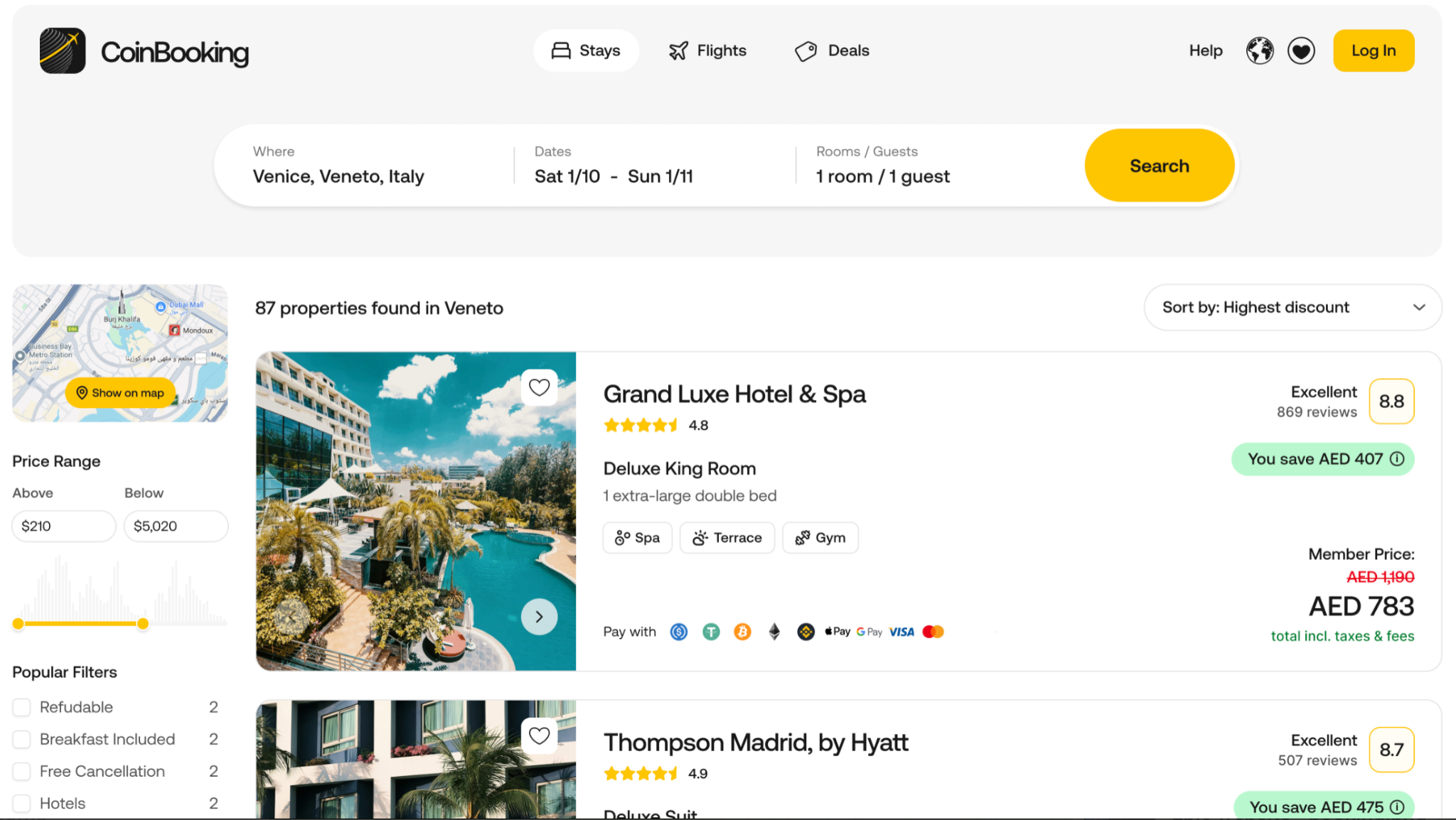
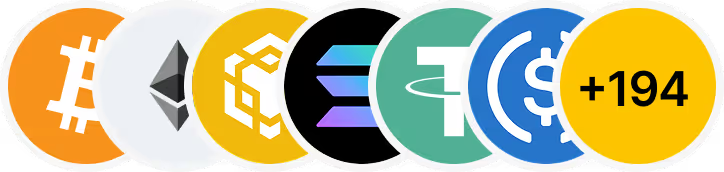
The easiest and most practical way to spend DAG is through CoinBooking. Book hotels and flights up to 30% lower than Booking.com. CoinBooking is a crypto-native travel platform operating across 190+ countries. It connects users to over 2 million hotels and flights globally and accepts 200+ cryptocurrencies, including DAG, as well as traditional payment methods such as Visa, Mastercard, Apple Pay, and Google Pay. New users get $25 off their booking.
Book your next hotel for up to 30% less
2. Send DAG across the Constellation Network
DAG can be used for peer-to-peer transactions on Constellation. Constellation's documentation describes the network as fee-free by default, meaning users can send and receive tokens without paying a fee in most cases. Small optional fees, from 0.002 DAG, can be attached to prioritise a transaction for the next snapshot, trigger parallel consensus, or bypass dynamic rate limits on low-balance accounts.
This is the most direct use of the token. Users can hold DAG in a compatible wallet and transfer it across the network. Constellation's official documentation identifies Stargazer Wallet as the wallet for storing, buying, swapping and sending DAG, and it is the wallet used for delegated staking. Constellation launched a second official wallet, Arca, in June 2026, but Arca is a self-custodial dollar-stablecoin wallet rather than a DAG wallet, so Stargazer remains the one to use for DAG.
3. Run a validator node
DAG can be used to participate directly in network validation. Constellation requires validators to stake 250,000 DAG per node to help secure the network and process transactions. Validators review and validate snapshots and receive DAG rewards for their role. Running a validator therefore uses DAG as network collateral as well as an incentive mechanism.
4. Delegate DAG and earn network incentives
DAG holders do not need to operate their own validator node to participate in network security. Constellation's delegated staking system, live on mainnet since 20 May 2025, allows holders to lock DAG behind a validator. The minimum is 5,000 DAG per position and a single wallet can hold up to ten positions.
According to Constellation's documentation, delegated positions earn a fixed 3% annualised incentive plus a share of 45% of network inflation emissions, and some metagraph validators offer additional Layer 0 token rewards. Validators set a commission, typically between 5% and 10%, on the rewards generated by delegated stake. Delegated tokens remain in the holder's wallet but become non-transferable while locked, and undelegating is subject to a 21-day lock-up before the tokens can be withdrawn.
5. Trade DAG on exchanges
DAG is available to trade on centralised exchanges. Constellation also has its own decentralised exchange, PacaSwap, which launched in late 2025 and is built as a metagraph on the network rather than as a smart contract on another chain. It is live but small: DefiLlama shows total value locked of roughly $309,000 and 24-hour volume in the low thousands of dollars, so most DAG trading still happens on centralised venues. DAG can therefore be held, transferred and traded as a network asset across both centralised and decentralised venues.
Is Constellation DAG a Good Investment?
Whether DAG is a suitable investment cannot be established from the network's documentation alone. The relevant verifiable information is its current market data, historical performance, token supply, documented network mechanics and real-world adoption.
As of 13 August 2026, CoinMarketCap lists DAG at $0.006994, with a $20.09 million market capitalisation, approximately $602,600 in 24-hour trading volume and a #614 ranking. CoinMarketCap records an all-time high of $0.4624 on 26 August 2021, leaving the current price approximately 98.5% below that recorded high based on CoinMarketCap's displayed performance figure. CoinMarketCap also records an all-time low of $0.0008968 on 21 March 2019, leaving the current price roughly 680% above that low.
On supply, CoinMarketCap reports 2.87 billion circulating DAG against 3 billion total supply, with no maximum supply listed. The Metanomics model means supply is adjusted through emissions and fee burning rather than fixed by a hard cap.
On the network-use side, DAG has documented functions in peer-to-peer transfers, validator collateral, delegated staking and metagraph snapshot fees, and the Hypergraph has documented enterprise and government engagements, including the Common Crawl data-validation partnership, a Panasonic Connect developer-program engagement for TOUGHBOOK devices, and US defence-sector blockchain work. Set against that, DAG is a small-cap asset with thin daily trading volume, which can make its price sensitive to modest buy or sell orders.
Note also that AIAI Holdings' 2026 product announcements, Gate AI, Arca and Dôr, do not reference the DAG token, and no statement on what the acquisition means for DAG tokenomics has been published. Separately, aggregators disagree on DAG's supply: CoinMarketCap counts 2.87 billion circulating, while CoinGecko counts 3.91 billion and reports a market cap roughly a third higher as a result.
These are factual characteristics of the asset and network. They do not establish a future price or make DAG a suitable investment for any particular investor. This is not financial advice. Crypto is volatile. Always do your own research and never invest more than you can afford to lose.
Explore Other Infrastructure and Layer 1 Coins
If you found this guide useful, explore these other coin guides:
- What Is Render (RENDER) Crypto Coin? Top 5 Ways to Use It in 2026
- What Is NEO Crypto Coin? Top 5 Ways to Use It in 2026
FAQs
1. What is Constellation (DAG)?
Constellation is a network that uses a directed acyclic graph architecture and the Hypergraph Transfer Protocol (HGTP) to process data and transactions. DAG is its native utility token, used for peer-to-peer transfers, network security and metagraph operations.
2. What is DAG used for?
DAG is used for peer-to-peer transfers, network security, metagraph operations and snapshot fees. It is also used as validator collateral, for delegated staking, and for trading on supported exchanges.
3. How much DAG is required to run a validator?
Constellation's documentation states that validators must stake 250,000 DAG as collateral per node.
4. Can I stake DAG without running a node?
Yes. DAG holders can delegate their tokens to a validator without operating their own node. Delegated positions earn a fixed 3% annualised incentive plus a share of network emissions, subject to a 21-day lock-up when undelegating.
5. What is the current price of DAG?
CoinMarketCap lists DAG at $0.006994, with a market capitalisation of $20.09 million, as checked on 13 August 2026.
6. What is the total supply of DAG?
CoinMarketCap currently lists 3 billion DAG as total supply and 2.87 billion DAG as circulating supply. It does not list a maximum supply figure.
7. Can you spend crypto on travel with CoinBooking?
CoinBooking is a crypto-native travel platform that is preparing to launch. It says that once live, it will accept 200+ cryptocurrencies for hotels and flights and let users save up to 30% compared with Booking.com, plus $25 off the first booking for new users.

Saira Parveen is a Dubai-based SEO content writer with a background in digital marketing and search visibility. She covers cryptocurrency adoption, travel booking with digital assets, and the practical side of spending crypto in everyday life.
Her work at CoinBooking focuses on helping readers navigate the intersection of crypto and travel, from finding the best rates on hotels and flights to understanding how to pay for travel with digital assets.
Found a hotel you like? Book it for up to 30% less

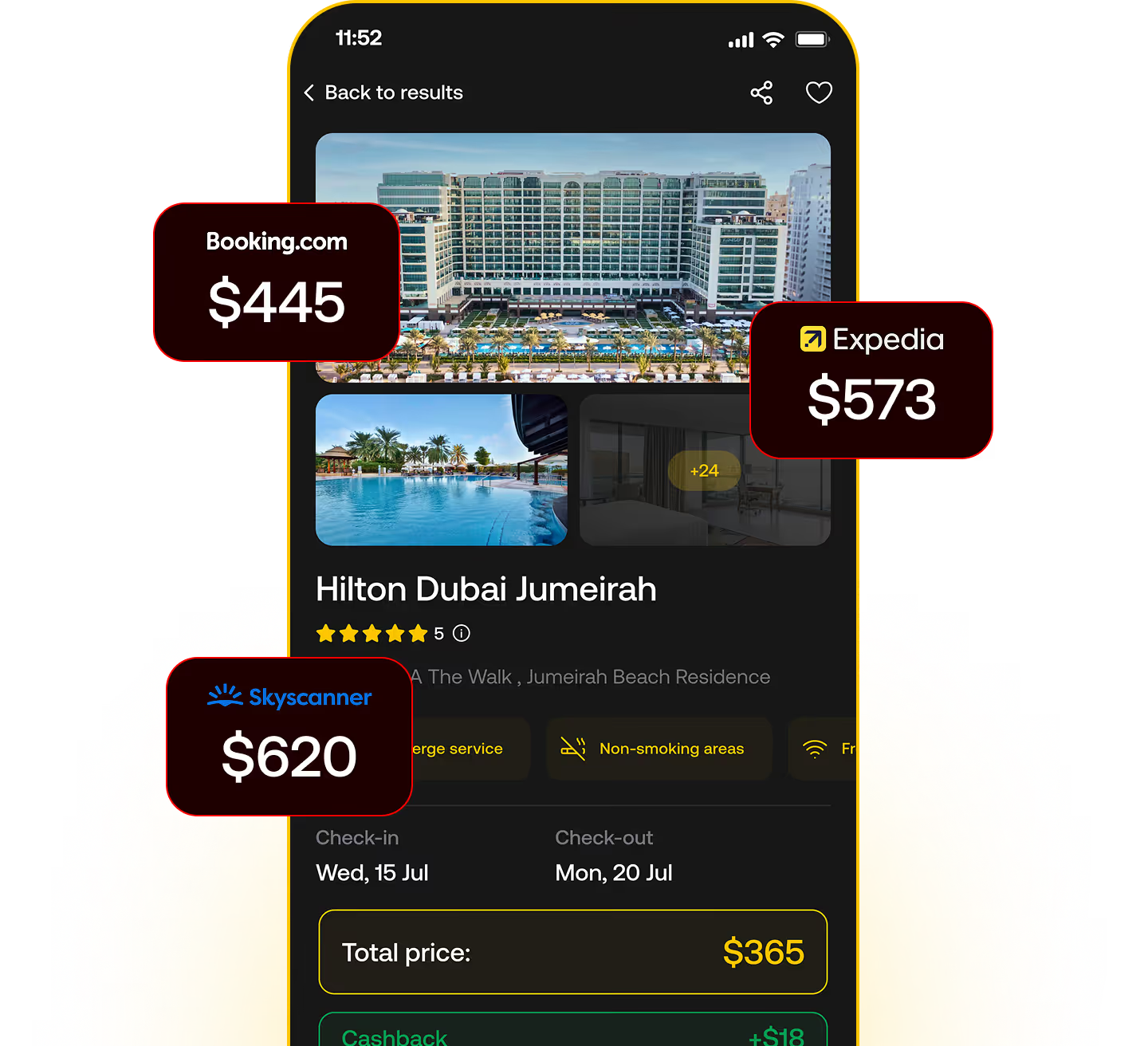
Found a hotel you like? Book it for up to 30% less