.avif)
.avif)

.png)

Content
What Is Pharos Coin (PROS)? Top 5 Ways to Use Pharos Crypto Coin in 2026

Pharos (PROS) is a Layer 1 blockchain engineered as institutional-grade infrastructure for tokenising and trading real-world assets (RWAs) alongside decentralised finance applications. Built by former Ant Group leadership, the network combines modular architecture, deep-parallel execution, and built-in compliance to process up to 30,000 per second with sub-second finality. Pharos has processed over 3 billion testnet transactions and attracted backing from Sumitomo Corporation, Flow Traders, and other global financial institutions.
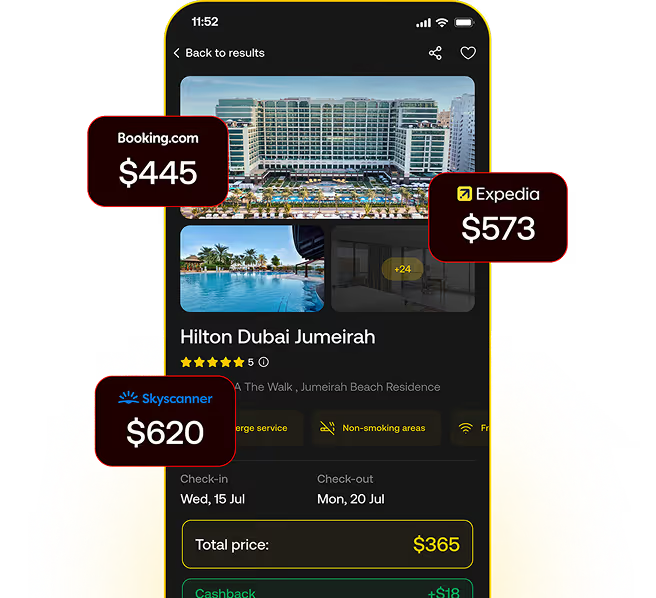
PROS trades at $0.4241 with a market capitalisation of $57.524 million. Beyond holding and staking, Pharos offers real utility: tokenising commodities and real estate on-chain, delegating to validators to earn staking rewards, deploying as a network validator, building decentralised applications, and booking hotels and flights with PROS on CoinBooking at up to 30% below Booking.com prices.
See how much you
could save with $PROS
Answer 2 questions to get your personalized
savings estimate.
Question 1 of 2
Where do you want to go?
Question 2 of 2
How many nights?
Your result
Get similar deals when we go live.
Get $25 off your first trip.
Key Takeaways
- Pharos is a modular Layer 1 blockchain launched by former Ant Group founders, operating the Pacific Ocean mainnet since late 2025 with partnerships including Sumitomo Corporation and Ant Digital Technologies overseeing a $1.5 billion RWA exchange pipeline.
- The network achieves 30,000 transactions per second with sub-second finality through deep-parallel execution, dual VM support (EVM and WASM), and AsyncBFT consensus, making it suitable for institutional-scale applications.
- Pharos has a maximum supply of 1 billion PROS tokens; approximately 135.6 million are currently circulating (13.56%), with remaining tokens reserved for ecosystem growth, validators, and core development over the next 3-5 years.
- Book hotels and flights with PROS on CoinBooking at up to 30% below Booking.com prices. Early access users receive $25 off their first booking, effectively doubling savings on initial trips.
- PROS holders can earn staking rewards through validator delegation or by delegating to validators themselves to earn higher rewards and gain governance voting power on protocol decisions.
Pharos at a Glance (July 2026)
What Is Pharos Network?
Pharos Network is an institutional-grade Layer 1 blockchain specifically designed to bridge traditional finance and Web3 by enabling seamless tokenisation and trading of real-world assets. Rather than restricting blockchain to speculative crypto trading, Pharos focuses on bringing regulated assets like bonds, real estate, commodities, and structured financial products on-chain in a compliant manner.
The problem Pharos addresses is the inefficiency and fragmentation in traditional asset settlement and cross-border commerce. Today, settling real estate transactions or commodities trades involves multiple intermediaries, takes days or weeks, and incurs substantial fees. Meanwhile, institutional capital remains sceptical of blockchain due to speed limitations, regulatory uncertainty, and architectural constraints. Pharos solves this by combining high throughput, built-in compliance modules, and institutional backing.
Pharos was co-founded by former Ant Group (Alibaba's fintech division) executives with deep expertise in blockchain infrastructure and financial systems. The leadership team includes:
- Alex Zhang (Founder & CEO) - Ex-CTO of Ant's blockchain group, former CEO of ZAN. Brings extensive experience in high-performance blockchain systems and distributed technologies.
- Wish Wu (CTO & Co-Founder) - Leads technical research and development, speaks publicly on Pharos's strategic direction and technological roadmap.
The broader team includes professionals from Ant Financial, Microsoft Research, and Stanford University with specialised expertise in blockchain infrastructure, formal verification, and zero-knowledge cryptographic systems. This deep technical bench combined with fintech experience shapes Pharos's focus on institutional-grade infrastructure.
A defining partnership came with Ant Digital Technologies, which is incubating a $1.5 billion real-world asset exchange pipeline on Pharos, representing a major institutional commitment to the platform.
Beyond this core partnership, Pharos has established strategic integrations with key ecosystem players:
- Morpho - The most significant recent partnership. Pharos is integrating Morpho's native lending infrastructure directly on its blockchain to support institutional-grade real-world asset (RWA) lending with modular, risk-isolated vaults. This enables transparent, scalable credit markets for tokenised assets.
- Orbiter Finance - Strategic bridge partnership enabling seamless ETH bridging from Arbitrum and Sepolia to Pharos, expanding cross-chain liquidity and interoperability.
- Bitverse - Collaboration to launch a high-speed PerpDEX (perpetual derivatives exchange) on Pharos, providing enterprise-grade perpetual trading infrastructure for both retail and institutional users.
Additional integrations with leading Web3 infrastructure providers ensure technical maturity and security at launch.
How Does Pharos Network Work?
Pharos operates through a layered architecture designed for modularity, scalability, and compliance. The system comprises three integrated layers: the Base layer handles data availability, the Core layer manages consensus and execution, and the Extension layer facilitates network expansion and specialised processing networks (SPNs).
The execution flow begins when users or institutions submit transactions or asset tokenisation requests. These transactions are propagated through the mempool to validators, which run through Pharos's validator software. Validators apply the AsyncBFT consensus mechanism, a variant of asynchronous Byzantine Fault Tolerance, allowing the network to reach finality in under one second.
Unlike traditional blockchains that process transactions sequentially, Pharos employs deep-parallel execution techniques such as Smart Access List Inferring (SALI), which automatically identifies non-conflicting transactions and processes them simultaneously. The network currently achieves 30,000 transactions per second in testnet conditions, with engineering roadmaps targeting 50,000+ TPS at scale through continued optimisation and modular expansion.
For real-world asset tokenisation, institutions interact with Pharos through specialised modules. Compliance is enforced at the protocol layer: transactions involving regulated assets pass through integrated zero-knowledge KYC (zk-KYC) and AML (anti-money laundering) checks before confirmation. This design removes the need for off-chain compliance review, accelerating settlement while maintaining regulatory alignment.
Pharos supports dual virtual machines: the Ethereum Virtual Machine (EVM) for Solidity-based smart contracts and WebAssembly (WASM) for high-performance applications. This flexibility allows developers familiar with Ethereum tooling to deploy existing contracts while giving performance-critical applications the option of WASM compilation.
Validators earn rewards for processing transactions and maintaining network consensus. Stakers delegate PROS tokens to validators and earn a share of block rewards. Special Processing Networks (SPNs) enable application-specific subnets that inherit security from the main chain while maintaining independent execution engines, validator sets, and governance, creating a composable scaling solution.
Validators can restake their PROS tokens into SPNs (supporting restaking protocols like Babylon and EigenLayer), earning additional rewards across multiple networks while maintaining security for specialised use cases.
Pharos Network Development Roadmap
Pharos follows a phased rollout designed to expand ecosystem capabilities, institutional partnerships, and protocol maturity. The roadmap reflects the project's commitment to supporting RWA integration, DeFi infrastructure, and community participation:
Q1 2025: Early Ecosystem Expansion. Focus on ecosystem development and network participation. Key activities include early community onboarding, initial developer recruitment and technical support, validator recruitment and infrastructure preparation, and foundational research into Special Processing Networks (SPNs) design and optimisation.
Q2 2025: Public Testnet Launch Scheduled for May 7, 2025, the public testnet introduced Pharos's modular architecture to developers and community participants. This phase featured full implementation of the architecture layers, community-driven testing of validator and staking mechanics, and engagement campaigns through partner wallets including Bitget Wallet. Testnet transactions and participation were recorded for future ecosystem rewards allocation.
Q3 2025: Integration & Mainnet Preparation The network accelerated institutional partnerships and protocol maturity. Key milestones include integration of Morpho's native lending infrastructure for RWA credit markets, early SPN implementations supporting specialised use cases, preparation for mainnet launch with final security audits and protocol refinements, and rollout of restaking support enabling validators to participate across multiple networks (Babylon, EigenLayer integration).
This roadmap reflects Pharos's evolution from research and testnet development into an institutional-ready Layer 1 capable of supporting real-world asset finance at scale.
Top 5 Ways to Use Pharos Network Crypto Coin (PROS)
1. Buy Tokenised Real-World Assets and Financial Products
The primary utility of PROS lies in accessing and trading real-world tokenised assets issued on the Pharos network. Institutions, funds, and sophisticated traders use Pharos to purchase fractional ownership of real estate portfolios, commodities (oil, metals, agricultural products), bonds, structured financial products, and emerging infrastructure assets. A $1 million real estate token could be divided into 1,000 fractional shares valued at 1,000 PROS each, enabling retail participation in assets previously reserved for accredited investors.
Traders use PROS to swap between tokenised assets with settlement finality in under one second, compared to the 2-5 business days required by traditional settlement. DeFi protocols deploy yield-generating strategies using Pharos's real-world asset base, offering users exposure to regulated yields without relying on speculative token mechanics. The compliance modules built into Pharos mean institutional investors can participate without legal uncertainty.
As Ant Digital Technology's partnership activates its $1.5 billion RWA pipeline, trading volume and asset diversity on Pharos are expected to expand significantly, increasing the practical use cases for PROS token payments within the ecosystem.
2. Book Hotels and Flights with PROS on CoinBooking
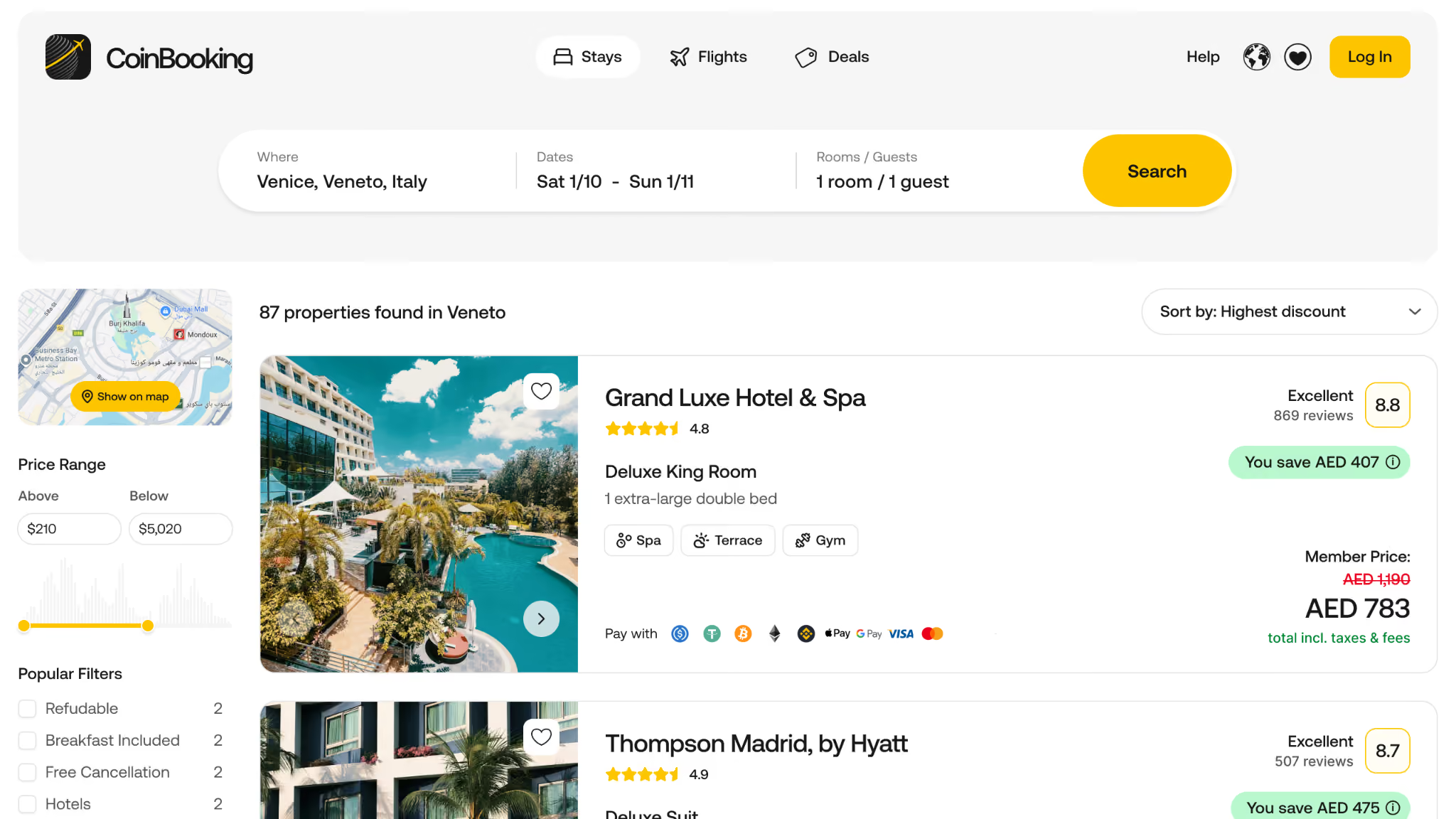
Booking travel with PROS on CoinBooking is the most accessible real-world use case for holders. Instead of liquidating PROS into fiat currency and booking hotels and flights via Booking.com, users can directly book accommodations and flights by paying entirely in crypto.
CoinBooking integrates PROS as a native payment option among 200+ other cryptocurrencies. The process is straightforward: search your destination, select your hotel or flight, choose PROS as payment at checkout, and authorise the transaction from your Web3 wallet. Your reservation is confirmed instantly, and you receive a booking confirmation.
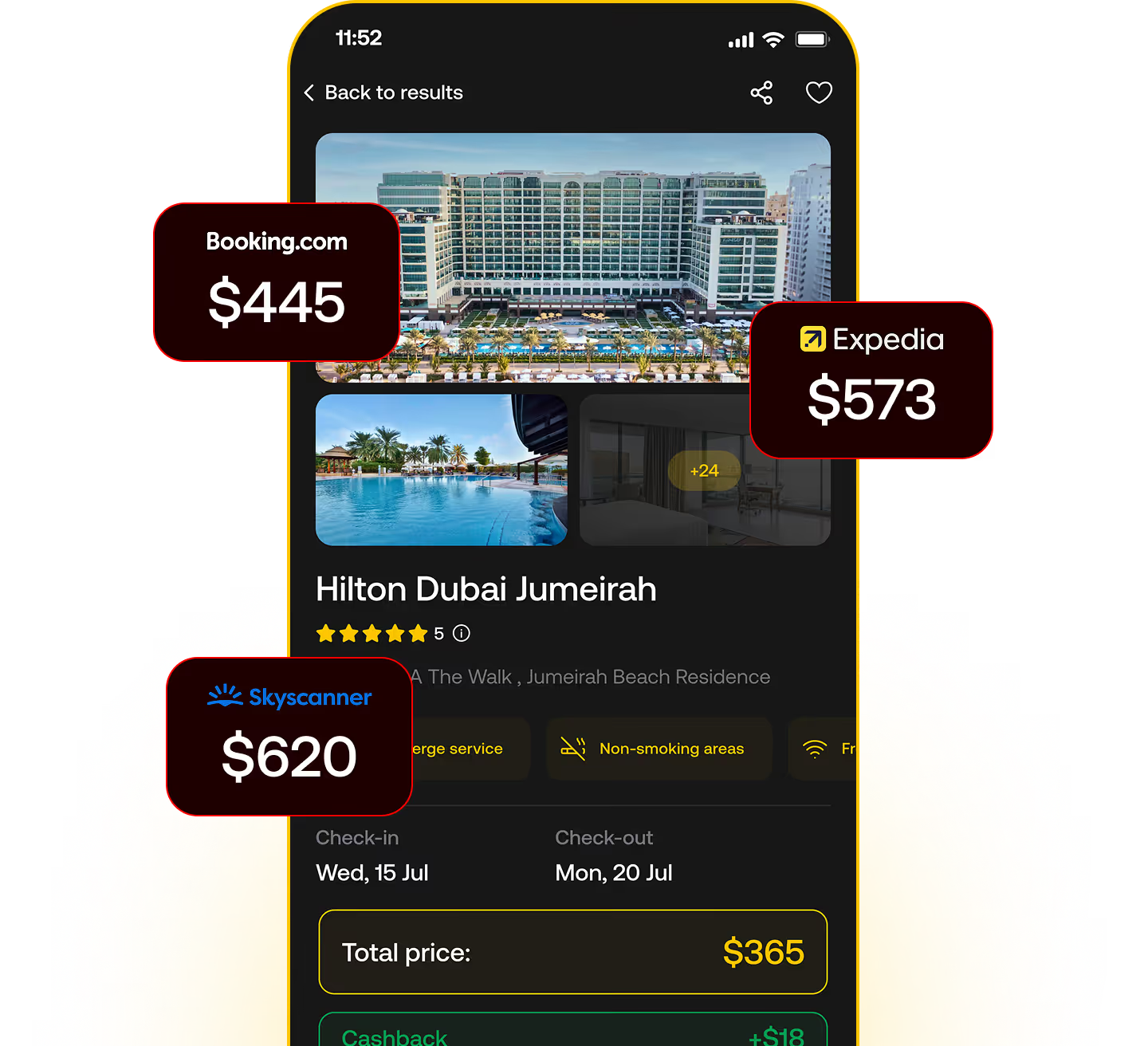
Most crypto travel platforms charge a 10–15% markup at checkout. Meanwhile, CoinBooking does not. That means if you book a $1,000 hotel room(placeholder), you could save $300 instead of paying an extra $100 to $150 on top.
Book your next hotel for up to 30% less
Early access users also receive $25 off their first booking. This effectively doubles the savings on your first trip: you benefit from the discount plus the early access $25 gift.
3. Stake PROS for Passive Rewards
PROS holders can stake their tokens directly to secure the Pharos network and earn rewards through the protocol's native staking mechanism. Staking is non-custodial. Simply connect your Web3 wallet to the Pharos network explorer, select a trusted validator, and delegate your desired amount of PROS to begin earning rewards immediately. Rewards are distributed at regular intervals called epochs and can be claimed and re-delegated to compound your returns over time.
Protocol-native validator staking gives you direct control of your private keys and direct participation in network security. For long-term holders, staking represents a way to generate passive income while supporting the network.
One important timing constraint: unstaking requires a 21-day unbonding period during which your tokens are locked and do not earn rewards. Plan your staking strategy and unstaking timing to avoid missing earning periods and optimise your compounding schedule.
Note: Specific staking yield rates vary based on network participation levels and are not fixed. Check the Pharos network explorer or official documentation for current reward rates at the time of staking.
Some cryptocurrency exchanges also offer limited-time promotional earning programs on PROS. These are exchange-specific incentives funded by the platform itself, separate from the native Pharos protocol rewards.
Exchange earn programs typically feature advertised yields but come with important caveats: they are time-limited promotions, have allocation caps that may fill quickly, are often restricted by region or account type, and may include additional terms or lock-in periods. Always review current terms and conditions before committing capital to any exchange earn program, as promotional yields are temporary and conditions change frequently.
4. Run a Validator or Operate an SPN (Special Processing Network)
If you have technical expertise and capital, operating a Pharos validator node offers higher earning potential than delegation. Validators maintain the blockchain infrastructure, execute consensus, and earn a larger share of network fees. The setup requires running validator software on reliable infrastructure, maintaining uptime, and staking a minimum amount of PROS as collateral.
Alternatively, developers can launch a Special Processing Network (SPN) on Pharos. SPNs are application-specific subnets that inherit security from the main Pharos chain while operating independent validator sets, execution engines, and governance.
An SPN for a specific asset class (real estate tokens, commodity futures, stablecoins) can attract transaction flow and earn fees while contributing to ecosystem growth. Both roles require operational overhead and technical depth, but they provide governance voting rights, higher revenue potential, and direct influence over protocol direction.
Pharos Labs provides detailed documentation and technical support through its developer hub. The network also offers grants and infrastructure funding through the $20 million Ecosystem Grant Program, making it possible to launch an SPN with community backing.
5. Build and Deploy Decentralised Applications on Pharos
Machine learning engineers, blockchain developers, and fintech product teams can build decentralised applications leveraging Pharos's high-throughput and compliance infrastructure. Use cases include real-time payment networks, decentralised exchanges for tokenised assets, automated market makers for real-world asset trading, portfolio management dashboards, and AI-powered financial agents that execute transactions autonomously.
Pharos supports EVM-based Solidity contracts and WebAssembly-compiled applications, allowing developers to use familiar tools or optimise for performance. The network includes comprehensive APIs, a Model Development Kit (MDK), REST and RPC endpoints, and a complete CLI toolkit. Developers deploying applications that generate transaction volume can earn from network fees while building sustainable on-chain businesses.
Through its strategic partnership with Morpho, developers can build on top of native lending infrastructure specifically optimised for real-world assets. This enables developers to create institutional-grade credit markets and financial applications without building their own lending engines from scratch, accelerating time-to-market for RWA-focused products and reducing development friction.
Pharos's compliance infrastructure (zk-KYC, AML, identity modules) is available as composable protocol primitives, allowing developers to build regulated DeFi products without re-implementing compliance from scratch. This architectural advantage attracts institutional users who would otherwise avoid decentralised applications due to regulatory concerns.
Contributors are rewarded through grants, eco, theoretically, and direct transaction fees. As the RWA ecosystem on Pharos expands, application developers will benefit from increasing asset tokenisation and institutional adoption.
Is Pharos a Good Investment?
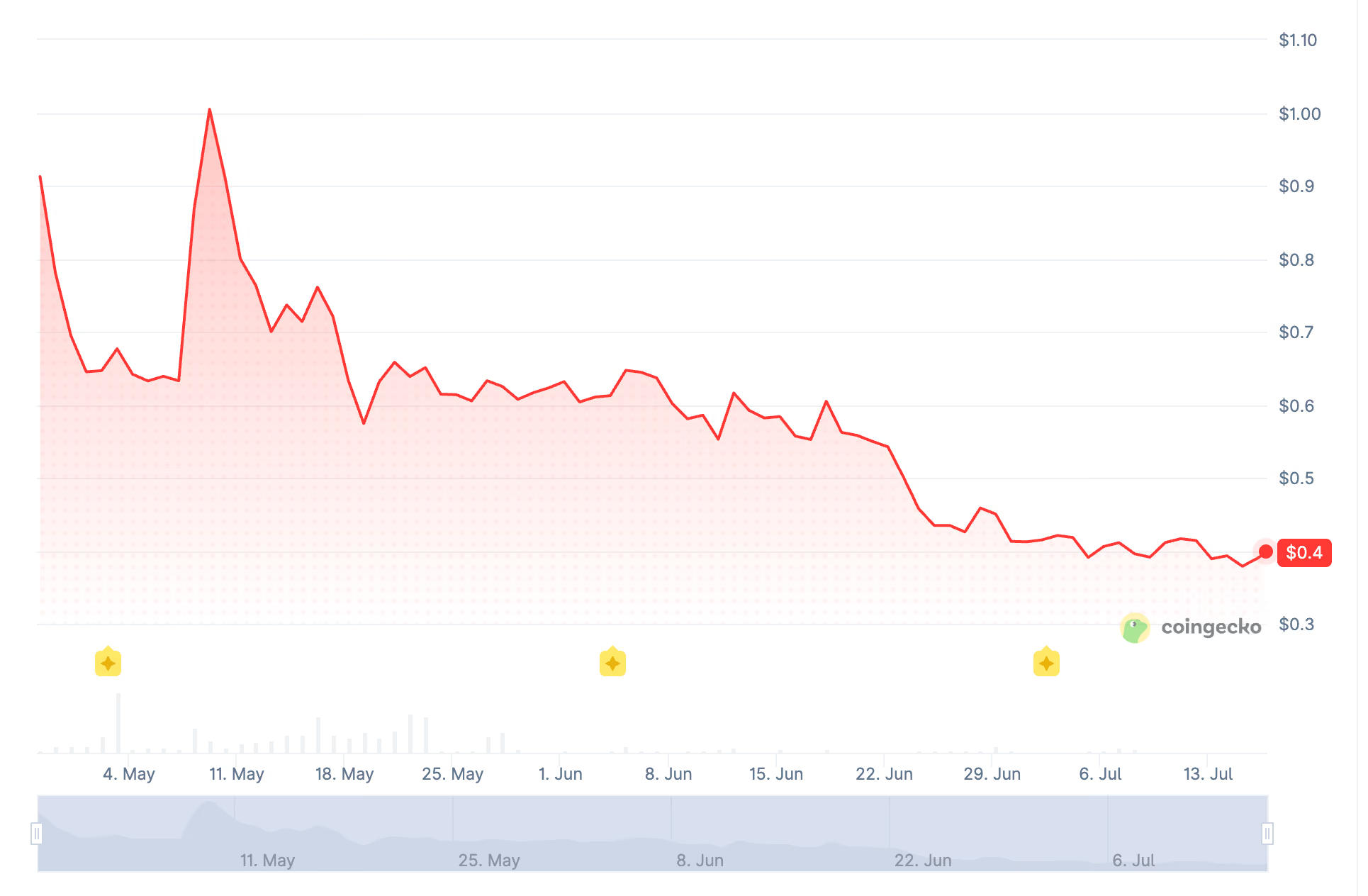
Pharos PROS token price chart showing a steep decline from $1.00 (May 11, 2026) to $0.40 (July 16, 2026) over 10 weeks. The red line graph displays significant volatility with a peak around $1.00 and a gradual downtrend through June, stabilising near $0.40 in mid-July. Three yellow event markers indicate key network milestones during the period.
Whether PROS is a good investment depends on your conviction about tokenised real-world assets as a long-term category and Pharos's ability to capture institutional adoption.
The bull case is institutional and technical. Pharos has real institutional backing (Sumitomo, Flow Traders, SNZ, Hack VC, Faction VC), an active partnership, theoretically 5 billion in RWA trading volume, and a founding team with proven execution experience at Ant Group. The network currently achieves 30,000 TPS with sub-second finality, and engineering roadmaps target 50,000+ TPS at scale through continued optimisation.
Built-in compliance (zk-KYC, AML) addresses a genuine institutional concern, reducing friction for regulated capital participation. The network has reached 174 million wallet addresses and 3 billion testnet transactions, demonstrating technical maturity and developer engagement. Theoretically concrete. PROS trades 62.6% below its all-time high of $1.13 reached on April 28, 2026, indicating significant volatility and ongoing price discovery (see CoinMarketCap's latest price analysis for technical signals).
Competitors in the RWA space, including newer Layer 1 projects and Ethereum Layer 2 solutions, are pursuing similar narratives with larger marketing budgets and established developer bases. Mainstream institutional adoption of decentralised infrastructure remains limited; many financial institutions maintain sceptical security, regulatory clarity, and operational guarantees on decentralised networks.
With only 13.56% of PROS tokens currently circulating, scheduled token unlocks to the core team, ecosystem initiatives, and validators over the next 3-5 years create dilution risk and potential sell pressure. Enterprise migration to on-chain asset tokenisation, while promising, remains nascent and dependent on favourable regulatory developments.
The token is best viewed as a high-risk, high-upside small-cap asset linked to the broader adoption of tokenised finance and institutional Web3 participation. Do thorough research before investing, and never commit capital you cannot afford to lose.
Key Takeaway
The most compelling reason to hold or use PROS is not speculative price appreciation, but the tangible utility it unlocks today. You can use PROS to access fractional ownership of real-world assets without traditional intermediaries. You can earn passive income through staking without relying on centralised exchanges.
Furthermore, you can deploy applications that serve institutional capital and compliance-conscious users. You can participate in network governance and shape the protocol's evolution toward inclusive institutional finance.
For those bullish on the convergence of traditional finance and Web3, Pharos represents one of the most credible experiments in building institutional-grade on-chain infrastructure.
Its success depends on sustained partnerships with real-world asset issuers, continued technological innovation in scalability and compliance, and mainstream adoption by financial institutions seeking faster settlement and reduced operational costs.
Book Your Next Trip with PROS on CoinBooking
Planning your next vacation? Book hotels and flights directly with PROS on CoinBooking and enjoy up to 30% below Booking.com. Early access users get $25 off their first booking.
Join the early access list now and start booking travel with PROS today.
FAQ
1. Is Pharos a good investment?
Pharos offers institutional backing, real-world asset partnerships, and technical performance advantages; PROS remains a high-risk small-cap token trading far below its all-time high. Conduct thorough research and only invest capital you can afford to lose.
2. What is Pharos Network?
Pharos Network is a Layer 1 blockchain engineered for institutional-grade real-world asset tokenisation and decentralised finance. It processes up to 30,000 transactions per second with built-in compliance (zk-KYC, AML), EVM and WASM support, and modular Special Processing Networks for scalability.
3. Who founded Pharos?
Pharos was founded by former Ant Group (Alibaba's fintech division) executives with in-depth experience in payment infrastructure and financial systems. The project raised $8 million to $52 million from Sumitomo Corporation, Flow Traders, SNZ, Hack VC, Faction VC, and other institutional investors.
4. How do I stake PROS?
To stake PROS, connect your wallet to the Pharos network explorer, navigate to the staking section, select a trusted validator, enter your delegation amount, and confirm the transaction. Rewards are distributed at each epoch and can be claimed and re-delegated to compound. Note that unstaking requires a 21-day unbonding period.
5. Can I earn PROS as a developer?
Yes. Blockchain developers and smart contract engineers can build applications on Pharos and earn transaction fees, grants through the $20 million Ecosystem Grant Program, or launch Special Processing Networks (SPNs) for application-specific subnets. The network provides APIs, development kits, and comprehensive documentation.
6. Where can I buy PROS?
PROS is listed on major exchanges including Binance, OKX, Coinbase, Gate, and other centralised platforms, as well as decentralised exchanges within the ecosystem. Daily trading volume varies depending on market conditions.
7. What is the max supply of PROS?
PROS has a maximum supply of 1 billion tokens. Approximately 135.6 million PROS are currently circulating, representing 13.56% of the total supply. The remaining tokens are reserved for ecosystem development, validators, team incentives, and grants over the next 3-5 years.
8. Can I use PROS to book travel?
Yes. While PROS is primarily designed for real-world asset tokenisation and network participation, travel platforms like CoinBooking are integrating crypto payment options. You can book hotels and flights with PROS at up to 30% below Booking.com.

Hadrian is a Web3 marketer with close to five years of experience across social media, content, and SEO for crypto-native brands. He currently leads social media for CoinBooking, shaping content strategy across B2C, B2B, and affiliate channels.
Over the years, Hadrian has worked across the Web3 space, including companies like Animoca Brands and Hailstone Labs, building content and marketing for crypto projects spanning DeFi, gaming, and beyond. From building go-to-market strategy from scratch to digging into competitor data to figure out what actually drives growth, he's learned what actually makes crypto audiences pay attention, and that's exactly what he's applying to CoinBooking.
Found a hotel you like? Book it for up to 30% less

Found a hotel you like? Book it for up to 30% less