.avif)
.avif)

.png)

Content
What Is Singularity Finance (SFI) Coin? Top 5 Ways to Use It in 2026

Singularity Finance (SFI) is a crypto coin created to power an EVM-compatible Layer 2 blockchain that brings the AI economy on-chain, covering the tokenisation of AI compute, AI agents, and real-world assets within decentralised finance. The token was born in February 2025 from the merger of three existing projects: SingularityDAO, Cogito Finance, and SelfKey.
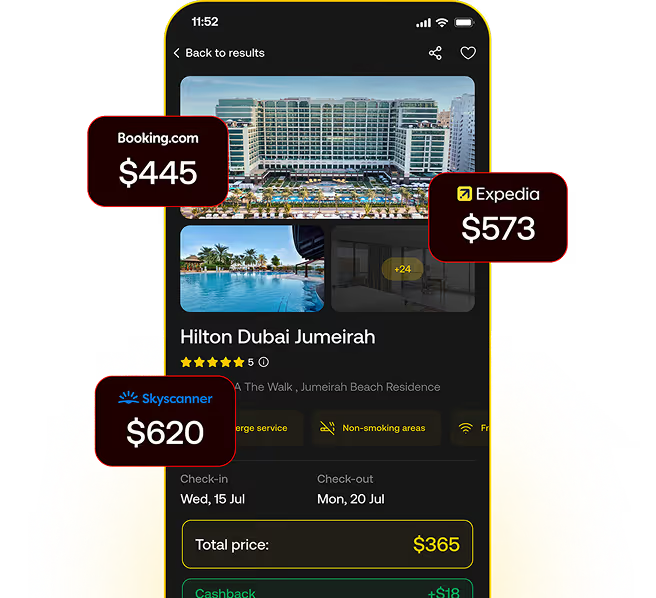
At the time of writing (13 August 2026), SFI trades near $0.0030, with a market capitalisation of roughly $468,000 and a rank of #8013 on CoinMarketCap. It is one of the smallest coins we have covered, and it set a new all-time low on the day of writing, so treat everything in this guide through a high-risk lens. SFI's designed utility covers network fees, staking, tokenisation, and governance within the Singularity Finance ecosystem. For travellers holding SFI or other cryptocurrencies, CoinBooking lets you book hotels and flights with up to 30% savings compared to Booking.com and a $25 discount on your first trip upon sign-up.
See how much you
could save with $SFI
Answer 2 questions to get your personalized
savings estimate.
Question 1 of 2
Where do you want to go?
Question 2 of 2
How many nights?
Your result
Get similar deals when we go live.
Get $25 off your first trip.
Key Takeaways
- Singularity Finance is an EVM-compatible Layer 2 project positioned as the DeFi engine of the Artificial Superintelligence Alliance (ASI), designed to tokenise AI compute, AI agents, and real-world assets.
- The SFI token launched on 6 February 2025 through a three-way token merger: 1 SDAO converted to 1 SFI, 1 CGV to 0.14122 SFI, and 800 KEY to 1 SFI.
- The merger created an initial 241.2 million SFI, with a further 258.8 million minted to fund development and incentives, bringing the maximum supply to 500 million.
- SFI is a micro-cap asset: per CoinMarketCap (13 August 2026), its market cap is roughly $468,000, daily volume is under $6,000, and the price is down 98% from its February 2025 all-time high.
- Spend crypto on travel with CoinBooking: book hotels and flights up to 30% lower than Booking.com across 190+ countries. New users get $25 off their booking.
SFI at a Glance
What Is Singularity Finance?
Singularity Finance is a project that aims to bring the AI economy on-chain. Its stated goal is to tokenise the components of the AI value chain, such as compute hardware, AI agents, models, and datasets, so they can be traded, collateralised, and monetised within DeFi. The platform is designed as an EVM-compatible Layer 2 built on the OP Stack using optimistic rollup architecture, with Ethereum as its security layer, according to the official documentation.
The project emerged from a merger announced in October 2024 between three companies: SingularityDAO, a decentralised portfolio management protocol; Cogito Finance, a real-world asset tokenisation platform within the SingularityNET ecosystem that had brought U.S. Treasury Bills on-chain before the merger; and SelfKey, a blockchain-based digital identity platform focused on KYC compliance. The combined entity launched the SFI token on 6 February 2025.
Singularity Finance was launched under CEO and co-founder Cloris Chen, previously six years at HSBC and CEO of Cogito Finance, though she has made no public appearance since early 2025 and SingularityNET's own ecosystem update for March 2025 referred to "leadership transitions" at the project. She was joined by co-founders Mario Casiraghi, CFO of SingularityNET, and Dr Ben Goertzel, founder and CEO of SingularityNET, who serves as Chief AI Advisor. The project positions itself as the primary financial layer of the Artificial Superintelligence Alliance (ASI), the token alliance originally formed by SingularityNET, Fetch.ai and Ocean Protocol. Ocean Protocol resigned from the alliance in October 2025, withdrawing its directors with immediate effect, and CUDOS has since joined as the compute layer; the alliance's current members are Fetch.ai, SingularityNET and CUDOS. Its CoinMarketCap profile describes progressive integration into ASI:Chain and support for non-EVM smart contracts written in MeTTa, though neither appears anywhere in Singularity Finance's own documentation; a July 2025 roadmap listed only "research and architecture design for cross-chain MeTTa compatibility".
One serious point of caution: there is no evidence the Layer 2 ever launched. The official documentation still schedules mainnet for Q1 2025 and has never been updated. The chain does not appear on chainlist.org or L2BEAT, DefiLlama tracks SFI only as a token on Ethereum, Base and BNB Chain rather than as a chain of its own, and the project's own mainnet explorer, RPC and app subdomains do not resolve. The only network ever documented is a testnet, whose explorer now returns an invalid security certificate.
How Does Singularity Finance Work?
SFI exists today as an ERC-20 token on Ethereum, token on Ethereum, with the same contract address deployed on BNB Chain and a separate deployment on Base. According to the official token utility documentation, SFI is designed to serve four functions on the Singularity Finance Layer 2:
- Network fees. SFI pays for transactions and smart contract execution, and projects tokenising assets on the platform pay a launch fee in SFI.
- Staking and node operations. Holders can stake SFI to operate nodes that validate transactions and generate fraud proofs, or delegate their tokens to node operators and share in rewards.
- Fee burning and incentives. The documentation specifies that 40% of net network fees are permanently burned, while the remaining 60% funds an Ecosystem Incentives Pool that pays node operator and delegator rewards.
- Governance. SFI holders vote on protocol upgrades and the allocation of ecosystem incentives, though the documentation notes these rights do not extend to the issuer's corporate governance.
On tokenomics, the merger converted the three legacy tokens at fixed ratios (1 SDAO = 1 SFI, 1 CGV = 0.14122 SFI, 800 KEY = 1 SFI), producing an initial 241.2 million SFI. A further 258.8 million SFI was minted to fund development and incentives, bringing the total and maximum supply to 500 million. Per CoinMarketCap (13 August 2026), 155.5 million SFI (31.1% of max supply) is in circulation.
Top 5 Ways to Use Singularity Finance Crypto Coin (SFI)
1. Book discounted hotels and flights with SFI on CoinBooking
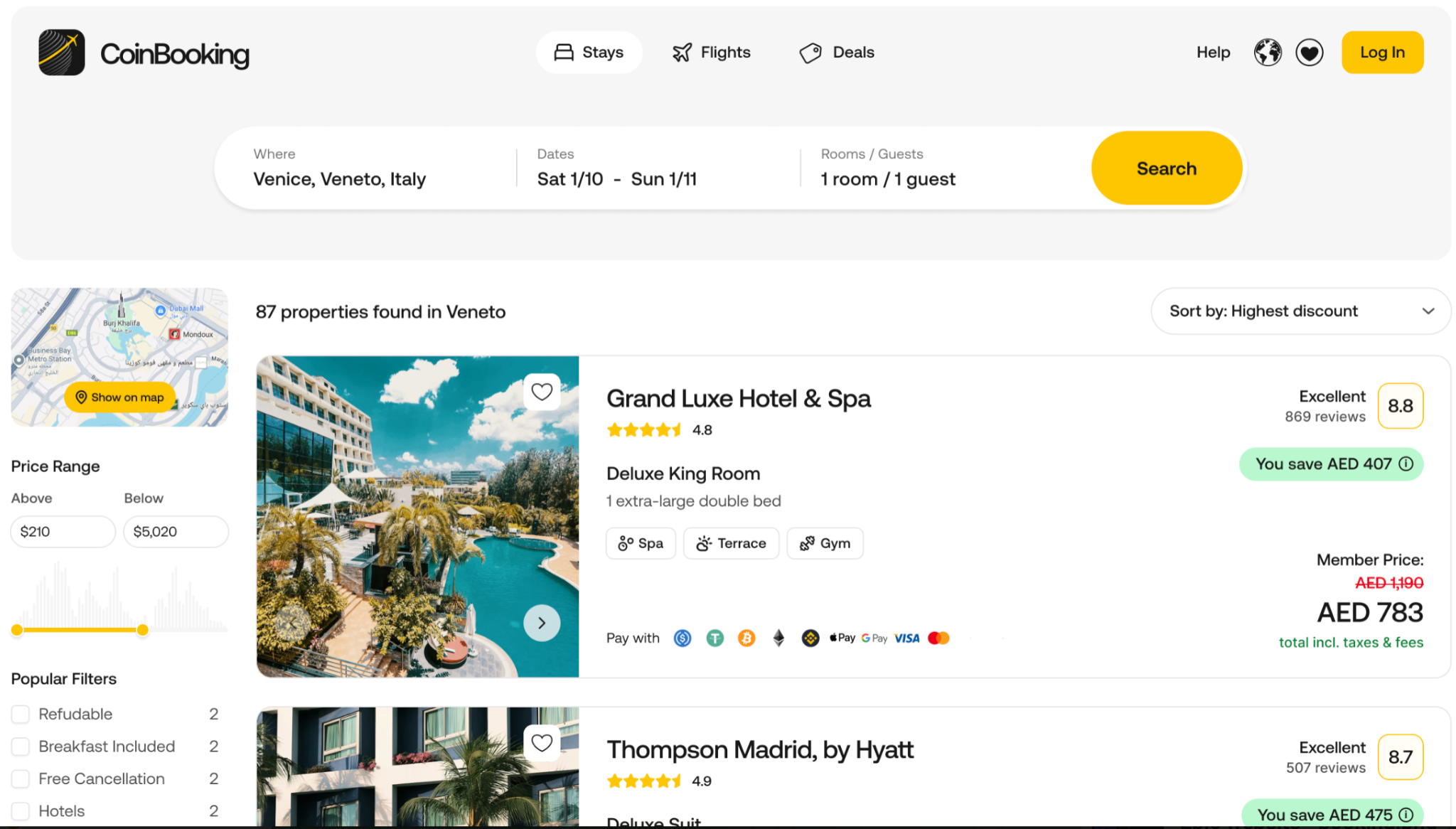
The easiest and most practical way to spend SFI is through CoinBooking. Book hotels and flights up to 30% lower than Booking.com. CoinBooking is a crypto-native travel platform operating across 190+ countries. It connects users to over 2 million hotels and flights globally and accepts 200+ cryptocurrencies, including SFI, as well as traditional payment methods such as Visa, Mastercard, Apple Pay, and Google Pay. New users get $25 off their booking.
Book your next hotel for up to 30% less
2. Stake SFI or delegate to node operators
Staking is SFI's core designed utility, but it has not shipped. The official documentation describes token holders staking SFI to run nodes that validate transactions and generate fraud proofs, and delegating to existing operators to share rewards. But it puts verifier nodes in the design phase, states that fraud proofs were to be added "in late 2025", and describes delegation in the future tense. Because the Layer 2 does not appear to be live, there is no staking product available today.
3. Pay network and tokenisation fees
SFI is the unit of account for the Singularity Finance Layer 2. Transactions, smart contract execution, and dApp operations are paid in SFI, and projects that tokenise assets on the platform pay their launch fee in SFI, per the official documentation. The deflationary counterweight is the burn mechanism, which permanently removes 40% of net fees from supply.
4. Vote on the protocol's direction
SFI holders receive governance rights covering protocol upgrades, the allocation of ecosystem incentives, and strategic decisions such as partnerships and integrations, according to the official token utility documentation. Governance is positioned as the community's lever over how the ecosystem develops as it integrates with the wider ASI Alliance.
5. Trade SFI
SFI's only centralised market with meaningful volume is KuCoin's SFI/USDT pair; the second-largest venue is Uniswap V3 on Ethereum. Small pools also exist on Base and BNB Chain. MEXC and Gate listed SFI at launch in February 2025, but neither has a live market visible on any major aggregator today. Be aware of the liquidity picture before trading: per CoinMarketCap (13 August 2026), 24-hour volume across all markets was under $6,000, and KuCoin's bid/ask spread on SFI runs 26 to 31%, which makes entering or exiting positions of any size difficult and magnifies price impact.
Is Singularity Finance a Good Investment?
Whether SFI is a good investment depends on your risk tolerance, and the honest picture here is stark. The bull case rests on the project's positioning: it is backed by names with genuine history in the AI-crypto sector, including SingularityNET founder Dr Ben Goertzel, and it describes itself as the DeFi engine of the ASI Alliance, one of the larger established alliances in decentralised AI.
The token also has a defined utility model with a fee-burning mechanism, and its RWA credentials trace back to Cogito Finance's tokenised U.S. Treasury Bill products, though those products are no longer verifiably operating: cogito. finance now serves unrelated third-party content, and its documentation site no longer resolves.
The risks are severe and documented. Per CoinMarketCap (13 August 2026), SFI trades 98.22% below its all-time high of $0.1693, set on 6 February 2025 within days of launch, and it recorded a new all-time low of $0.002638 on 13 August 2026, the day this guide was checked. Its market cap of roughly $468,000 and daily volume under $6,000 place it among the smallest and least liquid assets we have covered, with 9,528 holders of the Ethereum contract, per Etherscan; the top ten addresses hold roughly 86% of supply and the largest single holder about 24%.
Only 31.1% of the 500 million max supply circulates, leaving significant future unlocks from ecosystem, team and investor allocations, and the contract retains an active minter role despite the fixed 500 million cap. The Layer 2 mainnet, scheduled for Q1 2025, does not appear to have launched: it is absent from chainlist.org and L2BEAT, and the project's own mainnet explorer and RPC endpoints do not resolve.
The project publishes no verifiable usage or revenue figures. This matters because every utility described in this guide, from network fees to staking to tokenisation fees, depends on that chain existing. In April 2026, Singularity Finance was reported to have lost approximately $413,000 in an exploit attributed to an oracle misconfiguration and price-feed manipulation. The incident is recorded by multiple independent security trackers; the project has published no acknowledgement or post-mortem.
The project has also gone quiet. Its last substantive announcement was a roadmap update in July 2025, and no product news, roadmap or acknowledgement of the April 2026 incident has been published on any official channel in 2026. Its public GitHub organisation contains no repositories, and its documentation has not been updated since the Q1 2025 mainnet date passed.
SFI also competes in the crowded AI-crypto and RWA sectors against far larger networks.
This is not financial advice. Crypto is volatile, and micro-cap coins like SFI carry a real risk of total loss. Always do your own research and never invest more than you can afford to lose.
Explore Other AI and DeFi Coins
If you found this guide useful, explore these other coin guides:
- What Is Render (RENDER) Crypto Coin? Top 5 Ways to Use It in 2026
- What Is Allora Coin (ALLO)? Top 5 Ways to Use Allora Crypto Coin
- What Is Acurast Coin (ACU)? Top 5 Ways to Use It in 2026
FAQs
1. What is Singularity Finance?
Singularity Finance is a project building an EVM-compatible Layer 2 blockchain designed to tokenise the AI economy, including AI compute, AI agents, and real-world assets. It positions itself as the DeFi engine of the Artificial Superintelligence Alliance (ASI).
2. How was the SFI token created?
SFI launched on 6 February 2025 through the merger of SingularityDAO, Cogito Finance, and SelfKey. Legacy tokens converted at fixed ratios: 1 SDAO to 1 SFI, 1 CGV to 0.14122 SFI, and 800 KEY to 1 SFI.
3. Who founded Singularity Finance?
Singularity Finance was launched under CEO Cloris Chen, formerly at HSBC for six years and CEO of Cogito Finance, though she has made no public appearance since early 2025. Co-founders Mario Casiraghi, CFO of SingularityNET, and Dr Ben Goertzel, founder of SingularityNET, remain in their roles.
4. Is Singularity Finance a good investment?
SFI is an extremely high-risk micro-cap asset. Per CoinMarketCap (13 August 2026), it trades 98% below its all-time high, set a new all-time low in August 2026, and has daily volume under $6,000. It also has an unconfirmed mainnet and an unacknowledged April 2026 exploit on record. Do your own research before buying.
5. Can you spend crypto on real things?
Yes. CoinBooking is a crypto-native travel platform that accepts 200+ cryptocurrencies for hotels and flights at up to 30% below Booking.com prices, across 190+ countries. New users get $25 off their booking.
6. Where can you buy SFI?
SFI's only centralised market with meaningful volume is KuCoin's SFI/USDT pair, with Uniswap V3 on Ethereum as the next-largest venue and small pools on Base and BNB Chain. MEXC and Gate listed SFI at launch, but neither has a live market on major aggregators today. Liquidity is very thin, so check order book depth before trading.
7. What is the max supply of SFI?
The maximum supply is 500 million SFI: 241.2 million came from the token merger, and 258.8 million was minted for development and incentives. Around 155.5 million SFI circulates as of August 2026, per CoinMarketCap.

Saira Parveen is a Dubai-based SEO content writer with a background in digital marketing and search visibility. She covers cryptocurrency adoption, travel booking with digital assets, and the practical side of spending crypto in everyday life.
Her work at CoinBooking focuses on helping readers navigate the intersection of crypto and travel, from finding the best rates on hotels and flights to understanding how to pay for travel with digital assets.
Found a hotel you like? Book it for up to 30% less

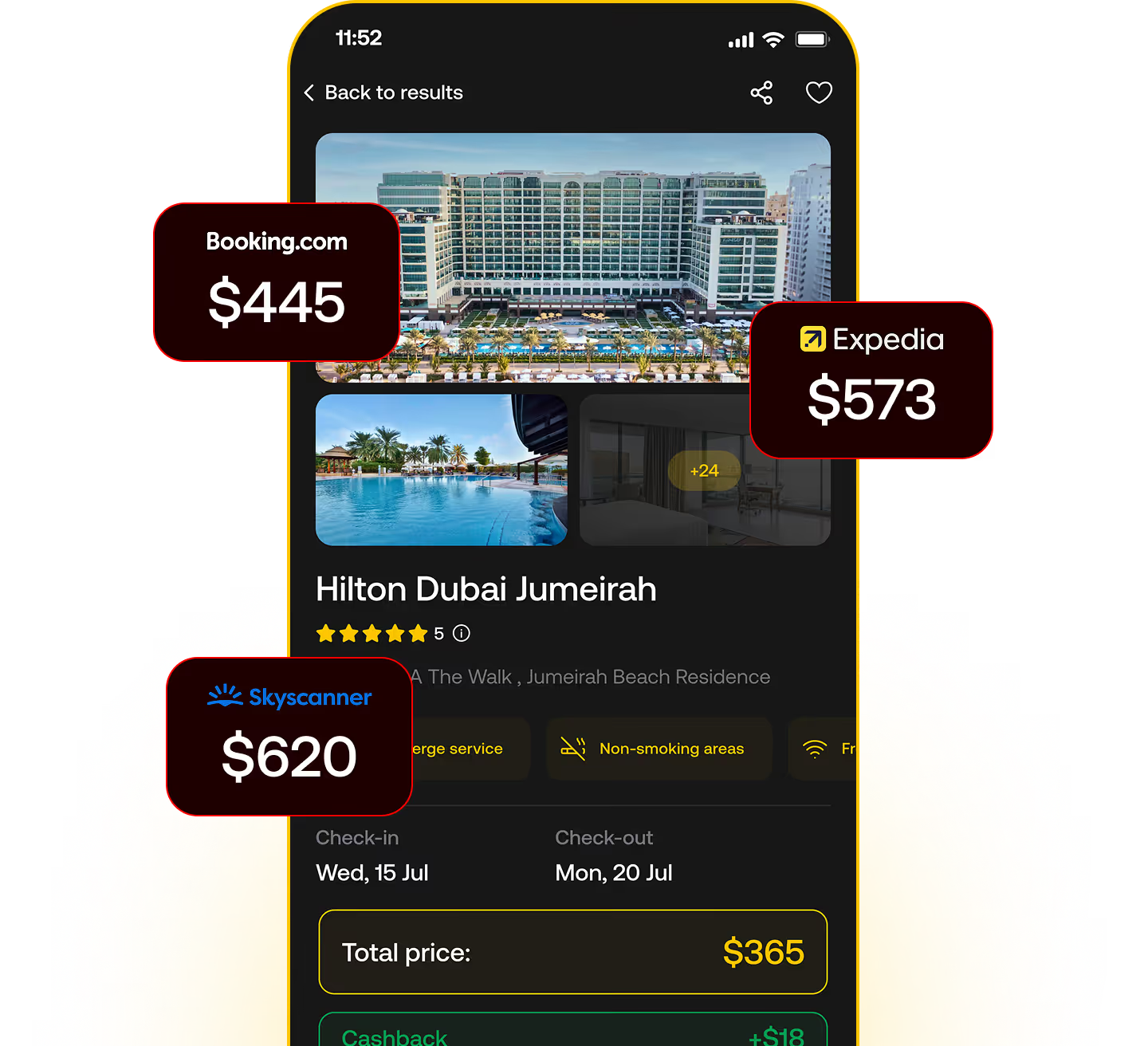
Found a hotel you like? Book it for up to 30% less